Table of Contents
- Understanding Baby Equipment Rental Safety Standards
- How to Choose a Reliable Rental Company for Your First Coast Vacation
- Baby Equipment Rental Sanitation Protocols That Matter
- Is It Safe to Rent a Crib? What Parents Need to Know
- Baby Gear Rental Safety Checklist: What to Inspect Upon Delivery
- Checking for Recalled Baby Products: How to Stay Protected
- Why Maintenance Checks and Quality Assurance Matter
- Rent with Confidence on the First Coast
Baby Equipment Rental Safety Standards: A Parent’s Guide
Last Updated: July 8, 2026
When packing for a family vacation to Saint Augustine or Jacksonville Beach, baby equipment rental safety standards matter. At First Coast Baby Rentals, we know parents need confidence that their little ones are safe in rented gear. This guide covers the safety standards that matter, how to spot trustworthy rental companies, and what to inspect when equipment arrives.
Understanding Baby Equipment Rental Safety Standards
Baby equipment rental safety standards protect infants and toddlers from injury and defects. The Consumer Product Safety Commission (CPSC) sets mandatory federal safety standards that every product must follow. The Juvenile Products Manufacturers Association (JPMA) offers voluntary certification, showing a manufacturer exceeded minimum requirements.
For traveling parents on the First Coast, this means rental companies should stock only equipment meeting these standards. Reputable services inspect every item before delivery to Jacksonville, Ponte Vedra, Amelia Island, or Fernandina, ensuring nothing arrives damaged or worn.
Ask your rental company: “Does your equipment meet CPSC standards?” and “Can you show me documentation?” A company that hesitates is a red flag.
JPMA Certification and CPSC Compliance
JPMA certification means a product passed rigorous independent testing. The Juvenile Products Manufacturers Association is a third-party testing organization, when you see the JPMA seal on a crib or stroller, that specific model met strict safety standards.
CPSC compliance is mandatory. Every baby product sold in the United States must comply with CPSC regulations, covering everything from crib slat spacing (no wider than 2⅜ inches to prevent head entrapment) to stroller wheel safety. The CPSC regularly recalls products that fail these standards.
When renting, ask: "Are all your products CPSC compliant?" A product can be CPSC compliant (legally allowed to sell) but not JPMA certified (not independently tested beyond minimum standards). For rentals, CPSC compliance is non-negotiable; JPMA certification is the gold standard.
JPMA certification = voluntary third-party testing. CPSC compliance = mandatory federal standard. Rental companies must meet CPSC requirements; JPMA certification is a bonus.
Safe Sleep for Babies Act Requirements
The Safe Sleep for Babies Act (2022) prohibits renting or reselling sleep products that pose suffocation risks, including drop-side cribs, non-full-size cribs, play yards not meeting current standards, and inclined sleepers.
This means rental companies cannot rent outdated equipment. Every crib and sleep surface must meet current standards. When booking for your Saint Augustine vacation, confirm your rental company provides only full-size cribs meeting Safe Sleep for Babies Act requirements. If they’re vague about sleep equipment, ask directly: "Do your cribs meet the Safe Sleep for Babies Act requirements?"
This law exists because babies died in unsafe sleep equipment. Rental companies following it take safety seriously.
How to Choose a Reliable Rental Company for Your First Coast Vacation
Start by asking about inspection and sanitization processes. How often do they check equipment? Do they replace worn items? What happens if something arrives damaged? A company unable to answer clearly isn’t worth your time.
Look for companies that deliver and set up equipment at your vacation rental. This reduces transport damage and ensures correct assembly. First Coast Baby Rentals delivers directly to your rental in Saint Augustine, Jacksonville, Jacksonville Beach, Amelia Island, or surrounding areas.
Check online reviews carefully. Look for patterns, multiple complaints about safety or cleanliness should concern you. Dozens of parents praising spotless, brand-new equipment signals a strong company.
If a rental company can’t provide a clear inspection checklist or sanitization protocol, they may not be taking safety seriously. Walk away, even if prices are lower.
What Questions to Ask Before Booking
On Safety:
- "Are all your products CPSC compliant?"
- "Do you have JPMA certification for any items?"
- "What’s your process for checking equipment before delivery?"
- "How do you handle recalls?"
On Cleanliness:
- "What disinfectant do you use, and how often?"
- "Can you show me your sanitization documentation?"
On Reliability:
- "What’s your delivery timeline?"
- "What’s your policy if equipment breaks during my stay?"
On Liability:
- "Are you insured?"
- "What’s covered if something breaks?"
A good company answers all questions without hesitation.
Verifying Insurance and Liability Coverage
Ask the rental company directly: "What liability insurance do you carry?" They should provide coverage amounts and what’s covered. Check your own homeowner’s or renter’s insurance too, some policies cover rental equipment; others don’t.
Also ask about damage coverage. Most rental companies charge reasonable damage fees, but you should know amounts upfront. Reputable companies are transparent about these details.
Baby Equipment Rental Sanitation Protocols That Matter
Cleanliness builds trust. Your baby will use equipment dozens of other babies have used. Ask about their specific process: hand-washing, commercial dishwashers, disinfectants used?
Many rental companies now use hospital-grade disinfectants, which kill 99.9% of germs. This is the standard you should expect. If they use basic household cleaners, that’s insufficient for shared baby equipment.
Thorough sanitation takes time. If a company claims turnarounds in hours, they’re probably not deep cleaning.
Ask for documentation. Reputable companies keep records of when each item was sanitized and by whom.
Hospital-Grade Disinfectant Standards
Hospital-grade disinfectants kill a broad range of pathogens, bacteria, viruses, and fungi. They’re EPA-tested and proven effective. For baby equipment, this is the baseline you should expect.
Different disinfectants work better on different materials, some for soft surfaces like stroller fabric, others for hard surfaces like crib rails. Contact time matters too; most disinfectants need 30 seconds to 10 minutes on a surface to be effective.
Ask: "What’s your disinfectant, and how long does it sit on the equipment?" If they can’t answer, they’re probably not following best practices.
Documentation and Verification
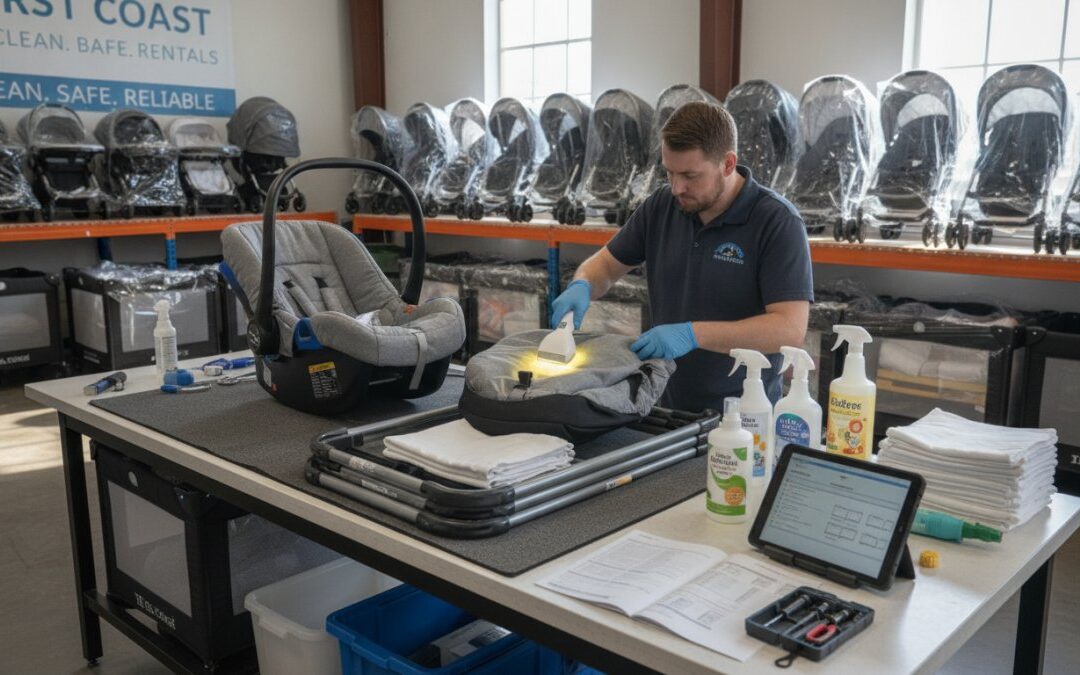
Good rental companies keep records documenting when each item was sanitized, inspected, and delivered. When your equipment arrives, ask for the sanitization record showing the date cleaned, person responsible, and method used.
Also ask for an inspection report confirming equipment was checked for defects, recalls, or wear. Keep this documentation while using the rental, it proves equipment was clean and safe upon arrival.
| Documentation Type | What It Shows | Why It Matters |
|---|---|---|
| Sanitization Record | Date cleaned, disinfectant used, person responsible | Proves proper disinfection before delivery |
| Inspection Report | Defects found, repairs made, safety check results | Ensures equipment is safe and functional |
| Recall Check | Any active CPSC recalls verified | Confirms equipment isn’t recalled |
| Maintenance Log | Repairs, replacements, wear assessments | Shows regular maintenance |
Is It Safe to Rent a Crib? What Parents Need to Know
Yes, it’s safe to rent a crib if the rental company meets current standards. Cribs must meet CPSC standards 16 CFR 1219 and 1220, covering mattress support, slat spacing, paint safety, and structural integrity.
A safe crib has slats no more than 2⅜ inches apart, a firm well-fitting mattress, no drop sides, no peeling paint or splinters, and stable construction. When your crib arrives, inspect it before use, this takes 10 minutes and prevents injury.
Modern full-size cribs meeting CPSC standards are safe to rent. Older cribs, mini cribs, or play yards marketed as cribs may not meet current requirements.
Crib Safety Standards and 16 CFR 1219
16 CFR 1219 is the federal standard for full-size baby cribs. The mattress support must hold 50 pounds without sagging more than 1 inch, preventing suffocation. Slats must be spaced no more than 2⅜ inches apart to prevent head entrapment. Paint must be non-toxic and lead-free. The crib must be stable with secure hardware.
Ask your rental company: "Does your crib meet 16 CFR 1219?" If they don’t know this standard, that’s a red flag.
When inspecting upon arrival, use common sense: Does it feel sturdy? Are slats evenly spaced? Is the mattress firm and snug? Does paint look good? If something feels off, contact the rental company immediately.
Your Crib Inspection Checklist
- Crib is sturdy and doesn’t wobble when pushed
- All slats are present and evenly spaced (no gaps wider than 2⅜ inches)
- Mattress fits snugly with no gaps around edges
- Mattress is firm and doesn’t sag
- Paint is intact with no peeling, chipping, or rough spots
- All hardware (bolts, screws, corner posts) is secure
- No splinters, cracks, or sharp edges
- Crib sheet fits properly without bunching
- No recalls listed for this model (verify on CPSC website)
If anything fails this checklist, contact the rental company immediately. Don’t use the crib until fixed or replaced.
Baby Gear Rental Safety Checklist: What to Inspect Upon Delivery
Beyond the crib, you’re likely renting strollers, car seats, pack-and-plays, and high chairs. Each needs inspection upon arrival.
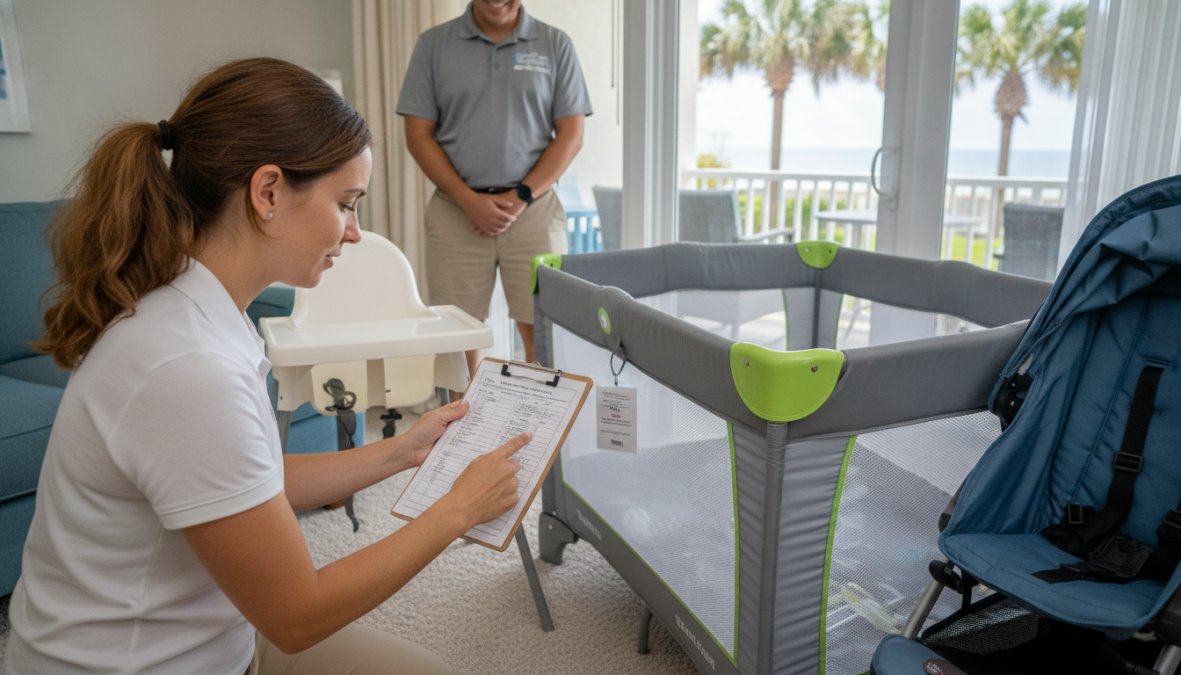
Spend 15-20 minutes inspecting everything before your vacation starts. Look for cleanliness, structural integrity, and proper function.
Structural Integrity and Assembly
Is everything assembled correctly? Are all bolts tight? Is anything cracked or broken?
For strollers, check wheels for smooth rolling and cracks. Test brakes, they should lock securely. For pack-and-plays, ensure all corners are locked in place. For high chairs, confirm the seat is secure and the tray locks firmly. For all equipment, if something isn’t assembled right, contact the rental company for replacement or correction rather than fixing it yourself.
Straps, Buckles, and Moving Parts
Straps and buckles are where injuries happen. For strollers, check harness straps are secure and not frayed. Buckles should click firmly and not be cracked. For car seats, the harness is critical, pull straps to ensure security and check that the buckle clicks and holds firmly. For pack-and-plays, check safety straps are intact. For high chairs, verify the safety harness is secure and the tray locks firmly.
If anything is loose, broken, or missing, don’t use it. Contact the rental company immediately.
Checking for Recalled Baby Products: How to Stay Protected
The CPSC maintains a searchable recall database. Before your rental arrives, look up model numbers on their website. If anything is recalled, contact the rental company and request a different model.
When equipment arrives, do a quick recall check by writing down model numbers and searching the CPSC database. This takes 10 minutes and prevents injury.
Never assume a recall has been fixed. Some rental companies fail to check for recalls before delivery. This is your responsibility to verify.
Using CPSC Recall Monitoring Tools
The CPSC website (cpsc.gov) has a free recall search tool searchable by product type, brand, or model number. You can sign up for recall alerts via email.
When booking, get exact model numbers and search the CPSC database. If you find a recall, contact the rental company immediately for a different model. You can also check manufacturer websites, most major brands have recall sections.
Car Seat Expiration and Crash-History Verification
Car seats expire, typically 6-10 years from manufacturing depending on brand. An expired car seat may not protect properly in a crash. Check the manufacturing date on the label. If the seat was manufactured more than 6 years ago, ask for a newer one.
Also ask: "Has this car seat been in a crash?" Even minor accidents can damage internal structure. A responsible rental company provides car seats manufactured within the last 5 years with documented no-crash history.
Why Maintenance Checks and Quality Assurance Matter
Rental equipment experiences more wear than home-used equipment. Regular maintenance and quality assurance keep rental equipment safe. Good rental companies inspect equipment regularly, replace worn parts, and retire items too damaged to rent safely, keeping detailed maintenance records.
Ask: "How often do you inspect equipment?" and "When do you retire items from service?" The answers reveal whether they take maintenance seriously.
Regular Hazard Assessment Protocols
Hazard assessment means looking for anything that could injure a child, loose bolts, peeling paint, broken wheels, torn straps. Professional rental companies do this systematically with checklists followed before and after each rental, documenting findings and fixes.
When receiving your rental, you’re doing a hazard assessment. Report anything suspicious immediately.
User Manual and Assembly Instructions
Equipment should come with user manuals and assembly instructions. These contain important safety information, weight limits, proper assembly, and safe use practices.
When your rental arrives, ask for the manual. If unavailable, search online by brand and model number. Read the manual before using equipment. If something confuses you, refer to the manual or contact the rental company. Don’t guess.
Traveling with a baby doesn’t require packing your car full of gear. When you rent from a company taking safety seriously, you can travel light. At First Coast Baby Rentals, every crib, stroller, car seat, and high chair is sanitized, inspected, and delivered directly to your vacation rental in Saint Augustine, Jacksonville, Jacksonville Beach, Ponte Vedra, Amelia Island, Fernandina, or surrounding areas. We stand behind our equipment because it protects your most precious cargo. Ready to book safe, spotless equipment for your First Coast getaway? Contact First Coast Baby Rentals today.
Frequently Asked Questions
Are baby equipment rentals safe if they follow baby equipment rental safety standards?
Yes, when rental companies adhere to JPSA certification, CPSC compliance, and Safe Sleep for Babies Act requirements, rented equipment is as safe as purchased gear. The key is verifying that your rental company conducts thorough maintenance checks, maintains quality assurance protocols, and provides documentation of their safety practices before delivery to your St. Augustine or Jacksonville Beach vacation rental.
What should I look for when inspecting a baby gear rental safety checklist upon delivery?
Check structural integrity by looking for cracks, loose joints, or missing parts. Test all straps, buckles, and moving components. Verify the equipment matches the user manual provided. Look for signs of damage, stains, or odors. Confirm the serial number hasn't been recalled using CPSC tools. For car seats, verify the expiration date and confirm no crash history. Take photos of any concerns and contact your rental company immediately if something doesn't look right.
How do I verify baby equipment rental sanitation protocols before booking?
Ask your rental company for their specific sanitation protocols, they should use hospital-grade disinfectant and document cleaning between each rental. Request to see their quality assurance process and ask when items were last sanitized. Reliable companies like First Coast Baby Rentals sanitize and inspect every item before delivery. Don't hesitate to ask for references or photos of their cleaning process. This transparency is a sign of a trustworthy rental service.
Is it safe to rent a crib, and what crash-history or expiration details should I verify?
Yes, renting a crib is safe if it meets 16 CFR 1219 standards and has been properly maintained. When your crib arrives, check the manufacturing date, confirm no recalls using the CPSC website, and inspect all hardware and slats. For car seats specifically, verify the expiration date (typically 6-10 years) and confirm the seat has never been in a crash. First Coast Baby Rentals delivers brand-new or excellent-condition equipment to homes throughout St. Augustine, Jacksonville, and surrounding areas, ask them to provide this verification documentation with your delivery.
This article was written using GrandRanker