Table of Contents
- Why Baby Gear Rental for Military Families Makes Sense
- Renting Baby Gear for Travel: How the Process Works
- Types of Baby Equipment Available to Rent
- Clean, Safe, and Insured: What to Expect from Quality Providers
- PCS Baby Gear Tips Every Military Parent Should Know
- Military Discount Baby Gear: How to Find and Verify Savings
- Baby Gear Rental for Military Families in Northeast Florida
- Conclusion
Last Updated: May 23, 2026
Military families face a logistical challenge that most traveling parents never encounter: moving frequently, often on short notice, to destinations where hauling a full nursery simply isn’t practical. Baby gear rental for military families solves this problem directly, and First Coast Baby Rentals has helped dozens of military parents traveling through Northeast Florida do exactly that: arrive light, settle in fast, and spend their time actually enjoying the trip. Below, we’ll cover everything from how the rental process works to base access considerations, TDY short-notice bookings, and how to verify military discounts before you reserve.
The core insight most guides skip: military families aren’t just "travelers who happen to have kids." PCS moves, TDY assignments, and leave travel all create distinct gear needs that standard baby rental advice doesn’t address. This guide does.
Why Baby Gear Rental for Military Families Makes Sense
Frequent relocation is the defining feature of military family life. The average military family moves every two to three years, according to Military OneSource relocation resources, and each move involves decisions about what to ship, store, or leave behind. Baby gear is bulky, expensive to ship, and depreciates fast. Renting makes financial and logistical sense across almost every travel scenario military families face.
Baby gear rental for military families is the practice of reserving clean, inspected, and fully assembled infant and toddler equipment from a local provider at your destination, so you don’t have to transport it yourself. The gear is delivered directly to your vacation rental, hotel, or temporary lodging facility, and picked up when your stay ends.
There’s a practical argument here that goes beyond convenience. Airlines charge fees for checked baby gear. Car seats and strollers take a beating in cargo holds. Pack n plays rarely survive multiple PCS moves in good condition. Renting locally eliminates all of that friction.
The travel-light philosophy resonates especially with military families who’ve already learned, often the hard way, that less gear means fewer headaches. Renting baby equipment at your destination means you board the plane with one less item to track and arrive at your lodging with everything already set up and waiting.
For military families, renting baby gear at the destination isn’t just convenient, it’s a smarter financial decision than shipping or checking bulky equipment that may not survive the journey intact.
Renting Baby Gear for Travel: How the Process Works
Most parents assume renting baby gear for travel is complicated. It isn’t. The process typically takes less than ten minutes from start to confirmation, and the gear arrives before you do.
Step-by-Step: From Reservation to Delivery
Booking baby equipment rental follows a straightforward sequence:
- Choose your gear. Select the specific items you need: crib, stroller, car seat, high chair, baby monitor, or beach gear. Reputable providers list exact brands and models so you know what you’re getting.
- Select your dates. Enter your arrival and departure dates. Many providers accommodate same-day or next-day reservations for short-notice military travel.
- Enter your delivery address. This can be a vacation rental, hotel, Airbnb, or temporary lodging facility. More on base delivery logistics below.
- Confirm and pay. You’ll receive a rental confirmation with delivery details, the provider’s contact information, and a summary of the gear reserved.
- Receive delivery. The gear is delivered, set up, and ready to use before or on your arrival. No assembly required on your end.
- Enjoy your stay. If your trip extends due to weather or orders change, many providers allow rental extensions with a quick phone call or message.
- Schedule pickup. At the end of your stay, the provider retrieves the equipment. You check out with nothing extra to pack.
If your travel orders change at the [last](/blog/last-minute-baby-gear-rental) minute, call your rental provider immediately. Providers who specialize in family travel are accustomed to military schedule changes and can often adjust reservations without penalty.
Delivery to Hotels, Vacation Rentals, and More
Baby gear delivery works across many accommodation types. Vacation rentals, beach houses, hotel rooms, Airbnb properties, and extended-stay suites all work well. The provider coordinates directly with you on timing, so the gear is in place when you arrive rather than waiting in a lobby.
One thing to clarify upfront: delivery to on-base lodging or temporary housing facilities requires coordination with base access protocols. We cover that specifically in the PCS and TDY section below.
Types of Baby Equipment Available to Rent
Quality baby equipment rental providers stock a comprehensive inventory that covers everything from sleep to mobility to mealtime. The specific brands available vary by provider, but the categories are consistent.
Cribs, Pack N Plays, and Sleep Essentials
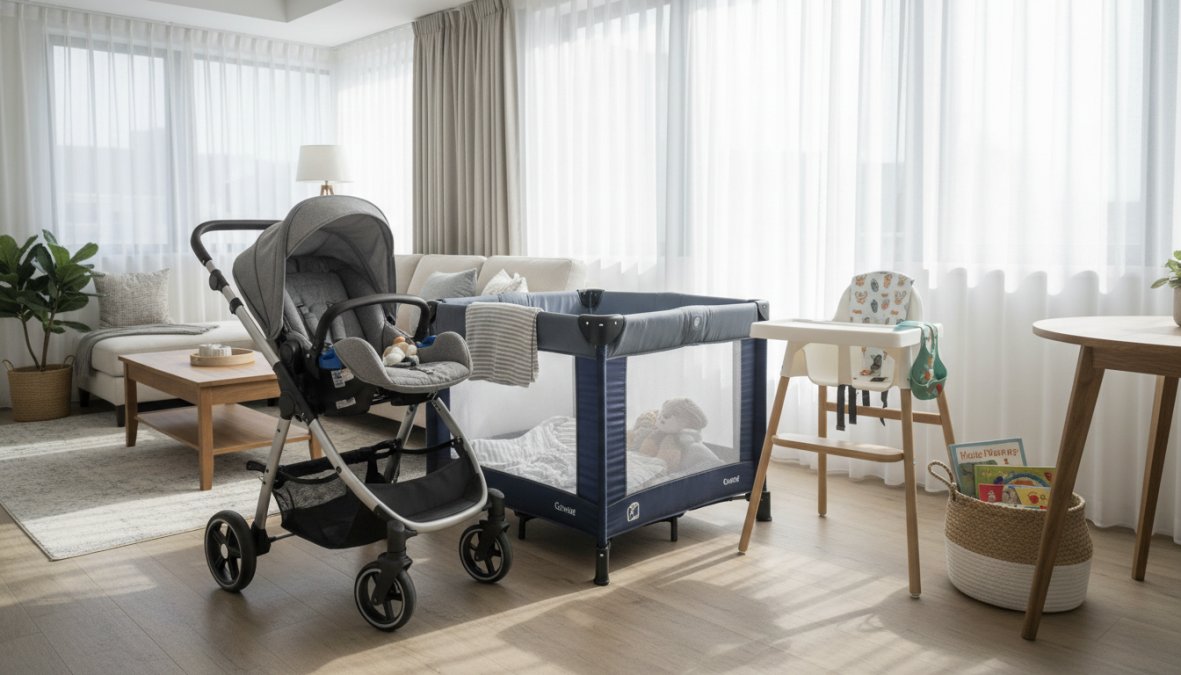
Sleep gear is the most commonly rented category, and for good reason. Traveling with a full-size crib isn’t realistic. Renting a crib or pack n play at the destination means your baby sleeps in a properly assembled, inspected sleep space without you hauling anything through security.
Available sleep equipment typically includes:
- Full-size cribs with fitted mattresses
- Pack n plays (also called portable cribs or playpens)
- Snoo smart sleepers, available through select providers including in Saint Augustine and Ponte Vedra
- Fitted sheets and sleep accessories
Every item should be sanitized and inspected before delivery. A provider worth trusting won’t deliver gear that shows wear, damage, or questionable cleanliness.
Strollers, Car Seats, and On-the-Go Gear
Car seat safety is non-negotiable, and renting a car seat is a legitimate option when flying with an infant. According to American Academy of Pediatrics car seat safety guidelines, children should remain in age- and weight-appropriate car seats on every ride, including rideshares and rental vehicles.
Popular stroller and car seat rentals include:
- UPPAbaby full-size strollers (available in Jacksonville Beach and Saint Augustine)
- BOB jogging strollers for active families in Fernandina Beach and Jacksonville Beach
- City Mini lightweight strollers in Ponte Vedra and Saint Augustine
- Nuna and Doona travel systems in Saint Augustine, Fernandina, and Jacksonville
- Infant and convertible car seats with installation guidance
The Doona car seat/stroller combo is particularly popular with military families traveling through Jacksonville Airport because it transitions from car seat to stroller without removing the child from the seat.
High Chairs, Baby Monitors, and Beach Gear
Beyond sleep and mobility, a complete rental inventory covers daily life essentials:
- High chairs for vacation rentals and beach houses
- Baby monitors for unfamiliar sleeping environments
- Beach wagons for hauling gear across sand at Amelia Island, St Augustine Beach, and Vilano Beach
- Beach tents, baby pools, and sun shelters
- Swings, bouncers, and activity gear
High chair rental is especially relevant in Northeast Florida, where beach house rentals rarely include baby-specific furniture. Renting locally means you’re not improvising with a booster seat on a bar stool for a week.
Clean, Safe, and Insured: What to Expect from Quality Providers
Cleanliness and safety are the first questions most parents ask about renting baby gear, and they are fair questions. The honest answer is that standards vary significantly between providers, and the difference between a trustworthy rental and a problematic one is not always visible on a website. This section gives you a concrete framework for evaluating providers, and adds context specific to military families, who often book remotely, sight unseen, for destinations they’ve never visited.
What a Real Sanitization Protocol Looks Like
Quality providers don’t just wipe down surfaces between rentals. A documented sanitization protocol for baby gear typically involves distinct steps for different material types:
Fabric components (crib sheets, stroller seat liners, high chair straps, carrier inserts) should be machine washed and dried between every rental. Ask your provider whether fabric components are laundered or spot-cleaned. Spot-cleaning is not sufficient for items in contact with infants.
Hard plastic and metal surfaces (stroller frames, high chair trays, car seat shells, crib rails) should be disinfected with a product appropriate for infant contact, meaning fragrance-free, alcohol-based or EPA-registered disinfectants that are safe once dry. The key question to ask: does the provider use a product that is both effective against pathogens and safe for infant skin contact after drying?
Mechanical components (stroller wheels and hinges, crib hardware, car seat harness adjusters) should be inspected for wear, debris, and function. A stroller wheel that wobbles or a crib rail that doesn’t lock securely is a safety issue, not just a cosmetic one.
A provider worth trusting can describe this process specifically when asked. Vague answers like "we clean everything thoroughly" are a yellow flag. A provider who says "fabric components are machine washed, hard surfaces are disinfected with [specific product], and hardware is inspected before every delivery" is demonstrating an actual protocol.
Safety Recalls: How to Verify a Provider Is Monitoring Them
Baby gear recalls are more common than most parents realize. The U.S. Consumer Product Safety Commission (CPSC baby product safety recall database) issues recalls on cribs, car seats, strollers, bouncers, and sleep products on a rolling basis throughout the year. A quality rental provider actively monitors this database and removes affected items from inventory immediately, they do not wait for a customer to flag it.
How to verify a provider is actually doing this:
- Ask for the brand and model of the specific item you’re renting. A provider who can give you a specific answer ("That’s a Nuna RIVA crib, model year 2023") allows you to run your own recall check at cpsc.gov before your rental begins.
- Ask when the item was last checked against the recall database. A good provider has a process for this, weekly checks, or checks triggered by CPSC email alerts.
- Check the CPSC recall database yourself. It takes two minutes and gives you independent confirmation. Search by brand name or product category.
For military families booking remotely, from a duty station in one state for a rental in another, this verification step matters more, not less. You cannot inspect the gear in person before it arrives. Getting the specific model information in advance and running a quick recall check is a reasonable precaution that takes very little time.
Insurance: What It Covers and What It Doesn’t
Reputable baby gear rental providers carry general liability insurance that covers their equipment and operations. What this means in practice:
- If a piece of equipment fails due to a defect or provider negligence and causes injury, the provider’s liability coverage is the relevant protection.
- If you damage the equipment through normal use, most providers have a damage policy, either a damage waiver included in the rental fee, or a deposit held against damage.
- If you damage the equipment through misuse or loss, you are typically responsible for repair or replacement costs.
For military families traveling on government orders, there is an additional layer worth understanding: the government travel charge card (GTCC) and some personal credit cards offer travel protection benefits that may cover rental equipment damage in certain circumstances. Check your card’s benefits guide before your trip, this is not a guarantee, but it is worth knowing before you decline a damage waiver.
One military-specific scenario: if gear is damaged during a PCS move or while in transit under government-arranged shipping, that is a separate claim process through the Transportation Service Provider (TSP) or Defense Personal Property Program (DP3), not through the rental provider. Baby gear you own and are shipping is covered under different rules than gear you are renting at the destination.
A Practical Pre-Delivery Checklist for Military Families Booking Remotely
Because military families frequently book rental gear for destinations they haven’t seen, and sometimes for lodging arrangements that are still being finalized, a short pre-delivery checklist reduces friction:
- Confirm the specific brand and model of each item reserved
- Run a quick recall check on each item at cpsc.gov
- Ask whether fabric components are laundered between rentals
- Confirm the delivery address is accessible (especially relevant for on-base or TLF/TLE delivery, see the PCS section below)
- Verify the provider’s policy on same-day replacement if delivered gear has a problem
- Confirm the damage policy and whether a waiver is included or available
Never accept delivery of baby gear that shows visible damage, staining, missing hardware, or any component that doesn’t function correctly. A reputable provider will replace the item without question and without making you feel unreasonable for asking. If they push back, that tells you something important about how they handle safety standards overall.
For military families booking from a remote duty station, request photos of the specific items reserved, not stock photos from the manufacturer, but photos of the actual units in the provider’s inventory. A provider confident in their gear quality will send them without hesitation.
PCS Baby Gear Tips Every Military Parent Should Know
PCS moves and TDY travel create gear needs that don’t fit neatly into standard vacation rental scenarios. The logistics are different, the timelines are compressed, and the stakes are higher when you’re moving a family rather than taking a weekend trip.

Base Access Restrictions and Delivery Logistics
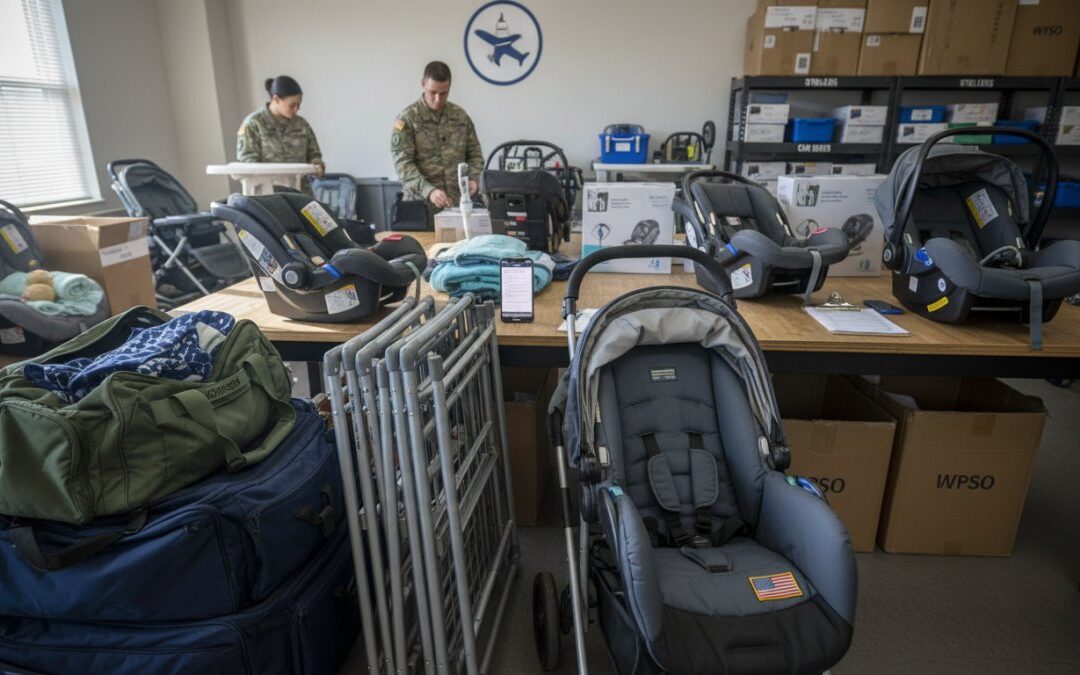
Delivery to on-base housing or temporary lodging facilities (TLF/TLE) requires advance coordination. Most military installations require visitors to have a base pass, vehicle registration, and proof of insurance before entering. A baby gear rental provider cannot simply drive onto base without prior authorization.
The practical solution:
- Contact your installation’s visitor control center before your arrival date to understand the pass process
- Provide your rental provider with the specific gate they’ll need to use and the name of the sponsoring service member
- Some families find it easier to arrange delivery to an off-base address (a hotel near the gate, a family member’s home) and transport the gear onto base themselves
- For TLF/TLE stays, ask the lodging office directly whether vendor deliveries are permitted and what the process requires
Base access restrictions vary significantly by installation. What works at NAS Jacksonville may not apply to Camp Blanding or Kings Bay. Always verify with your specific installation’s protocol.
TDY Travel and Short-Notice Rentals
TDY travel is where baby gear rental for military families proves its value most clearly. Orders drop with little warning. The service member deploys. The spouse is left managing travel with an infant and a compressed timeline.
Short-notice rentals work when the provider is responsive and carries sufficient inventory. Qualities to look for:
- Same-day or next-day availability for core items (crib, pack n play, car seat)
- Direct phone or text communication rather than a multi-day email queue
- Flexibility to adjust rental dates when orders change
- Willingness to accommodate last-minute reservations without punitive fees
For TDY travel specifically, keep a saved list of rental providers near your most common TDY destinations. Northeast Florida families traveling through Jacksonville or staying near NAS Jacksonville should have a local Saint Augustine or Jacksonville Beach provider already bookmarked.
Military Discount Baby Gear: How to Find and Verify Savings
Military discounts on baby gear rental exist, but the landscape is inconsistent enough that knowing how to find, verify, and evaluate them is genuinely useful, and almost no rental guide covers this in any depth. Here is a practical framework built around how military family discounts actually work in 2025 and 2026.
How Military Discount Verification Actually Works
Most legitimate military discounts in the consumer space now route through one of two verification paths:
ID.me verification is the most widely adopted method. ID.me is a third-party identity verification platform used by hundreds of retailers and service providers to confirm active-duty status, veteran status, reservist status, and military spouse status without requiring the business to handle sensitive documents directly. When a rental provider says they use ID.me, the process works like this:
- You create or log into your ID.me account and verify your military affiliation once (using a CAC, DD-214, or service branch records).
- At checkout or booking, you click the provider’s ID.me verification link and authorize the share.
- The discount is applied automatically, no emailing documents, no waiting for manual approval.
ID.me verification takes roughly five to ten minutes the first time and is instant on subsequent uses. If a provider claims to offer a military discount but has no ID.me integration and no clear documentation process, ask specifically how they verify eligibility before you assume the discount will apply at booking.
Manual documentation is the alternative. Accepted forms typically include:
- A Common Access Card (CAC), shown at delivery or photographed and submitted at booking
- A uniformed services ID card (DD Form 1173 for dependents)
- A .mil email address used to create the account or confirm the reservation
- A DD-214 for veterans and separated service members
One practical note: some providers accept a .mil email as sufficient verification. If you have one, use it at booking even if the provider doesn’t explicitly advertise a military discount, it signals your affiliation and opens the door to ask.
Which Discount Categories to Actually Prioritize
Not all military discounts are structured the same way, and some are worth more than others depending on your rental scenario:
- Percentage off total rental cost, the most straightforward. A 10-15% discount on a week-long multi-item rental (crib, car seat, stroller, high chair) can represent meaningful savings.
- Waived delivery fee, delivery fees on baby gear rentals typically range from a flat rate to a distance-based charge. Having that waived can be worth as much as a percentage discount on shorter rentals.
- Extended rental at daily rate, some providers offer military families the option to extend at the daily rate rather than a premium extension rate, which matters significantly for TDY travel where return dates are uncertain.
- Last-minute booking without surcharge, a few providers waive short-notice booking fees for military customers. This is worth asking about explicitly, because it addresses one of the most common friction points in TDY travel.
Government Travel Reimbursement and Rental Costs
This is the angle almost no baby gear rental guide addresses: when a service member is traveling on orders, some incidental costs associated with infant care at the TDY location may be documentable as part of the overall travel claim. This is not a guarantee of reimbursement, and the rules vary by branch and command. However, families traveling on orders should:
- Keep itemized receipts from their rental provider (not just a credit card charge, an itemized receipt listing each piece of equipment and the rental period)
- Note whether the rental was necessary because the TDY lodging did not provide a crib or appropriate sleep surface
- Consult their unit’s finance office or a military legal assistance attorney if the amounts are significant
This is not tax or legal advice, and reimbursement is not guaranteed. But having clean documentation costs nothing and preserves the option.
The Honest Trade-Off: Discount vs. Quality
A military discount from a provider who delivers worn, poorly sanitized, or outdated gear is not a good deal. The discount framework above is only useful when the underlying provider meets a baseline quality standard. A few signals that a discounted rental is actually worth taking:
- The provider lists specific brands and models in their inventory (not just "crib" or "stroller")
- They can confirm when the item was last sanitized and inspected
- They have verifiable reviews from other military or traveling families
- They offer a replacement guarantee if delivered gear doesn’t meet expectations
A provider charging full market rate with brand-new or near-new equipment, responsive communication, and genuine flexibility for schedule changes will often deliver more total value than a discounted rental from a provider who treats military customers as a marketing category rather than a logistics priority.
The most valuable military discount in baby gear rental isn’t always a percentage off, it’s a provider who waives short-notice fees and extends rentals at the daily rate when orders change. Ask about those terms before you ask about the headline discount.
Baby Gear Rental for Military Families in Northeast Florida
Northeast Florida is one of the most active military regions in the country. NAS Jacksonville, Mayport Naval Station, Camp Blanding, and Kings Bay Naval Submarine Base all draw service members and their families to the region regularly. That creates consistent demand for baby gear rental near military installations and along the First Coast’s beaches.
First Coast Baby Rentals serves the full Northeast Florida region with delivery to Saint Augustine, Jacksonville, Jacksonville Beach, St Augustine Beach, Vilano Beach, Ponte Vedra, Fernandina Beach, Amelia Island, Nocatee, and the Jacksonville Airport corridor. For families flying into JAX and heading to a beach rental, car seat rental near Jacksonville Airport is one of the most requested services, particularly for families traveling from duty stations without a vehicle.
What makes local providers the right choice over national aggregators for military families in this area:
- Local knowledge. A Saint Augustine-based provider knows which beach house complexes allow vendor access, which roads flood after summer storms, and how to coordinate delivery around the unpredictable Northeast Florida weather.
- Flexibility for military schedules. Local providers are more likely to accommodate last-minute changes without the rigid cancellation policies of larger platforms.
- Rental extensions. If orders change or a tropical weather system delays departure, a local provider can extend the rental with a phone call rather than a customer service ticket.
The beach gear component matters here too. Families staying at Amelia Island, Fernandina Beach, or Vilano Beach need more than a crib. Beach wagons, sun tents, and sand toys are all part of a complete rental package for families spending time on the First Coast.
For families arriving at Jacksonville Airport with an infant, arrange car seat rental pickup or delivery to the airport zone in advance. Rideshare vehicles are not required to provide car seats, and rental car companies often charge premium rates for them. A local rental provider typically offers better equipment at a lower total cost.
Military families deal with enough logistical complexity without adding baby gear transport to the list. The solution is straightforward: rent locally, arrive light, and spend the trip focused on the family rather than the freight. First Coast Baby Rentals delivers sanitized, inspected, and often brand-new baby equipment directly to your vacation rental, hotel, or temporary lodging across the entire Northeast Florida region, with the flexibility to accommodate last-minute military travel schedules and rental extensions when plans change. Reserve your gear at First Coast Baby Rentals before your next assignment, PCS move, or leave period and arrive ready.
Frequently Asked Questions
How does baby gear rental work for military families?
Baby gear rental for military families works like any standard rental service, but with extra considerations for PCS moves and TDY travel. You browse available equipment online, select what you need, such as a crib, stroller, or car seat, choose your rental dates, and confirm your delivery address. A local provider then delivers, sets up, and later retrieves the gear. For military families, it helps to communicate any base access restrictions to your provider in advance so delivery goes smoothly.
Can military families get discounts on baby gear rentals?
Many baby gear rental providers offer a military discount as a thank-you to service members and their families. To verify eligibility, you typically need to provide a valid military ID, a .mil email address, or proof of active duty or veteran status at the time of booking. Always ask directly when making your reservation confirmation, since discounts are not always advertised prominently. Discounts can range from a small percentage off to free delivery upgrades depending on the provider.
Is it better to rent or buy baby gear when PCSing?
Renting is often the smarter choice during a PCS move because it eliminates the hassle of transporting bulky baby equipment across the country or overseas. Baby equipment rental lets you travel light and arrive at your new duty station with essentials already waiting. Buying makes more sense once you are settled long-term. For TDY travel or temporary lodging during a PCS transition, renting a crib, pack n play, or stroller is a practical and cost-effective solution.
Are baby gear rentals safe and sanitized?
Reputable baby gear rental providers follow strict gear sanitization and inspection protocols before every delivery. Equipment should meet current safety standards, and items like car seats are checked for recalls and expiration dates. Look for providers that use background checked staff, offer insured equipment, and clearly describe their cleaning process. When booking, ask specifically about sanitization methods and whether gear is inspected after each rental to ensure it arrives in clean, safe condition for your little one.
What baby gear is essential to rent during a PCS move or TDY trip?
The most essential items to rent during a PCS move or TDY trip include a crib or pack n play for safe sleep, a car seat for transportation, and a stroller for outings. High chairs and baby monitors are also popular rentals that make temporary housing feel more manageable. Renting these travel essentials means you are not hauling heavy gear through airports or in a packed moving truck, and your baby has familiar, quality equipment waiting upon arrival.
This article was written using GrandRanker