Table of Contents
- Why Sanitized Baby Equipment Rental Is a Game-Changer for Family Travel
- Traveling with Baby Gear vs Renting: An Honest Cost-Benefit Breakdown
- Baby Equipment Rental Cost: What to Expect for Each Item
- Available Baby Gear Categories for Rent in Northeast Florida
- How to Clean Rented Baby Equipment: Our Sanitization Methodology Explained
- Baby Gear Rental Safety Standards: Insurance, Background Checks, and Car Seat Certification
- How the Sanitized Baby Equipment Rental Booking Process Works
- The Eco-Friendly Case for Renting Over Buying Baby Gear
- Conclusion: Travel Light and Vacation Right with Confidence
Last Updated: May 19, 2026
Why Sanitized Baby Equipment Rental Is a Game-Changer for Family Travel
Packing for a family vacation with a baby is one of those experiences that sounds manageable until you’re staring at a pile of gear that won’t fit in your car. Sanitized baby equipment rental solves this problem directly: you arrive at your destination and find clean, inspected, ready-to-use gear already set up at your vacation rental. First Coast Baby Rentals has helped hundreds of families vacationing in Northeast Florida do exactly that, delivering everything from cribs to strollers to car seats so parents can travel light and actually enjoy their trip.
Here’s what most guides on traveling with babies get wrong: they treat gear as a packing challenge rather than a logistics decision. The real question isn’t "how do I fit the pack-n-play in my luggage?" It’s "why am I hauling 40 pounds of equipment across airports when a local rental service can handle it?" Below, we’ll show you exactly how the rental process works, what gear is available, how every item is cleaned before it reaches your family, and why this approach is safer and more practical than most parents realize.
A common mistake is assuming rented baby equipment is lower quality or less clean than what you own at home. The opposite is often true. Rental providers who specialize in baby gear clean and inspect every item before each delivery, frequently rotating inventory so families receive near-new or brand-new equipment.
Sanitized baby equipment rental is the practice of renting professionally cleaned, safety-inspected baby gear delivered directly to your vacation rental, eliminating the need to transport bulky items through airports or in an already-packed car.
Traveling with Baby Gear vs Renting: An Honest Cost-Benefit Breakdown
Most parents default to packing their own gear. It’s familiar, it’s free (or feels free), and there’s comfort in knowing exactly what your baby has been sleeping and sitting in. But the actual cost calculation tells a more complicated story.
The Hidden Costs of Packing Your Own Baby Gear
Airlines charge checked bag fees that add up fast. A full-size stroller and a car seat together can mean two additional checked bags at each leg of travel. Beyond the fees, there’s the real risk of damage: strollers and car seats routinely get mishandled on the tarmac, and a damaged car seat should never be used again according to car seat safety guidelines from the National Highway Traffic Safety Administration.
Then there’s the physical toll. Carrying a travel system through a busy airport with a baby in arms is exhausting. Gate-checking a stroller means waiting at baggage claim. Assembling a portable crib in an unfamiliar vacation rental after a long travel day is nobody’s idea of a relaxing start.
When Renting Makes More Financial and Practical Sense
Renting baby equipment makes clear financial sense for trips of three or more days, especially when flying. The rental cost for a week’s worth of gear is often comparable to or less than airline baggage fees alone, with none of the hassle. You also avoid the risk of arriving at a Saint Augustine beach house to find your pack-n-play was lost in transit.
Here’s where it gets interesting: rental gear is often newer and better maintained than what families own. Rental providers replace items on a regular schedule, so you’re frequently getting equipment that’s only a few months old. That’s a meaningful advantage for items like car seats, where expiration dates and model recalls matter.
| Scenario | Pack Your Own | Rent Locally |
|---|---|---|
| Airline baggage fees | $50-$150 per trip | $0 |
| Risk of damage/loss | High (tarmac handling) | None |
| Setup on arrival | You assemble it | Done for you |
| Equipment age | Varies | Often near-new |
| Flexibility to extend | Not possible | Yes, rental can extend |
Baby Equipment Rental Cost: What to Expect for Each Item
Rental pricing for baby gear varies by item type, rental duration, and provider. Without fabricating specific dollar amounts, here’s what families generally find: nightly rates decrease as rental duration increases, so a week-long rental costs significantly less per day than a two-night rental.
Sleep gear like portable cribs and bassinets tends to be the most frequently rented category, followed by strollers and travel systems. Specialty items like the SNOO smart sleeper carry a premium over standard cribs given their higher equipment cost. Car seats are typically priced separately from strollers, even when rented together as a travel system.
The practical tip most families miss: bundle rentals when possible. Renting a crib, high chair, and stroller together from one provider is almost always cheaper than sourcing each item separately, and it means a single delivery window rather than coordinating multiple drop-offs at your vacation rental.
Ask about last-minute availability before assuming a provider is booked. First Coast Baby Rentals accommodates last-minute reservations more often than families expect, which is useful when travel plans change suddenly.
Available Baby Gear Categories for Rent in Northeast Florida
Families visiting Saint Augustine, Jacksonville Beach, Ponte Vedra, Amelia Island, Fernandina Beach, and surrounding areas have access to a full range of rental gear covering every stage of a baby’s day.
Sleep Gear: Cribs, Portable Cribs, Bassinets, and SNOO Rentals
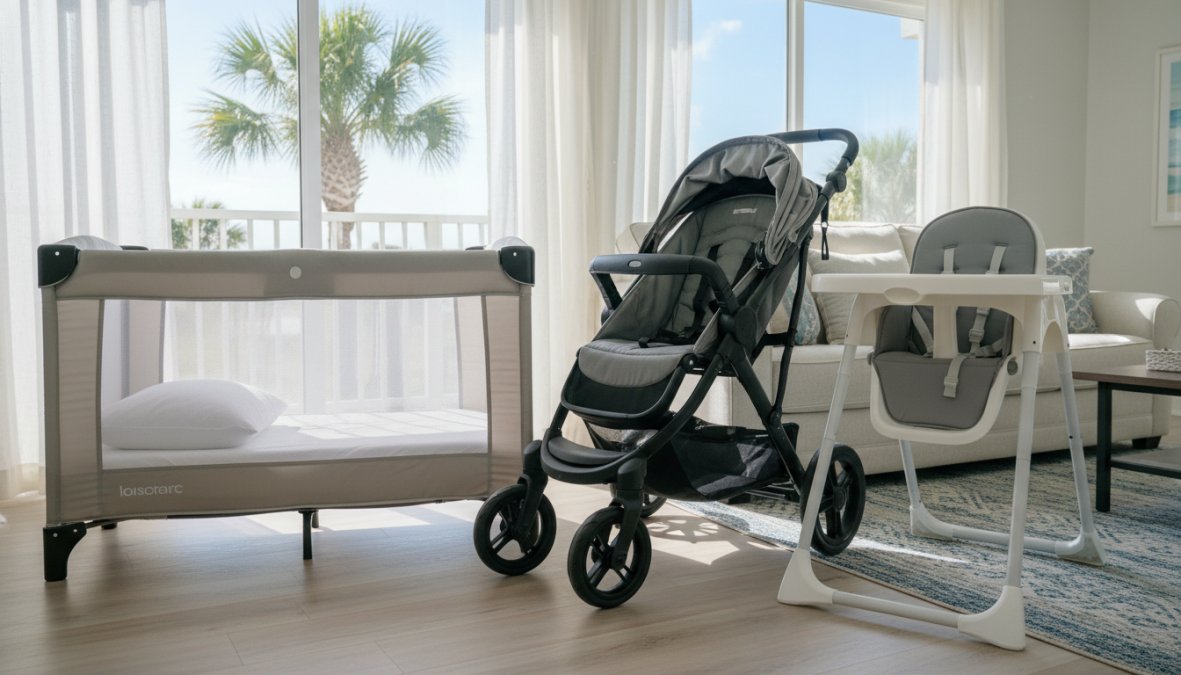
Sleep is non-negotiable, which makes this the most important rental category for most families. Options include full-size cribs, portable cribs (pack-n-plays), bassinets for younger infants, and the SNOO smart sleeper for families who rely on it at home. SNOO rental in Saint Augustine, Ponte Vedra, Jacksonville, and Amelia Island is available for families who don’t want to travel without the responsive bassinet their newborn already sleeps in.
All sleep surfaces arrive sanitized and assembled, with fresh fitted sheets. Parents don’t need to bring their own bedding or spend twenty minutes reading assembly instructions at 9pm after a travel day.
Travel Systems: Stroller and Car Seat Rental Options
Stroller rental in Saint Augustine covers everything from compact city strollers to jogging strollers suited for beach paths and park trails. Specific models available include UPPAbaby, BOB strollers, City Mini, Nuna, and Doona travel systems, which convert between car seat and stroller in a single motion.
Car seat rental is available for families flying into Jacksonville Airport (JAX) or driving without a seat in the vehicle. Car seat rental in Jacksonville and car seat rental at Jacksonville Airport are particularly popular for grandparents traveling to meet families who are already local.
Feeding, Beach, and Everyday Essentials
High chair rental in Saint Augustine and Amelia Island rounds out the everyday essentials category. Beach gear is also available, including beach wagons for hauling gear across the sand at Saint Augustine Beach, Vilano Beach, or Fernandina Beach.
The full inventory covers what families actually need for a complete vacation, not just the headline items.
How to Clean Rented Baby Equipment: Our Sanitization Methodology Explained
Sanitization is the single biggest anxiety parents have about renting baby gear, and it is the area where virtually every competitor on this SERP is least transparent. Most rental sites use the word "sanitized" as a marketing badge without explaining what that word actually means in practice. This section breaks down the specific methodology, cleaning agents, temperatures, dwell times, and allergen protocols, so you can evaluate any rental provider’s claims against a concrete standard.
Why Vague ‘Sanitized’ Claims Are Not Enough
The word "sanitized" has no single regulated definition in the context of consumer baby gear rental. A provider can technically claim sanitization after a basic wipe-down with a general-purpose cleaner. That is meaningfully different from a multi-stage protocol that addresses bacteria, mold spores, contact allergens, and structural integrity. Parents deserve to know which category their rental provider falls into before a car seat or crib is set up in their vacation rental.
The distinction matters most for two groups: families with infants under six months, whose immune systems are still developing, and families with children who have known allergies or sensitivities to common cleaning residues such as fragrances, quaternary ammonium compounds (quats), or latex-based products.
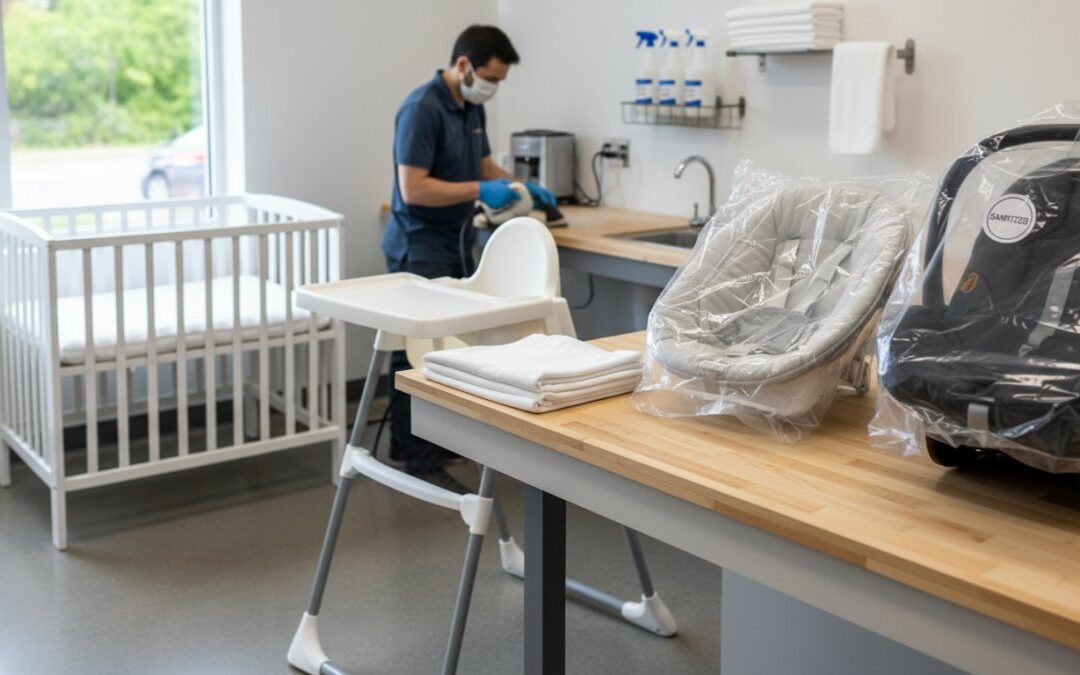
The Four-Stage Sanitization Protocol
A rigorous sanitization process for baby gear covers four distinct stages, each addressing a different contamination risk:
Stage 1, Disassembly and pre-inspection
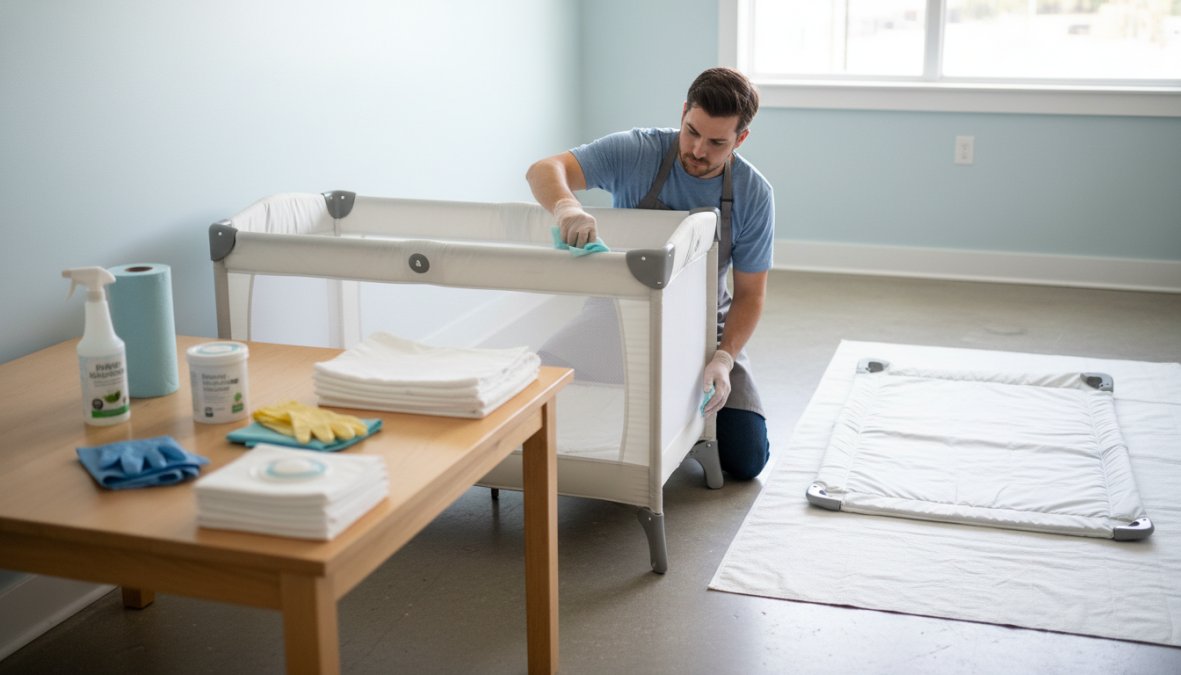
Every item is fully disassembled to the extent the manufacturer allows: harness straps removed from car seats, fabric inserts pulled from stroller frames, crib mattress pads separated from frames. This step exists because contamination concentrates in joints, buckle housings, and fabric seams, areas that are invisible during a surface wipe and unreachable by a spray-and-wipe approach.
Stage 2, Fabric laundering with allergen-aware detergents
All removable fabric components, crib sheets, stroller seat liners, car seat inserts, high chair pad covers, are machine-washed. The critical detail most providers omit: the detergent matters. Fragrance-free, dye-free detergents formulated for infant laundry (such as those meeting the criteria outlined by the American Academy of Dermatology guidance on infant skin and detergent sensitivities) eliminate the risk of chemical residue contact dermatitis, which is a real and underreported issue with gear cleaned using standard commercial detergents. Wash temperatures should be sufficient to address common bacterial loads while remaining within the fabric care limits specified by the manufacturer.
Stage 3, Steam cleaning of hard surfaces and non-removable fabric
Steam cleaning is the step that separates a surface-clean item from a genuinely sanitized one. Pressurized steam at temperatures above 212°F (100°C), the standard output of a commercial garment or upholstery steamer, denatures proteins in bacterial cell walls and disrupts mold spore structures without leaving chemical residue. This is particularly important for padded surfaces that cannot be machine-washed: the foam padding inside a car seat shell, the mesh sidewalls of a portable crib, and the cushioned seat of a high chair. Steam penetrates these materials in a way that spray-and-wipe cannot.
The no-residue aspect of steam cleaning is significant for families concerned about chemical exposure. No cleaning agent is applied, so there is no rinse step required and no risk of residue contact with a baby’s skin.
Stage 4, Structural and safety inspection
Cleaning and inspection are separate functions that must both happen. A structurally compromised item can be spotlessly clean and still be unsafe. The inspection checklist for each category covers:
- Car seats: harness strap integrity (no fraying, cuts, or twisting), chest clip function, buckle release force (should release with adult thumb pressure, not require tools), shell inspection for cracks or stress marks, manufacture date and expiration date verification, and confirmation that the seat has not been involved in a moderate or severe crash
- Portable cribs and bassinets: mesh panel integrity, locking mechanism engagement on all four corners, mattress pad firmness (a safe infant sleep surface should not conform visibly when pressed with an open hand), and frame joint stability
- Strollers: wheel lock engagement, harness buckle function, canopy frame integrity, and fold-latch security
- High chairs: tray latch engagement, harness buckle function, and base stability on flat surfaces
Any item that fails inspection at any point in this process is removed from rental rotation, not cleaned again and re-rented.
Questions to Ask Any Rental Provider Before You Book
Use this as a quick screening checklist when evaluating any sanitized baby equipment rental service:
- What specific cleaning agents do you use on hard surfaces, and are they fragrance-free and dye-free? A provider who cannot answer this question specifically has not standardized their process.
- Are fabric components machine-washed between rentals, or only spot-cleaned? Spot cleaning does not address allergen buildup in fabric fibers.
- Do you use steam cleaning on non-removable padded surfaces? If not, ask what method they use and why.
- Who performs the structural inspection, and what does it cover? The answer should be specific, not "we check everything."
- What happens to an item that fails inspection? The answer should be retirement or manufacturer-authorized repair, not re-cleaning and re-rental.
According to child product safety guidance from the American Academy of Pediatrics, parents should inspect any sleep surface for structural integrity before placing a baby in it. A reputable rental provider performs this inspection before delivery, but knowing what the inspection covers lets you verify the work was done.
If a rental provider’s website or booking confirmation does not mention their sanitization process at all, that is a meaningful signal. Providers who have invested in a rigorous protocol are motivated to describe it. Providers who have not invested in one are motivated to stay vague.
Baby Gear Rental Safety Standards: Insurance, Background Checks, and Car Seat Certification
Safety standards for baby gear rental go beyond cleanliness. Parents rightly want to know who is delivering equipment to their vacation rental, whether the provider carries appropriate insurance, and, most critically, how to independently verify that a rented car seat is actually safe to use. This section covers all three, with particular depth on car seat verification, which is the highest-anxiety topic in the entire rental category and the one where most providers give parents the least useful information.
Insurance and Provider Credentialing
Reputable local rental providers maintain general liability insurance covering the equipment they deliver and the service they provide. When evaluating a provider, it is reasonable to ask directly whether they carry liability coverage and whether their delivery personnel have undergone background screening. Established providers treat these questions as routine; a provider who is evasive about either is worth reconsidering.
Background checks for delivery personnel matter because the delivery process typically involves access to your vacation rental, often before you arrive, to set up gear. Knowing that the person who assembled the crib in your rental bedroom is a verified professional is a reasonable expectation, not an unreasonable demand.
The Parent’s Car Seat Verification Checklist
This is the section most rental providers do not give you, and it is the most important one. Car seat safety is not something you should take entirely on faith from a rental provider, however reputable. The following checklist gives you the tools to verify a rented car seat yourself, in under five minutes, before you put your child in it.
1. Confirm the manufacture date and calculate the expiration
Every car seat sold in the United States has a manufacture date stamped or molded directly onto the plastic shell, typically on a sticker on the back or bottom of the seat. This is not the purchase date, it is the date the seat was manufactured.
Car seat expiration timelines vary by manufacturer and model, but the general ranges are:
- Infant-only car seats (bucket seats): typically 6 years from manufacture date
- Convertible car seats: typically 7-10 years from manufacture date
- All-in-one seats: typically 10 years from manufacture date
- Booster seats: typically 6-10 years from manufacture date
The expiration date is sometimes printed explicitly on the same label as the manufacture date. If it is not, the seat’s manual (available on the manufacturer’s website by model number) will specify the service life. According to car seat expiration and safety standards guidance from Safe Kids Worldwide, using an expired car seat is unsafe because the plastic shell degrades over time, harness webbing weakens, and the seat may no longer meet the federal safety standards current at the time of use. A seat that looks pristine can be expired.
2. Check the NHTSA recall database before your trip
The NHTSA vehicle and car seat recall lookup tool allows you to search by the seat’s model name or, more precisely, by its model number. The model number is on the same label as the manufacture date. A recalled seat may have a safety defect that has not been remediated, harness buckle failures, chest clip issues, and shell integrity problems have all been subjects of real recalls. This check takes approximately two minutes and is worth doing for any car seat, rented or owned.
A trustworthy rental provider will have already checked this and will be able to confirm the seat is not subject to an open recall. Ask them directly. If they cannot confirm it, you can verify it yourself with the model number.
3. Inspect the harness system
With the seat in front of you, run through this physical check:
- Strap condition: Run your fingers along the full length of both shoulder straps and the crotch strap. You are feeling for fraying, cuts, twisting that has been stitched over, or any point where the webbing feels thinner than the surrounding material. Any of these conditions is a disqualifying finding.
- Buckle function: The chest clip and buckle should engage with a firm click and release cleanly with adult thumb pressure. If the buckle requires a tool to release, or releases too easily with light pressure, the seat should not be used.
- Harness adjuster: Pull the adjuster strap at the front of the seat. The harness should tighten smoothly. Release it and confirm the harness does not loosen on its own when the adjuster is not being pulled.
- Chest clip position: The chest clip should rest at armpit level when the harness is properly fitted. This is a usage check, not a defect check, but it confirms the clip is functional and in the correct position.
4. Inspect the shell for crash damage
Car seats involved in moderate or severe crashes must be retired, even if they appear undamaged. Crash forces stress the plastic shell in ways that are not visible to the naked eye. The car seat safety standards and crash replacement guidance from the National Highway Traffic Safety Administration is clear that a seat should be replaced after any moderate or severe crash.
What you can check visually: look at the underside of the seat shell and the area around the harness slot openings for stress cracks, discoloration, or any point where the plastic appears to have flexed and not returned to its original shape. These are signs of impact stress. A reputable rental provider tracks the history of each seat and retires any seat that has been in an accident, ask them directly whether the specific seat you are receiving has a documented crash history.
5. Confirm the seat is appropriate for your child’s current weight and height
This is the most commonly overlooked check. Every car seat has a weight and height range printed on the side of the shell. Confirm that your child falls within the range for the specific mode you will be using (rear-facing, forward-facing, or booster). A seat that is technically unexpired and structurally sound provides no reliable protection if a child has outgrown it.
Never accept a rented car seat without confirming its manufacture date and expiration date, checking the NHTSA recall database by model number, and physically inspecting the harness system. A seat that looks pristine can be expired, recalled, or have a compromised harness. This five-minute check is the most important safety step in the entire rental process.
What a Trustworthy Provider’s Answer Looks Like
When you ask a rental provider about car seat safety, the answer that should give you confidence is specific: they can tell you the manufacture date and model year of the seat you will receive, confirm it is not subject to an open recall, confirm it has no crash history, and confirm it is within its manufacturer-specified service life. They should answer without hesitation and without needing to look it up in the moment.
A provider who responds to these questions with vague reassurances, "all our seats are safe" or "we check everything", has not standardized their process in a way that gives you verifiable information. The checklist above exists precisely so you are not dependent on a provider’s word alone.
How the Sanitized Baby Equipment Rental Booking Process Works
The booking process for sanitized baby equipment rental is straightforward and designed to work around your travel schedule, not the other way around.
Step 1: Browse and select your gear. Choose the items your family needs based on your baby’s age, your itinerary, and the length of your stay. Most families start with sleep gear and a stroller, then add high chairs, beach gear, or specialty items.
Step 2: Choose your rental dates and delivery address. Your vacation rental address becomes the delivery point. Provide arrival and departure dates so the gear is ready when you check in and picked up after you check out.
Step 3: Confirm your booking. You’ll receive a booking confirmation with delivery details. First Coast Baby Rentals accommodates last-minute reservations, so don’t assume it’s too late to book even if your trip starts soon.
Step 4: Arrive and find everything set up. Gear is delivered, assembled, and ready before you arrive. No assembly required, no instructions to decode after a long travel day.
Step 5: Extend if needed. Weather in Northeast Florida can change plans. Rental duration can be extended if your family decides to stay longer or if a rainy stretch makes leaving less appealing.
Delivery, Setup, and Pickup at Your Saint Augustine Vacation Rental
Delivery covers Saint Augustine, Saint Augustine Beach, Vilano Beach, Ponte Vedra, Jacksonville Beach, Jacksonville, Jacksonville Airport, Fernandina Beach, Amelia Island, Nocatee, and surrounding areas. The provider handles setup so you don’t have to, and pickup is scheduled around your checkout time so gear doesn’t sit outside unattended.
The thing nobody tells you about baby gear delivery services: punctuality matters more than almost anything else. Arriving at a vacation rental to find the crib isn’t there yet, with a tired baby in arms, is a genuinely stressful experience. Punctual delivery is a core part of what makes a rental service worth using.
The Eco-Friendly Case for Renting Over Buying Baby Gear
The environmental argument for renting baby gear is straightforward and often overlooked. Baby equipment has a short use window: most items are only needed for six to twenty-four months before a child outgrows them. Buying new gear for that window, then storing or disposing of it afterward, generates significant material waste.
Renting extends the useful life of each item across multiple families, reducing the total number of units manufactured, packaged, and eventually discarded. A single portable crib that serves twenty families over three years displaces twenty portable cribs that would otherwise be bought, used briefly, and sent to landfill.
The sustainability impact of the sharing economy on consumer goods is well documented: shared-use models consistently reduce per-use resource consumption compared to individual ownership of short-lifecycle products. Baby gear is a textbook case for this model.
For families already making conscious choices about consumption, renting baby equipment near their destination is a natural extension of that approach. No new manufacturing, no shipping a product across the country for a single trip, no storage unit full of gear the baby has outgrown.
The practical and environmental cases point in the same direction: rent locally, travel light, and leave less behind.
Hauling heavy, bulky baby gear through airports and cramming it into an already-packed car is a solvable problem, not an inevitable part of traveling with young children. First Coast Baby Rentals delivers spotless, thoroughly inspected, and often brand-new baby equipment directly to vacation rentals across Northeast Florida, from Saint Augustine and Ponte Vedra to Amelia Island and Jacksonville Beach, with punctual setup and flexible rental extensions if your plans change. Reserve your gear before your trip and arrive ready to enjoy the First Coast, not assemble furniture.
Frequently Asked Questions
Is it safe to rent baby equipment while traveling?
Yes, renting sanitized baby equipment from a reputable local provider is generally very safe. Trustworthy rental services inspect every item before delivery, check for recalls, verify that car seats have not expired, and thoroughly clean all gear between uses. When booking, ask specifically about their sanitization process, whether items are safety checked, and how they handle recalled products. A provider that delivers brand-new or like-new equipment adds an extra layer of reassurance for traveling families.
How do baby equipment rental companies sanitize their gear?
Quality providers use a multi-step process to clean rented baby equipment. This typically includes disassembling removable parts, steam cleaning fabric components to kill bacteria and allergens, wiping hard surfaces with baby-safe disinfectants, and performing a full safety inspection before repacking. The best companies document this process and deliver gear that looks and smells spotless. Always ask a rental service to describe their specific sanitization methodology before you book, especially for items like cribs and high chairs.
What baby items can you rent for travel in Northeast Florida?
In the Saint Augustine and broader Northeast Florida area, families can rent a wide range of baby travel gear including cribs, portable cribs, bassinets, SNOO smart sleepers, strollers, travel systems, car seats, high chairs, pack-n-plays, beach wagons, and UPPAbaby, BOB, Doona, and City Mini strollers. Many local rental services also offer beach gear bundles. Having all essentials delivered directly to your vacation rental means you can travel light without sacrificing comfort or safety for your little one.
How far in advance should I book a baby equipment rental?
Booking at least one to two weeks before your trip is recommended during peak vacation seasons, especially in popular destinations like Saint Augustine and Amelia Island. That said, some local providers accommodate last-minute reservations when inventory allows. To guarantee your preferred items, particularly specialty gear like SNOO rentals or specific stroller brands, booking early is always the safer choice. Confirm your booking with a written rental confirmation that includes delivery time, rental duration, and pickup details.
Is renting baby gear cheaper than bringing your own or buying new?
For short vacations, renting baby equipment is almost always more cost-effective than checking oversized gear as airline baggage or buying items you will only use once. Airline fees for large strollers or travel cribs can add up quickly, and the risk of damage in transit is real. Rental costs vary by item and duration, but renting a crib or stroller for a week is typically far less than purchasing new gear. It also eliminates storage hassles once you return home, making it a smart choice for occasional travelers.
What should I look for in a baby equipment rental company?
Prioritize providers who are transparent about their sanitization methodology, perform safety inspections on every item, and carry proper insurance. Check whether staff are background checked and whether car seats are within their certified expiration date. Look for companies that offer direct delivery and setup at your vacation rental, carry a broad rental inventory of well-known brands, and have clear policies on rental duration extensions. Reading recent customer reviews focused on cleanliness, punctuality, and equipment condition will also help you make a confident decision.
This article was written using GrandRanker