Table of Contents
- Why Travel Light with Baby Tips Actually Matter (And What Most Parents Get Wrong)
- Your Minimalist Baby Packing List: What to Bring and What to Leave Behind
- Flying with a Baby Tips: Carry-On Strategy, TSA Rules, and Airline Baggage Hacks
- Renting Baby Gear While Traveling: The Smartest Way to Travel Light
- How to Wash Baby Clothes While Traveling (Without Losing Your Mind)
- Travel Light with Baby Tips for Special Situations: Transit, Long Trips, and Eco-Conscious Families
- The Post-Trip Gear Audit: How to Pack Even Smarter Next Time
- Conclusion: Pack Less, Enjoy More on the First Coast and Beyond
Last Updated: May 29, 2026
Packing for a trip with a baby can feel like preparing for a military operation. Most parents dramatically overpack, arrive exhausted, and spend their vacation tripping over gear they never used. The travel light with baby tips in this guide cut through that noise, giving you a practical, field-tested framework for packing smarter, not heavier. First Coast Baby Rentals has helped hundreds of families vacation across Northeast Florida, and the single biggest lesson we’ve seen: the families who pack least enjoy their trips most.
Here’s what most guides get wrong: they treat baby travel as a checklist problem. It’s not. It’s a decision problem. Below, we’ll show you exactly how to decide what to bring, what to rent, and what to buy at your destination, so you arrive at Saint Augustine Beach or Amelia Island feeling like a traveler, not a moving company.
Why Travel Light with Baby Tips Actually Matter (And What Most Parents Get Wrong)
Most parents approach baby travel backwards. They start with everything the baby owns, then try to subtract. The right approach starts from zero and adds only what’s essential.
Minimalist baby travel is the practice of bringing only the gear and supplies a baby genuinely needs for a specific trip, replacing bulk items with rentals, destination purchases, or multi-purpose gear. The result is less physical strain, faster airport navigation, and a vacation that actually feels like one.
The common mistake is confusing "prepared" with "overpacked." These are not the same thing. A well-prepared parent carries a diaper bag with flight essentials and knows exactly where to get the rest. An overpacked parent checks two extra bags, pays baggage fees, and still forgets the one thing they actually needed.
There’s also a safety angle that rarely gets discussed. Overloaded parents are distracted parents. Fewer bags means more hands free for the baby, especially on public transit, airport walkways, or beach boardwalks near Ponte Vedra and Vilano Beach.
The throughline in every section below is the same: every item you pack should earn its place. If it doesn’t serve multiple purposes or can’t be rented or bought locally, leave it home.
The biggest packing mistake parents make is bringing a full-size item “just in case.” Full-size swings, bouncers, and travel cribs are almost never necessary when [gear rental services operate in your destination area](/coastie-chronicles/baby-equipment-rental-for-vacation-homes). Packing them adds checked bag fees and physical strain for zero practical gain.
Your Minimalist Baby Packing List: What to Bring and What to Leave Behind
A minimalist baby packing list is not about deprivation. It’s about precision. The goal is a carry-on for you, a diaper bag for the baby, and nothing else checked unless the trip genuinely demands it.
Start with this framework: if the item is available to rent at your destination, don’t pack it. Pack n plays, high chairs, strollers, and baby swings fall into this category entirely. If the item is available at any major grocery or pharmacy, pack only enough to get through the flight and first day. Diapers, wipes, and formula are the clearest examples.
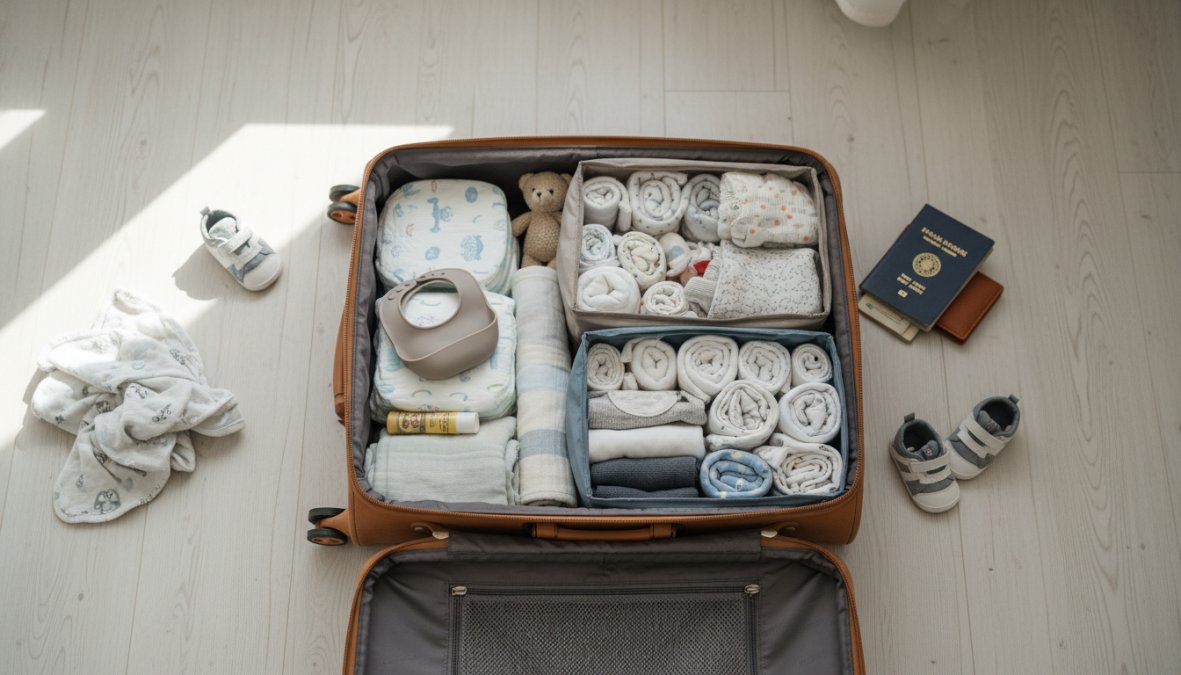
What remains after applying that filter is shorter than you think:
- Baby carrier (replaces stroller for many situations)
- Portable changing mat
- Enough diapers and wipes for travel day plus one buffer day
- Travel-sized versions of diaper cream, baby wash, and lotion
- Medications you can’t easily source (prescription items only)
- A few comfort items: a favorite small toy, a pacifier, a familiar swaddle
That’s the core list. Everything else is optional or rentable.
Clothing and Capsule Wardrobe Strategy for Babies
The capsule wardrobe concept works even better for babies than for adults. Babies wear fewer outfits than parents expect, especially in warm destinations like Northeast Florida, where lightweight onesies cover most situations.
A practical formula: pack one outfit per day, minus two. A five-day trip needs three outfits, not five. Babies get messy, but you’ll do laundry or buy a cheap replacement before you run out. Roll clothes tightly and use packing cubes to compress volume.
Stick to one color palette so every piece mixes and matches. Two onesies, two pairs of pants, one light layer for air conditioning, one swimsuit, and one "nice" outfit covers almost any trip under a week. Shoes for babies who aren’t walking are unnecessary weight.
Diaper Bag Essentials for Flights and On-the-Go Days
The diaper bag is your command center for the entire trip. It needs to handle a full travel day and fit under the seat in front of you.
Diaper bag essentials for flights break down into three categories:
Feeding: Breast pump if nursing (TSA regulations allow breast pumps and milk through security), pre-measured formula packets, collapsible bottles, and enough snacks for toddlers to last the flight plus a two-hour delay.
Diapering: Six to eight diapers for a full travel day, a compact changing mat, travel wipes, and a small wet bag for soiled items.
Comfort: A pacifier with a clip, a small teething toy, a lightweight swaddle that doubles as a blanket, and a change of clothes for both baby and one parent. Blowouts at 30,000 feet are not hypothetical.
According to TSA guidelines on traveling with infants and children, formula, breast milk, and juice for infants are exempt from the standard liquid restrictions and should be declared at the security checkpoint. Knowing this in advance saves significant stress.
Pack your diaper bag the night before travel and do a “gate check” of its contents at the airport. Parents frequently forget the changing mat or the extra outfit because they’re packed in a different bag. Keep all flight essentials in one dedicated compartment.
Flying with a Baby Tips: Carry-On Strategy, TSA Rules, and Airline Baggage Hacks
Flying with a baby is the part that intimidates most parents most. The good news: airports and airlines are more family-friendly than the horror stories suggest, especially when you know the rules before you arrive, and specifically when you know how to use the infant-in-lap baggage allowance system to your advantage.
The core principle for flying with a baby is to minimize what you’re managing physically. A baby in a carrier, a diaper bag under the seat, and a single carry-on is a manageable system. Two checked bags, a stroller, a car seat, and a carry-on is a logistics problem you’ll be solving all day.
Carry-On vs. Checked Luggage: How to Decide What Goes Where
The decision framework is straightforward. Carry-on gets everything you need for the flight and first 24 hours. Checked luggage gets nothing if you can avoid it.
For trips under five days with one adult and one infant, carry-on only is achievable. For longer trips or multiple children, one checked bag is reasonable. The mistake is checking a second bag to hold gear that could be rented at the destination.
| Item | Carry-On | Check It | Rent at Destination |
|---|---|---|---|
| Diaper bag essentials | Yes | No | No |
| Baby clothing (3-4 days) | Yes | No | No |
| Pack n play / travel crib | No | No | Yes |
| Stroller | No | Only if necessary | Yes |
| Car seat | No | If driving at destination | Yes (airport pickup) |
| High chair | No | No | Yes |
| Baby monitor | Yes | No | No |
The Infant-in-Lap Baggage Allowance: What Airlines Actually Give You
This is the most underused policy in family travel, and most parents don’t know it exists until after they’ve paid unnecessary fees.
When you book a lap infant, a child under two years old who flies without their own seat, most major U.S. carriers extend additional baggage rights specifically for that infant. The standard policy across airlines like Delta, United, American, and Southwest allows one stroller and one car seat to be checked free of charge per infant, in addition to your own standard baggage allowance. These items do not count against your personal checked bag limit.
The critical detail: this policy applies whether the stroller and car seat are checked at the ticket counter or gate-checked at the jet bridge. Gate-checking is almost always the better choice for strollers because the item is returned to you at the jet bridge immediately after landing, not at baggage claim. You walk off the plane and the stroller is waiting. This matters enormously when you’re navigating a long terminal walk with a baby and a carry-on.
How to use this allowance to maximize carry-on space:
- Check the car seat at the ticket counter, not the gate. Car seats are bulky and awkward to carry through the terminal. Checking it at the counter frees your hands for the entire airport experience. Confirm with the agent that it’s being checked under the infant equipment allowance so it isn’t counted against your bag limit.
- Gate-check the stroller. Fold it at the jet bridge, hand it to the ground crew, and collect it on arrival before you enter the terminal. This is the single most practical move for families with infants.
- Use the freed carry-on space strategically. With the stroller and car seat checked under the infant allowance, your carry-on can hold the items you’d otherwise check: an extra outfit layer, a small sound machine, or a day’s worth of snacks and supplies.
Airline infant baggage policies are not uniformly enforced. Gate agents have discretion, and policies differ between domestic and international routes on the same carrier. Call the airline’s customer service line before your trip, ask specifically about the infant equipment allowance, and request a confirmation number or email summary of what you’re told. Having that reference number at the gate removes ambiguity.
Specific Airline Baggage Policy Hacks Most Parents Miss
Beyond the infant allowance, several less-publicized policies can meaningfully reduce what you’re managing at the airport:
Breast pump as a medical device. TSA classifies breast pumps as medical devices. They do not count as your personal item or carry-on bag on most carriers. Carry it separately, declare it if asked, and it travels free. Confirm with your specific airline, as implementation varies.
Formula and breast milk volume exemption. As documented in TSA guidelines on traveling with infants and children, formula, breast milk, and juice for infants are exempt from the standard 3.4-ounce liquid rule. You can carry a full day’s worth of prepared formula or pumped milk through security. Pack these in a clearly labeled, accessible outer pocket of your diaper bag and declare them proactively at the checkpoint. Additional screening (such as a test strip) may be applied, but the items cannot be confiscated.
Seat selection strategy for lap infants. Window seats are consistently better for lap infant travel than middle or aisle seats. The fuselage wall gives the baby a surface to lean against during sleep, reduces the number of people who need to pass you during the flight, and keeps you out of the aisle during beverage service. Bulkhead rows offer extra floor space but typically have fixed armrests, which limits how you can position a sleeping baby. Rows directly in front of an exit row often don’t recline, which can make a long flight harder. Avoid these.
TSA PreCheck and family lanes. TSA PreCheck removes the need to remove shoes, laptops, and liquids from bags, which is a significant time and stress reduction when you’re also managing a baby. Families with children under 12 are allowed to use the PreCheck lane with a PreCheck-enrolled adult. At airports without PreCheck, most security checkpoints have a designated family lane, ask an agent if it isn’t clearly marked. Strollers must be folded and sent through the X-ray machine; babies are carried through the metal detector by a parent.
As documented in FAA guidance on child safety seats in aircraft, the FAA recommends children under 40 pounds use an FAA-approved child restraint system during flight. If you’re bringing a car seat on board for a purchased infant seat, confirm it carries the FAA-approved label before you leave home. Not all car seats are approved for aircraft use, and the label is required, not optional.
If you’re flying with a lap infant and your flight is not full, ask the gate agent whether the seat next to you is available. Airlines will sometimes block the adjacent seat for families with infants on less-full flights. This isn’t guaranteed, but it costs nothing to ask at the gate after boarding has begun.
Renting Baby Gear While Traveling: The Smartest Way to Travel Light
Renting baby gear at your destination is the single highest-use travel light with baby tip available. It transforms the packing equation entirely: instead of checking a pack n play, a high chair, and a full-size stroller, you arrive with a carry-on and find everything waiting at your rental.
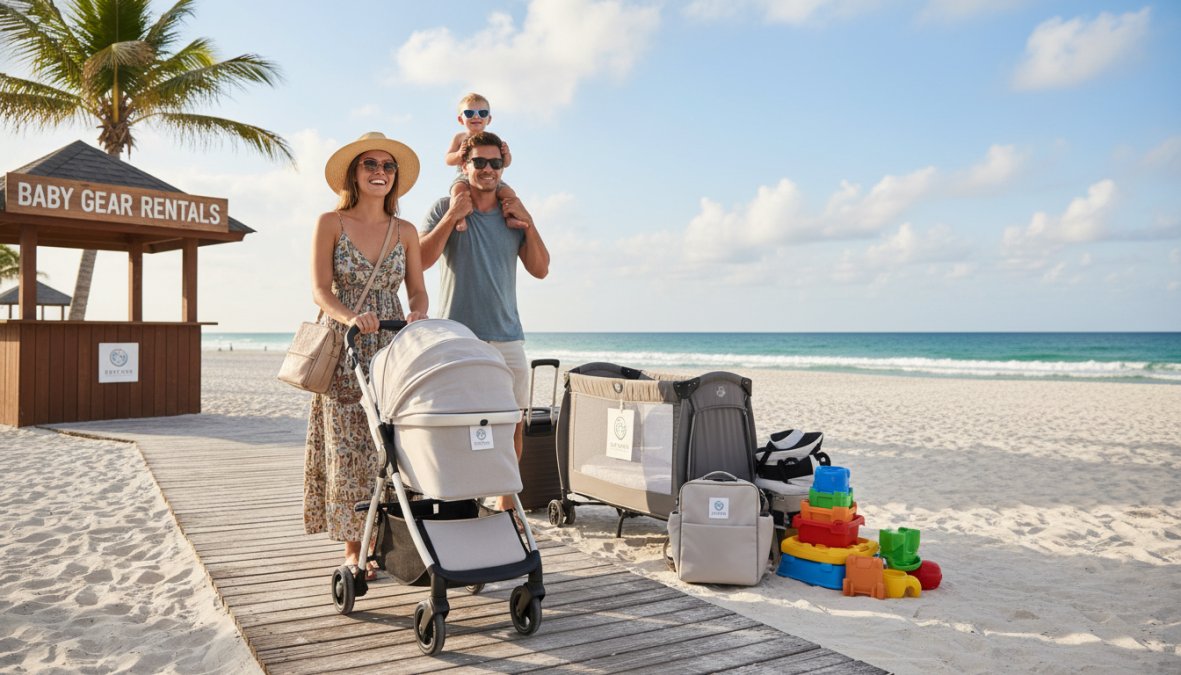
First Coast Baby Rentals delivers sanitized, inspected, and often brand-new baby gear directly to vacation rentals across Saint Augustine, Jacksonville Beach, Fernandina Beach, Amelia Island, Ponte Vedra, Nocatee, and Vilano Beach. The gear is set up before you arrive, so you walk in and your baby’s environment is ready. For families flying into Jacksonville Airport, car seat rental is available so you’re covered from the moment you land.
The practical impact: a family that previously checked two bags now checks zero. The stroller, pack n play, high chair, and beach wagon are waiting at the property. Parents who’ve used this approach consistently describe it as the single change that made traveling with a baby feel manageable rather than overwhelming.
Renting baby gear while traveling also removes the anxiety of equipment condition. Gear that’s been in checked baggage is gear that’s been thrown, dropped, and compressed. Rented gear that arrives sanitized and inspected is, in many cases, in better condition than what parents own at home.
Renting a pack n play, stroller, and high chair at your destination typically costs less than two round-trip checked bag fees, and you arrive without the physical strain of managing oversized luggage through an airport.
How to Wash Baby Clothes While Traveling (Without Losing Your Mind)
Knowing how to wash baby clothes while traveling is what makes the capsule wardrobe strategy actually work. The math only holds if you’re washing mid-trip, and the good news is that baby laundry is genuinely easier than most parents expect, because baby items are small, dry fast, and require almost no special handling beyond a gentle detergent.
The laundry strategy you choose depends on your trip length, your accommodation type, and how much you want to pack. Here is a complete breakdown of every viable approach, ranked by practicality.
Option 1: In-Unit Washer and Dryer (The Default for Vacation Rentals)
Most vacation rentals in Saint Augustine and across Northeast Florida include a washer and dryer. Confirm this before booking, it’s a filter worth applying specifically because it changes your entire packing equation.
With in-unit laundry, one mid-trip wash on a five-day trip means you only need three to four outfits instead of six to eight. The practical workflow: pack three outfits, wear them in rotation, run a single load on day three, and arrive home with clean clothes. This is the lowest-effort, highest-return laundry strategy available and the one that makes a carry-on-only trip most achievable.
For detergent, bring two or three fragrance-free, dye-free laundry pods rather than a full bottle. They weigh almost nothing and take up no meaningful space. According to American Academy of Pediatrics guidance on infant clothing and washing, fragrance-free, dye-free detergents are recommended for infant clothing to minimize skin irritation, and travel-sized pods in these formulas are widely available at major retailers.
Option 2: Sink Washing for Short Trips and Warm Climates
For trips of three to four days, or when you’re staying somewhere without in-unit laundry, sink washing is a practical and underrated option. Baby items are ideal candidates: onesies, socks, and light cotton pants are small enough to wash by hand in two minutes and dry in two to four hours in a warm climate.
The practical method:
- Fill the sink with warm water and add a small amount of fragrance-free travel detergent or a dissolved detergent pod.
- Submerge the items, agitate gently for one to two minutes, and let soak for five minutes.
- Rinse thoroughly, detergent residue on baby skin causes irritation, so rinse twice.
- Wring gently and hang near a window, fan, or over a shower rod.
In Florida’s warm, humid climate, a thin cotton onesie hung near an open window or a ceiling fan dries in two to three hours. In air-conditioned rooms, hang items in the bathroom with the door closed and the shower run warm for a few minutes, the humidity accelerates drying. This is genuinely faster than finding and traveling to a laundromat for a small load.
Travel detergent options worth packing: Tide Travel Sink Packets, Dropps fragrance-free pods, or a small solid laundry bar (brands like Fels-Naptha or travel-specific solid soap bars). Solid bars are the most luggage-friendly option, no liquid, no leak risk, and one bar handles a week of baby laundry.
Pack a three-to-four-foot length of travel clothesline with two small suction hooks. It weighs almost nothing, attaches to any bathroom tile or window frame, and gives you a dedicated drying line without using the shower rod or furniture. This is a $6 item that makes sink washing significantly more practical.
Option 3: Laundromat Visits for Longer Trips
For trips of a week or more, or for families who prefer not to hand-wash, a single laundromat visit mid-trip handles everything in under an hour. Saint Augustine has several laundromats within a short drive of the historic district and beach areas. Most vacation rental hosts can point you to the nearest one, and a quick map search for the destination area will surface options.
The laundromat approach works best when you batch it: bring everything that needs washing in one trip, use two machines simultaneously if available, and you’re done in 45 to 60 minutes. Bring your own detergent pods to avoid the vending machine markup and to ensure you’re using a formula safe for infant skin.
Option 4: Buy at the Destination and Skip Laundry Entirely
For very short trips, two to three days, or when you’re traveling to a destination with easy retail access, buying a few cheap replacement items locally and skipping laundry altogether is a legitimate strategy that most packing guides overlook.
A three-pack of basic onesies from a local Target, Walmart, or even a beach gift shop costs very little and eliminates the need to pack, wash, or track clothing for that trip. After the trip, donate the items to a local family, a hotel lost-and-found donation box, or a charity drop. This approach is especially practical for blowout-prone infants on short trips where laundry logistics feel like more trouble than they’re worth.
This is also the foundation of the long-term travel model: buy locally, use for the duration, and pass items forward rather than hauling them. For families doing extended travel, this approach applied to clothing, gear, and supplies reduces both luggage weight and the mental overhead of tracking inventory across multiple destinations.
The Buy-at-Destination Strategy for Consumables
The laundry question connects directly to the broader buy-at-destination principle, which is the most powerful single concept in minimalist baby travel. Diapers, wipes, formula, baby wash, sunscreen, and most consumables are available at grocery stores, pharmacies, and big-box retailers in virtually every destination, including smaller beach towns.
The practical application: pack enough diapers and wipes for the travel day plus one buffer day. Buy the rest at your destination. A standard box of diapers at a destination Target costs the same as at home and eliminates the single bulkiest item most parents check. The same logic applies to formula, baby food pouches, and sunscreen.
For families visiting Northeast Florida, Publix, Walmart, and Target locations are accessible from Saint Augustine, Jacksonville Beach, Fernandina Beach, and Ponte Vedra. Most vacation rental hosts can confirm the nearest grocery option, and many rentals are within a short drive of a full-service pharmacy for any last-minute needs.
The laundry strategy and the buy-at-destination approach work together as a system. Pack three outfits and enough consumables for day one. Wash mid-trip or buy locally as needed. This combination is what makes a carry-on-only trip with a baby achievable for trips of five days or longer, not just theoretically, but in practice.
What to Do When Nothing Goes to Plan
Blowouts happen. Spit-up happens. A full outfit change at a rest stop or airport gate is not a failure of planning, it’s a normal part of traveling with an infant. The practical safeguard is keeping one complete change of clothes for the baby (and one shirt for yourself) in the most accessible pocket of your diaper bag at all times, not buried in your carry-on.
For unexpected messes beyond what your packed supply covers, most airport terminals have a pharmacy or convenience store airside. Most beach towns have a drugstore within a short drive. The contingency plan for baby travel is not more packing, it’s knowing where to buy what you need when you need it.
Travel Light with Baby Tips for Special Situations: Transit, Long Trips, and Eco-Conscious Families
The core travel light with baby tips shift depending on your travel context. A weekend beach trip to Fernandina Beach looks different from a three-month digital nomad stint, which looks different from a family committed to low-waste travel. Here’s how to adapt.
Managing Baby Gear on Public Transit
Public transit with a baby rewards compact gear choices more than any other travel context. A full-size stroller on a city bus or subway is a problem for everyone. A baby carrier is not.
For urban travel, the carrier is the primary transport tool. A structured carrier with lumbar support handles infants and toddlers up to 40 pounds and keeps your hands free for turnstiles, stairs, and overhead holds. A lightweight umbrella stroller folds to carry-on size and works for longer walking distances.
The practical checklist for public transit days:
- Baby carrier packed and accessible (not buried in luggage)
- Diaper bag worn as a backpack, not a shoulder bag
- Stroller folded and strapped for easy one-hand carry
- Snacks and a bottle accessible without opening the main bag
- A change of clothes within reach, not at the bottom of the pack
Under-seat storage on trains and buses is limited. Everything you bring on transit needs to fit on your body or in a bag you can hold in your lap.
Long-Term and Digital Nomad Travel with a Baby
Long-term travel with a baby is less about packing and more about systems. Digital nomad families who travel for months at a time typically operate on a "buy, use, donate or ship" model: they buy bulky items locally, use them for the duration of the stay, and donate or ship them forward rather than hauling them.
For gear specifically, this means buying a cheap local stroller or high chair at the destination, using it for the month, and leaving it with a local family or charity when they move on. The cost is often lower than shipping or renting for the same period.
The non-negotiables for long-term baby travel: a quality carrier that holds up to daily use, a portable white noise machine or app, and a reliable sleep surface (rented or purchased locally). Everything else is context-dependent.
Sustainable and Eco-Friendly Minimalist Travel with Baby
Eco-conscious baby travel is an angle almost no packing guide addresses, and it’s worth naming directly. The minimalist approach is inherently more sustainable: fewer items purchased means less manufacturing demand and less waste.
Specific sustainable travel light with baby tips:
- Choose reusable cloth diapers for road trips where laundry is accessible, reducing disposable waste significantly.
- Pack concentrated, fragrance-free baby wash in a reusable silicone travel bottle rather than single-use travel sizes.
- Opt for gear rental over purchasing single-use travel gear. Renting a pack n play that’s used by dozens of families is materially more sustainable than buying one for a single trip.
- Choose destinations with walkable infrastructure or good public transit to reduce car rental needs.
The intersection of minimalist packing and sustainability is not accidental. Buying less, renting more, and choosing multi-purpose gear reduces both luggage weight and environmental footprint simultaneously.
The Post-Trip Gear Audit: How to Pack Even Smarter Next Time
The post-trip gear audit is the step every packing guide skips, and it’s the one that compounds your results over time. Done right, it turns one good trip into a template for every trip after it.
Within 48 hours of returning home, go through everything you packed and answer three questions for each item:
- Did I use this item? If no, it doesn’t make the next list.
- Did I wish I had something I didn’t bring? Add it, but identify what it replaces.
- Did I bring something I could have rented or bought locally? Remove it from the permanent list.
Create a simple packing document from your answers. After two or three trips, this document becomes a precision instrument: a list that reflects your actual travel behavior, not theoretical preparedness.
A few patterns that emerge from most post-trip audits:
- Parents consistently overpack clothing by 30-40% relative to what they actually wear.
- Bulky comfort items like bouncers and swings are almost never used when babies have sufficient outdoor stimulation and a reliable sleep surface.
- Snacks are consistently underpacked for toddlers and overpacked for infants.
The audit also reveals what gear to invest in. If you consistently wish you had a better carrier, that’s worth spending on. If you’ve never once used the travel high chair you own, that’s a rental candidate for every future trip.
Take a photo of your packed bags before every trip and another of what came home unused. After three trips, the pattern is obvious and the next packing list almost writes itself.
Conclusion: Pack Less, Enjoy More on the First Coast and Beyond
Traveling with a baby doesn’t have to mean traveling heavy. The families who have the best experiences on the First Coast are almost always the ones who arrive with less and rent the rest. A carry-on, a diaper bag, and a gear rental waiting at your vacation property is genuinely achievable, and it changes the entire texture of the trip.
For families visiting Saint Augustine, Jacksonville Beach, Amelia Island, Ponte Vedra, Fernandina Beach, Nocatee, Vilano Beach, or flying in through Jacksonville Airport, First Coast Baby Rentals delivers sanitized, inspected, and often brand-new baby gear directly to your rental property, set up before you arrive. Every item is thoroughly cleaned and inspected before each delivery, and last-minute reservations are accommodated. If the weather turns and you need to extend your stay, the rental can be extended to match.
Reserve your gear with First Coast Baby Rentals before your next Northeast Florida trip and arrive with a carry-on instead of a checked-bag nightmare.
Frequently Asked Questions
How do you travel light with a baby without forgetting essentials?
The key to traveling light with baby tips is building a minimalist packing list around multi-purpose gear and destination shopping for bulk items like diapers and wipes. Use packing cubes to compress a small capsule wardrobe, stick to carry-on only when possible, and plan to rent larger baby gear, like a pack n play or stroller, at your destination. This approach dramatically cuts luggage volume without sacrificing baby comfort.
Is renting baby gear while traveling worth it?
Renting baby gear while traveling is one of the most effective ways to reduce checked baggage fees and travel stress. Instead of hauling bulky items like cribs, high chairs, or beach wagons, you can reserve sanitized, inspected equipment delivered directly to your vacation rental. This is especially practical for families visiting Northeast Florida destinations like St. Augustine, Amelia Island, or Ponte Vedra, where local rental services offer brand-name gear on demand.
Should I bring a stroller or a baby carrier when flying with a baby?
For flying with a baby, a baby carrier is almost always the better ultralight travel choice. It keeps your hands free, fits under the seat, and breezes through TSA without extra hassle. A stroller adds checked baggage weight and gate-check logistics. If you need a stroller at your destination, renting one locally is often more practical. That said, if your baby is a toddler who won't tolerate a carrier, a lightweight umbrella stroller can be gate-checked for free on most airlines.
How do you handle baby laundry while traveling?
Learning how to wash baby clothes while traveling saves you from overpacking outfits. Pack a small travel-sized bottle of baby-safe laundry detergent and hand-wash items in the hotel or vacation rental sink every one to two days. Alternatively, choose accommodations with in-unit laundry. Bringing quick-dry fabrics and limiting your baby's capsule wardrobe to five to seven mix-and-match pieces means you can realistically manage laundry every few days without running out of clean clothes.
What are the best airline baggage policy hacks for traveling with a baby?
Most major airlines allow infant-in-lap passengers to check one additional bag for free, and nearly all allow a stroller and car seat to be checked at no charge. A diaper bag typically counts as a personal item, freeing up your carry-on allowance. Always confirm the airline's specific policy before booking. Some carriers also let you gate-check a baby carrier or compact stroller, which means you have it right up until boarding, a major convenience for navigating busy airports.
This article was written using GrandRanker