Table of Contents
- What to Know Before You Choose a Beach Wagon for Toddlers
- Best Beach Wagons with Big Wheels for Sand Traction
- Beach Wagon with Canopy for Sun Protection: What to Look For
- Beach Wagon Safety Tips for Toddlers: Harnesses, Brakes, and More
- Foldable Design, Storage, and Vehicle Compatibility
- Long-Term Durability in Salt Air: What Most Buyers Overlook
- How to Clean Sand Out of a Beach Wagon After Every Trip
- Key Mistakes to Avoid When Choosing a Beach Wagon for Toddlers
Last Updated: June 6, 2026
Knowing how to choose a beach wagon for toddlers before you arrive at the shore saves you from a very specific kind of vacation misery: a heavy, sand-stuck cart, a sweaty toddler, and a 200-yard walk that feels like a mile. At First Coast Baby Rentals, we help families headed to Saint Augustine, Ponte Vedra, Amelia Island, and the surrounding Northeast Florida coast get this decision right before they leave home. The right wagon rolls smoothly across soft sand, keeps your toddler shaded and secure, and folds flat enough to fit in your rental car’s trunk.
Below, we’ll cover every factor that actually matters: wheel physics on soft sand, harness safety standards, canopy UV ratings, fold dimensions, and the long-term effects of salt air on frame materials.
What to Know Before You Choose a Beach Wagon for Toddlers
The single most important rule: a wagon that works on pavement will likely fail on soft sand. Understanding that distinction upfront eliminates half the bad options immediately.
Wagon Stroller Hybrid vs. Traditional Pull Wagon: Which Is Right for You?
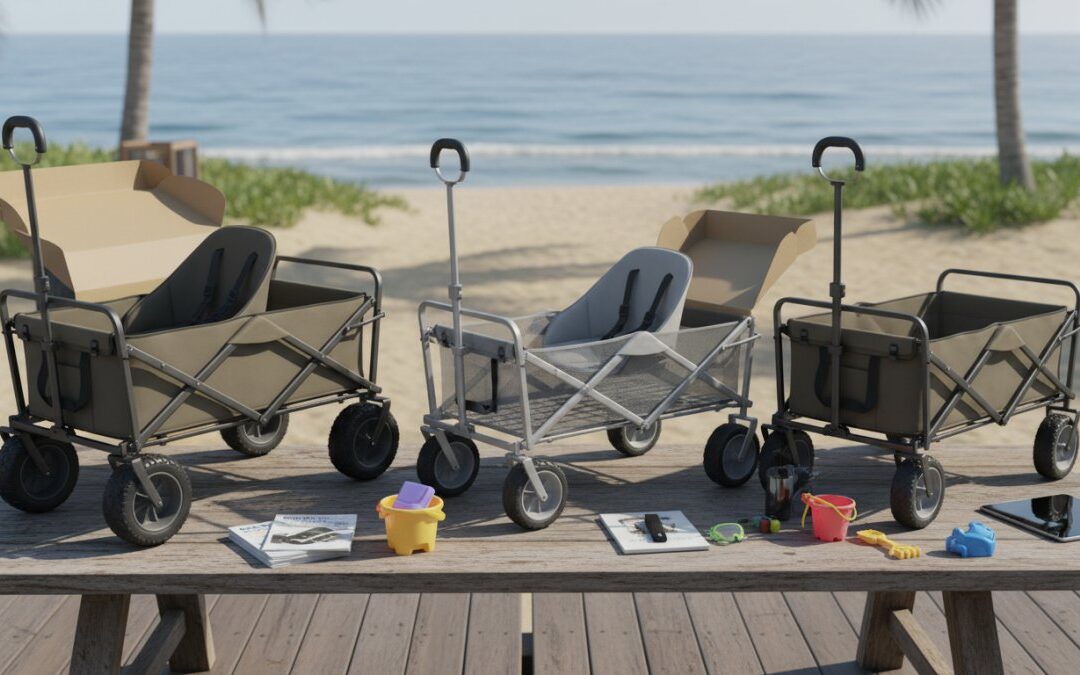
A wagon stroller hybrid combines a traditional pull wagon frame with stroller-grade features: a 5-point harness, padded seating, a canopy, and a telescoping handle that can be pushed or pulled. A traditional pull wagon is simpler, lower to the ground, and lacks built-in safety restraints.
For toddlers under three, the stroller wagon hybrid is the clear choice. The 5-point harness keeps a squirmy toddler seated on moving terrain, the elevated seat keeps small children above hot sand, and the telescoping handle lets you push or pull without awkward repositioning. Traditional pull wagons make more sense for kids four and up who can sit independently. For mixed-age groups, a hybrid with removable seats often covers both scenarios.
| Feature | Wagon Stroller Hybrid | Traditional Pull Wagon |
|---|---|---|
| 5-point harness | Standard | Rarely included |
| Canopy/UV protection | Usually included | Rare |
| Telescoping handle | Push and pull | Pull only |
| Weight | 25-40 lbs | 15-25 lbs |
| Cargo space | Moderate | High |
| Best for | Toddlers under 4 | Kids 4+ |
Weight Capacity and Interior Dimensions: Sizing It Right
Weight capacity typically ranges from 100-150 lbs. For two young children, aim for 120 lbs or more and verify interior width: many wagons advertise dual-seat capacity but only comfortably fit two children up to about 30 lbs each. A wagon seating two toddlers side-by-side needs at least 30 inches of interior width. Also check floor-to-rim height: deeper wagons (12+ inches) contain toddlers better on bumpy terrain.
Never exceed the manufacturer’s stated weight limit. Overloading stresses frame welds and wheel axles, the two most common failure points on sand terrain.
Best Beach Wagons with Big Wheels for Sand Traction
The best beach wagons for sand share one defining characteristic: wide, large-diameter wheels with soft or pneumatic tread. Wheel size is the primary engineering variable that determines whether your wagon glides across soft sand or digs into it.
 and a toddler wearing a sun hat across soft white sand on a bright sunny day, ocean waves visible in the background, warm afternoon light](https://cdn.grandranker.com/articles/how-to-choose-a-beach-wagon-for-toddlers-2026-guide-content-1-1780709556.jpg)
Sand-Specific Wheel Physics: Why Wheel Size and Width Actually Matter
A small, narrow wheel concentrates the wagon’s weight over a tiny contact area, creating high ground pressure that causes the wheel to sink rather than roll. A large, wide wheel spreads the same weight over a much larger area, allowing it to stay on top of the sand. According to CPSC guidelines on children’s wheeled products, wheel diameter and tread design are primary variables in outdoor terrain performance for juvenile products. Practically: wheels under 10 inches struggle on soft sand regardless of tread; wheels at 12 inches or larger with a wide, flat profile perform significantly better.
Pneumatic (air-filled) tires outperform solid foam or hard plastic on sand because air pressure can be adjusted, lower pressure increases the contact patch for better float. The trade-off is occasional inflation and puncture risk versus maintenance-free foam-filled tires.
All-Terrain Wheels vs. Standard Swivel Wheels on Soft Sand
Standard swivel wheels are designed for hard surfaces and dig unpredictably on soft sand. All-terrain wheels are larger, fixed or semi-fixed in orientation, and use a treaded surface to grip irregular terrain. The fixed orientation helps on sand: the wheel tracks straight rather than crabbing sideways under resistance.
The best setup is large all-terrain rear wheels (12+ inches) paired with smaller swivel front wheels for maneuverability on hard surfaces.
Before your first beach trip, reduce air pressure in pneumatic tires by about 20% from the recommended maximum. This widens the contact patch and noticeably improves sand performance without risking rim damage.
Beach Wagon with Canopy for Sun Protection: What to Look For
Sun protection is not optional when spending a day at Saint Augustine Beach or Fernandina Beach with a toddler. Toddler skin burns faster than adult skin, and reflective glare off white sand amplifies UV exposure beyond what most parents expect.
UPF 50 Ratings, Removable Fabric, and UV Protection Coverage
A UPF 50 canopy blocks at least 98% of UV radiation. Look for canopies that extend forward and have side panels to block low-angle sun, a canopy that only shades the top of the head leaves a toddler’s face, arms, and legs exposed. According to American Academy of Dermatology sun protection guidelines, UV exposure is highest between 10am and 4pm, exactly when most families are on the beach.
Removable, machine-washable fabric is a practical feature that extends product lifespan: salt air, sunscreen, and sand degrade canopy fabric faster than any other part of the wagon. Also check the attachment mechanism, Velcro-only attachments loosen in salt air, while button snaps combined with a telescoping frame hold position better in coastal wind.
Beach Wagon Safety Tips for Toddlers: Harnesses, Brakes, and More
Safety covers the full system: harness design, brake reliability, frame integrity, and handle ergonomics. Each element has a specific failure mode.
Toddler-Specific Safety Harness Standards: What the 5-Point Harness Must Do
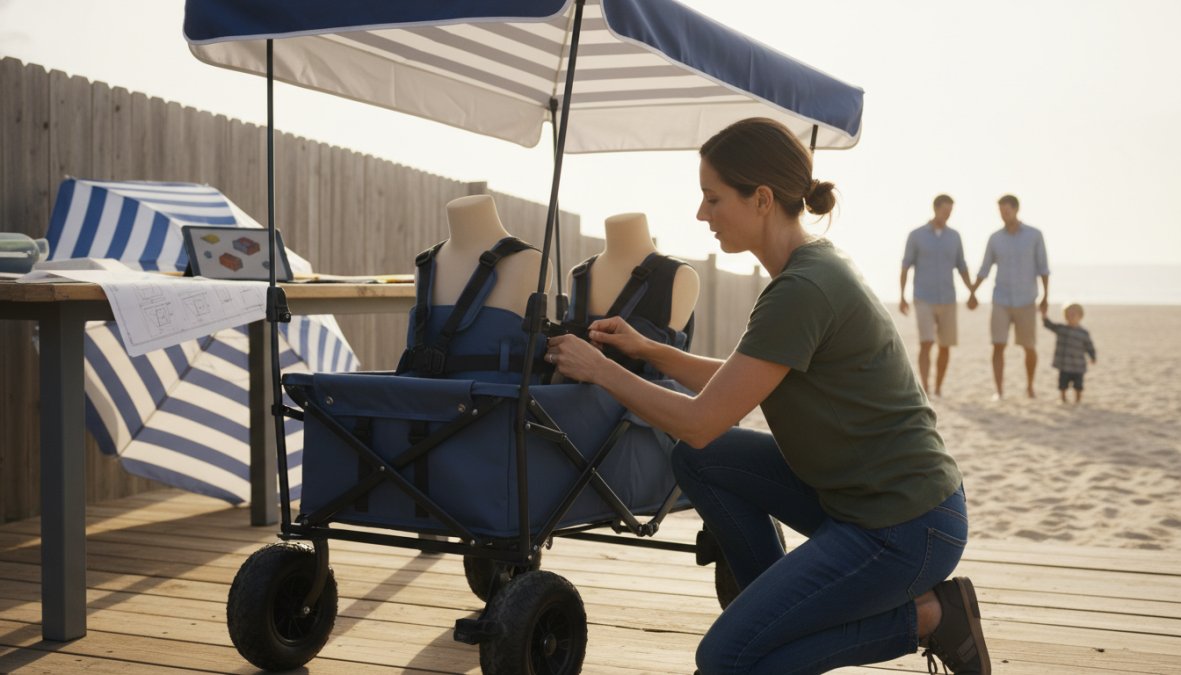
A 5-point harness has five attachment points, two shoulder straps, two hip straps, and a crotch strap, preventing forward ejection, lateral sliding, and submarining. Key quality indicators:
- Buckle release force: Should require deliberate adult force to release.
- Shoulder strap padding: Distributes pressure and prevents neck cutting on long sessions.
- Adjustability range: Should accommodate roughly 20-50 lbs without slack at either end.
- Crotch strap anchor: Must be anchored to the wagon floor, not seat fabric, fabric anchors tear under load.
As noted in ASTM International juvenile product safety standards, wagon stroller hybrids sold in the US should meet ASTM F2012 standards for juvenile wheeled goods, which includes restraint system performance requirements.
Brake Systems, Frame Durability, and Telescoping Handle Safety
A parking brake prevents the wagon from rolling on slopes. Many wagons use a foot-activated strap around the rear axle, functional but prone to wear in salt air. Better designs use a lever-actuated caliper or friction pad. Frame durability comes down to material: powder-coated steel is rigid but heavy; aluminum is lighter and naturally corrosion-resistant, which matters enormously on the coast; plastic frames flex under load and accelerate joint fatigue.
The telescoping handle should lock at multiple heights and require a deliberate button press to release. For adults over 5’8", confirm the maximum handle extension height, many wagons max out at a height that forces taller parents to hunch.
Foldable Design, Storage, and Vehicle Compatibility
Most families driving to the First Coast from Atlanta, Charlotte, or further north are packing a full car. A beach wagon that doesn’t fit in your trunk is one you’ll leave at home.
Does It Fit in Your Car? Compact Fold Dimensions Explained
The two common fold types are:
- Flat fold: Collapses completely flat. Typical dimensions run 35-45 inches long by 20-25 inches wide by 6-10 inches tall.
- Book fold: Folds in half lengthwise, less common but useful for narrow cargo areas.
Measure your vehicle’s cargo area with rear seats up before buying. A compact crossover or sedan trunk is restrictive: anything over 40 inches folded may require dropping a rear seat. Also consider assembly time, wagons requiring tools are impractical for daily beach trips. The best designs set up and break down in under 60 seconds.
Measure your car trunk before choosing a wagon. A wagon with a 42-inch folded length won’t fit in most compact crossover trunks without dropping a rear seat, which eliminates passenger capacity.
Long-Term Durability in Salt Air: What Most Buyers Overlook
Salt air accelerates oxidation on steel components, degrades rubber seals, and breaks down plastic connectors faster than inland use. The most vulnerable components are wheel axle bearings, frame joint connectors, canopy attachment hardware, and the brake mechanism. Sealed bearings resist salt infiltration far better than open bearings; stainless steel or anodized aluminum hardware outlasts zinc-plated steel significantly.
According to NOAA coastal environment materials degradation guidance, salt air accelerates corrosion on unprotected steel by a factor of five compared to inland environments, a wagon rated for five years of normal use may show significant wear after a single heavy coastal season.
After each beach day, rinse the frame, wheels, and hardware with fresh water. This single habit extends the life of any beach wagon more than any other maintenance practice.
How to Clean Sand Out of a Beach Wagon After Every Trip
Sand trapped in wheel bearings, joint connectors, and fabric folds grinds against moving parts every use, accelerating wear at every friction point. A practical post-beach cleaning routine takes about five minutes:
- Shake the fabric: Remove any removable liner or seat and shake it out away from the wagon.
- Rinse the frame: Use a garden hose to rinse the frame, wheel axles, and joint connectors. Focus on wheel hubs where sand packs most densely.
- Spin the wheels: While rinsing, spin each wheel to flush sand from the bearing area. Wet grit is far easier to remove than dried grit.
- Wipe the hardware: Wipe down exposed metal hardware, particularly the brake mechanism and telescoping handle joints.
- Air dry before folding: Folding a wet wagon traps moisture, accelerating mold on fabric and corrosion on metal.
For the canopy, a mild soap and water wipe-down every few uses prevents salt and sunscreen residue from degrading the UPF coating. Avoid harsh detergents, which strip UV-blocking treatments.
Key Mistakes to Avoid When Choosing a Beach Wagon for Toddlers
Choosing based on price alone. Budget wagons often use standard swivel wheels and unprotected steel hardware that fail within one or two coastal seasons.
Ignoring the folded dimensions. Many buyers discover the wagon doesn’t fit in their car after the purchase. Measure first.
Overlooking harness quality. Not every wagon marketed with a "5-point harness" has a properly anchored crotch strap and adult-force buckle release. Check both before trusting the label.
Skipping the salt air rinse. One week at the beach without rinsing can introduce corrosion that shortens the wagon’s life by years.
Buying a wagon that’s too heavy. A 40-lb wagon loaded with gear and a toddler can exceed 80 lbs of total pull weight, genuinely difficult on soft sand. Prioritize lighter frames when all other features are equal.
Here’s a quick decision checklist before you commit:
- Wheel diameter is 12 inches or larger
- Wheels are pneumatic or wide foam-filled all-terrain type
- Canopy is rated UPF 50 and has removable, washable fabric
- 5-point harness has a floor-anchored crotch strap and adult-release buckle
- Brake mechanism uses metal components, not fabric straps
- Frame is aluminum or powder-coated steel with sealed wheel bearings
- Folded dimensions fit your specific vehicle’s cargo area
- Total wagon weight (empty) is under 30 lbs for manageable transport
For families visiting Saint Augustine, Jacksonville Beach, Vilano Beach, or anywhere along the First Coast, this checklist covers every variable that separates a good beach day from a frustrating one. The right wagon is the one you barely notice because it just works.
Hauling the right gear to the beach while keeping a toddler safe and comfortable is easy to underestimate. First Coast Baby Rentals delivers sanitized, inspected, often brand-new beach wagons and baby gear directly to your vacation rental in Saint Augustine, Jacksonville Beach, Ponte Vedra, Amelia Island, Fernandina Beach, Nocatee, and surrounding areas, so you arrive light and set up fast. Every piece of equipment is thoroughly checked before delivery, and rentals can be extended if poor weather extends your stay. Reserve your gear with First Coast Baby Rentals and spend your vacation on the sand, not in the parking lot assembling equipment.
Frequently Asked Questions
What features should I look for in a beach wagon for toddlers?
When choosing a beach wagon for toddlers, prioritize all-terrain or wide wheels for sand traction, a 5-point safety harness, a UPF 50 canopy for UV protection, and a sturdy parking brake. A foldable design with a compact fold makes transport easier, while a deep storage basket adds cargo space for beach gear. Look for a telescoping handle, cup holders, and removable fabric that can be cleaned after salty, sandy days.
Do I need a wagon with big wheels for the beach?
Yes, big wheels make a significant difference on soft sand. Wider, larger-diameter wheels distribute weight over a greater surface area, reducing how deeply the wagon sinks into loose sand. Standard swivel wheels tend to dig in and drag, making the wagon much harder to pull. For beaches like those in Saint Augustine and Amelia Island, all-terrain wheels with a wide profile are strongly recommended for comfortable maneuverability across the shoreline.
Is a beach wagon safe for a toddler?
A beach wagon can be very safe for toddlers when it includes the right safety features. Look for a 5-point harness that keeps your child securely seated, a reliable parking brake to prevent rolling on uneven terrain, and high sidewalls to prevent falls. Avoid models with pinch points in the folding frame. A stroller wagon hybrid with a certified harness system offers the best combination of toddler comfort and safety for beach outings.
What is the weight limit for most toddler beach wagons?
Most toddler-focused beach wagons have a weight capacity between 100 and 150 pounds, which is typically enough for two young children plus some beach gear. Always check the manufacturer's stated weight limit before loading the wagon with both kids and cargo. Exceeding the weight limit can stress the frame, compromise the brake system, and reduce overall safety. If you plan to carry multiple children, look for heavy-duty models with higher weight capacity ratings.
How do you clean sand out of a beach wagon after a trip?
Start by letting the wagon dry completely in the sun, then shake out loose sand from the storage basket and seat fabric. Use a stiff brush or handheld vacuum to remove sand from wheel axles, folding joints, and fabric seams. If the wagon has removable fabric, take it off and rinse it with fresh water to remove salt residue. Wipe down the frame with a damp cloth and dry thoroughly to prevent rust, especially important in salt-air coastal environments.
Can a beach wagon fit in a standard car trunk?
Many foldable beach wagons are designed with vehicle compatibility in mind, but compact fold dimensions vary widely by model. Some collapse to roughly the size of a large suitcase and fit easily in an SUV or minivan cargo area, while others require more trunk space. Before buying or renting, check the folded dimensions against your vehicle's cargo area. If you are traveling to Northeast Florida and want to skip the hassle entirely, renting a beach wagon locally means zero trunk space lost on the drive.
This article was written using GrandRanker