
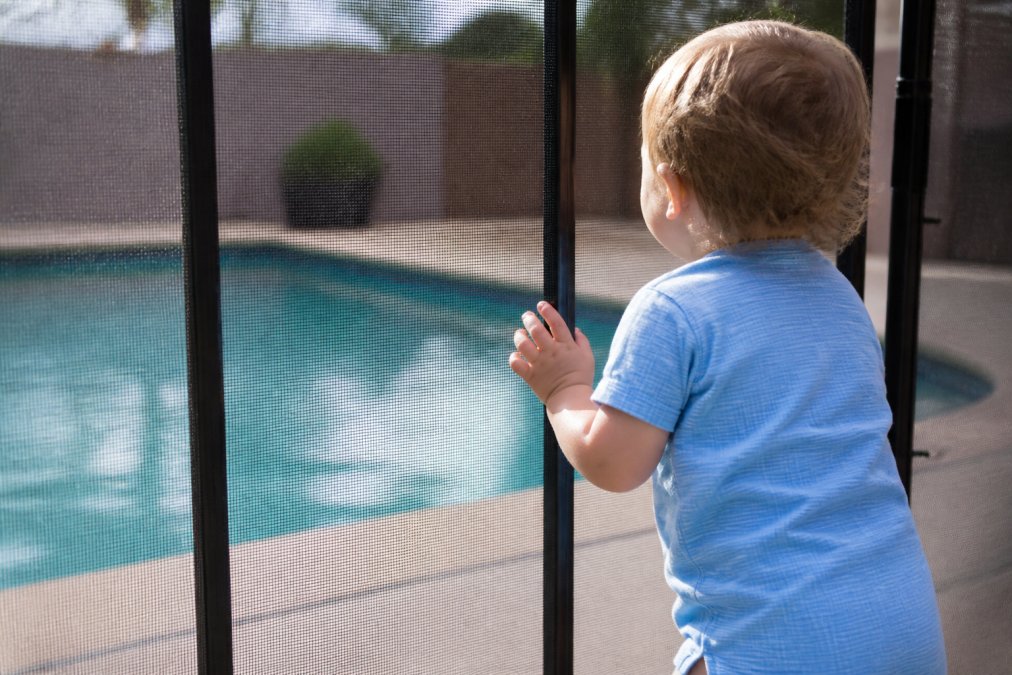
Table of Contents
- Pool Safety for Toddlers in Florida: Why Layers of Protection Matter
- Florida Pool Fence Laws and Four-Sided Barriers
- Active Supervision and Touch Supervision: Your First Line of Defense
- Door Alarms, Pool Alarms, and Water Watcher Technology in Florida
- Swim Lessons for Toddlers in Florida: Building Water Confidence
- CPR for Parents in Florida: Emergency Preparedness and Resuscitation
- Practical Pool Safety Checklist for Vacation Rentals on the First Coast
- Conclusion: Protect Your Toddler With Confidence This Summer
Last Updated: July 30, 2026
Pool Safety for Toddlers in Florida: Why Layers of Protection Matter
Drowning is the leading cause of unintentional injury death for children ages 1-4 in the United States. The good news: drowning is preventable. It’s not about fear, it’s about layers of protection working together. At First Coast Baby Rentals, we’ve worked with many visiting families across Northeast Florida who want to enjoy the water with their little ones, safely. This guide breaks down practical, actionable strategies that actually work to keep toddlers protected around pools, whether you’re staying in St. Augustine Beach, Ponte Vedra, or near Jacksonville Airport.
Think of pool safety like building a fence around a fence. You don’t rely on just one safety measure. Instead, you stack multiple barriers so if one fails, others catch the gap.
Drowning happens silently and quickly, often in less than two minutes. There are no splashing sounds or calls for help. Active supervision combined with physical barriers is the only proven way to prevent it.
Understanding Drowning Risk and Prevention
Drowning doesn’t look like an emergency. It looks like a child quietly slipping underwater, unable to call out. Children can drown in as little as one inch of water, and it takes only seconds. Many drowning incidents happen when a parent is present but distracted, checking a phone, talking to another adult, or looking away for just a few seconds.
According to the Centers for Disease Control and Prevention, about 1 in 5 children who die from unintentional drowning are ages 1-4. For every child who dies, approximately 5 more receive emergency care for non-fatal submersion injuries, some resulting in permanent brain damage.
The key insight: drowning prevention isn’t about teaching your toddler to swim. Swim lessons are wonderful, but they don’t prevent drowning in toddlers. A 2-year-old doesn’t have the cognitive ability to remember water safety rules when panicked. Prevention relies entirely on you, your supervision, your barriers, and your emergency preparedness.
Never assume your child knows how to swim or that they’ll remember safety lessons in a panic. Toddlers lack the impulse control and judgment to self-rescue. Your supervision is their only real protection.
Florida Pool Fence Laws and Four-Sided Barriers
Florida takes pool safety seriously. If you’re renting a vacation home with a pool in St. Augustine, Jacksonville, or surrounding areas, the property should meet state standards.
The Florida Residential Swimming Pool Safety Act requires all residential swimming pools be surrounded by a four-sided fence or enclosure that completely separates the pool from the house and yard. The fence must be at least 4 feet tall, measured from ground to top. Gates must be self-closing and self-latching, with the latch positioned at least 54 inches above the ground, well out of reach of a toddler. The fence must have no gaps larger than 4 inches.
When you arrive at your vacation rental in Vilano, Fernandina, or Jacksonville Beach, take five minutes to walk the pool perimeter. Check that the fence is intact, gates close properly, and there are no obvious gaps. If something looks wrong, contact your rental property manager immediately.
Walk the pool fence perimeter on your first day. Look for gaps, broken slats, or gates that don’t close. A four-sided fence is your first line of defense, but only if it’s actually maintained.
Self-Closing Gates and Self-Latching Locks
A fence is only effective if the gate actually closes and stays closed. Florida law requires gates to be self-closing and self-latching, with the latch positioned at least 54 inches above the ground, beyond the reach of a standing toddler.
When checking your rental property’s gate, open it fully and release it. It should swing closed on its own and click into place. Try to open the gate without lifting the latch. If it opens easily, the self-latching mechanism isn’t working. Report this to your rental manager before allowing your child near the pool.
Active Supervision and Touch Supervision: Your First Line of Defense
Here’s what separates families who experience near-drowning incidents from those who don’t: active, constant supervision. Not watching from across the yard. Not checking occasionally. Not supervising while scrolling your phone. Constant, focused, uninterrupted attention.
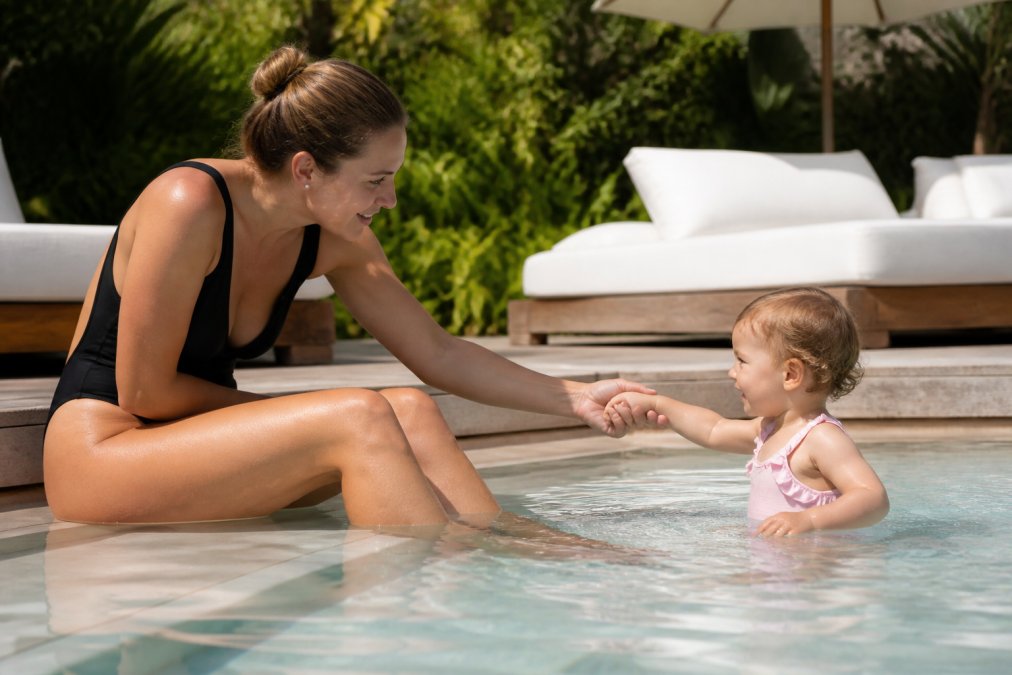
Active supervision means your eyes are on your child the entire time they’re near water. But it goes deeper, it means touch supervision, staying within arm’s reach of your toddler at all times when they’re in or near the water. Arm’s reach means you can reach out and touch your child without taking a step.
Many drowning incidents happen in the presence of adults. The adult was watching, but from too far away. In the time it takes you to walk 10 feet, a toddler can be underwater.
Assign one adult as the “water watcher” when your family is at the pool. That person’s only job is watching your child. No phone, no reading, no conversation. Rotate this role every 15-20 minutes so the supervising adult stays alert.
Arm’s Reach Supervision for Toddlers
For toddlers, arm’s reach supervision means you’re close enough to reach out and touch your child without moving your feet. If your child is in the water, you’re in the water. If your child is on the pool deck, you’re on the pool deck, within immediate grabbing distance.
A toddler can fall into a pool in less than a second and be underwater and unconscious in seconds more. When you’re at a public pool or beach in Jacksonville Beach, St. Augustine Beach, or Amelia Island, keep your toddler within arm’s reach at all times. Don’t rely on lifeguards, they’re watching the entire water, not just your child.
If you’re vacationing with multiple children or another adult, establish clear roles. One adult is responsible for direct supervision of the toddler from arm’s reach, continuously. This clarity prevents the "I thought you were watching" scenario that leads to tragedy.
Door Alarms, Pool Alarms, and Water Watcher Technology in Florida
Layers of protection means adding technology to your supervision. Door alarms, pool alarms, and water watcher devices are not replacements for supervision, they’re backup systems that alert you if something goes wrong.
A door alarm is mounted on doors and windows leading from the house to the pool area. When the door opens, the alarm sounds, alerting supervising adults that a child may be heading toward the pool. A pool alarm detects when something falls into the water and emits a loud sound. Water watcher devices are wearable alarms worn by the child that detect submersion.
The American Academy of Pediatrics recommends using multiple barriers and backup systems. Alarms are part of that strategy, but they’re not primary protection.
Never rely on a pool alarm or water watcher device as your main protection. These are backup systems only. Active supervision from arm’s reach is the only reliable way to prevent drowning.
Additional Safety Equipment: Pool Covers and Safety Nets
Pool covers and safety nets are physical barriers that prevent access to the water. A safety pool cover is rigid or semi-rigid material that sits on top of the pool. When properly installed and secured, it can support a child’s weight. Safety covers are different from tarp covers, tarps are not safety devices and a child can slip under them.
A safety net is a mesh barrier installed above the pool. If a child falls toward the water, they land on the net instead. At your vacation rental in Ponte Vedra, Jacksonville, or St. Augustine, check whether the pool has a cover or net in place and verify it’s properly secured.
Swim Lessons for Toddlers in Florida: Building Water Confidence
Swim lessons do not prevent drowning in toddlers. A 2-year-old or 3-year-old cannot learn to self-rescue. They don’t have the cognitive ability to remember what they learned when panicked.
What swim lessons do is build water comfort and familiarity. If you want your toddler to take swim lessons during your vacation on the First Coast, look for instructors in St. Augustine, Jacksonville, or Amelia Island who specialize in toddler water safety. Quality instructors focus on water comfort, not rescue skills, and keep classes small with high adult-to-child ratios.
The real value of swim lessons is building a foundation for water safety as your child grows. For toddlers, swim lessons are about comfort and familiarity, not survival.
CPR for Parents in Florida: Emergency Preparedness and Resuscitation
Even with perfect supervision and multiple barriers, accidents can happen. Knowing CPR is your final layer of protection. CPR can restart a child’s heart and breathing after a drowning incident. It’s the difference between a child who recovers fully and one who suffers permanent brain damage.
The American Red Cross and American Heart Association both offer CPR certification courses in Florida. Many are available online with in-person skills verification. When you take a course, ask about infant and child CPR specifically. The technique differs from adult CPR because of children’s smaller bodies and different physiology.
Keep CPR skills current. Refresher training every two years is recommended.
Take a CPR course before your family vacation. Many First Coast locations have courses available. Knowing CPR gives you confidence and could save your child’s life.
Practical Pool Safety Checklist for Vacation Rentals on the First Coast
When you arrive at your vacation rental in St. Augustine, Jacksonville, Jacksonville Beach, Vilano, Amelia Island, Fernandina, or Ponte Vedra, use this checklist to verify the pool area is safe.
| Safety Element | Check | Status |
|---|---|---|
| Four-sided fence | Fence surrounds entire pool area with no gaps | ✓ or ✗ |
| Fence height | Fence is at least 4 feet tall | ✓ or ✗ |
| Gate closing | Gate closes automatically and latches | ✓ or ✗ |
| Latch height | Latch is at least 54 inches above ground | ✓ or ✗ |
| Pool cover/net | Cover or net is in place and secure (if applicable) | ✓ or ✗ |
| Door alarms | Alarms on doors leading to pool area are functional | ✓ or ✗ |
| Pool alarms | Pool alarm is installed and functional (if applicable) | ✓ or ✗ |
| Rescue equipment | Life ring or rescue pole is accessible poolside | ✓ or ✗ |
| Phone access | Phone is poolside for emergency calls | ✓ or ✗ |
| CPR knowledge | Adult supervising knows infant/child CPR | ✓ or ✗ |
Walk through this checklist on your first day. If anything is marked with an ✗, contact your rental property manager immediately. Don’t use the pool until issues are resolved.
Conclusion: Protect Your Toddler With Confidence This Summer
Pool time with your toddler should be joyful, not stressful. When you understand the real risks and apply proven protection strategies, you can relax and enjoy the water with your little one.
The layers of protection approach, fencing, supervision, alarms, covers, and CPR knowledge, works because it doesn’t rely on any single system. If one barrier fails, others catch the gap.
At First Coast Baby Rentals, we understand that vacationing parents want to travel light and enjoy their time on the First Coast without worrying about gear. We deliver sanitized, brand-new equipment to your rental in St. Augustine, Jacksonville, Jacksonville Beach, Amelia Island, Fernandina, Ponte Vedra, Vilano, and surrounding areas, so you can focus on what matters: creating safe, happy memories with your family.
For your next vacation, let us handle the equipment while you handle the safety. Book or inquire with First Coast Baby Rentals to reserve cribs, strollers, and other gear delivered directly to your rental. Enjoy your time on the First Coast knowing your family is protected.
Frequently Asked Questions
What are Florida's specific pool fence laws for properties with toddlers?
Florida's Residential Swimming Pool Safety Act requires four-sided fencing that completely surrounds the pool. Fences must be at least 4 feet tall with self-closing, self-latching gates. Spacing between vertical slats cannot exceed 4 inches. Horizontal railings must have no opening larger than 4 inches. Door and window alarms are required on doors leading from the home to the pool area. These requirements apply to all residential pools in Florida, including rental properties where families vacation with young children.
How does the 'layers of protection' approach prevent toddler drowning?
Layers of protection means combining multiple safety measures so no single failure causes drowning. The layers include: four-sided fencing, self-latching gates, active arm's reach supervision, door and window alarms, pool covers or safety nets, CPR certification, and swimming ability. When used together, these barriers and practices create redundancy. If a toddler somehow bypasses the fence, active supervision catches them. If supervision lapses, alarms alert you. This multi-layer approach is recommended by the Florida Department of Health and significantly reduces drowning risk.
At what age can toddlers start swim lessons in Florida, and do they prevent drowning?
Swim lessons for toddlers in Florida can begin around age 1, though formal instruction typically starts at age 3-4. While swim lessons build water confidence and basic skills, they should never replace supervision or other safety measures. Lessons teach water awareness and can reduce panic, but even strong swimmers can drown silently and quickly. View lessons as one layer of your protection strategy, not a substitute for fencing, alarms, and constant supervision. Many Florida instructors focus on water comfort and basic floating rather than independent swimming for very young toddlers.
Is CPR certification necessary for parents vacationing with toddlers in Florida?
Yes, CPR certification is strongly recommended for any parent or caregiver with young children, especially near water. In Florida, CPR classes are widely available through the American Red Cross and local hospitals. Infant and child CPR differs from adult CPR, chest compressions are gentler and hand placement is different. Learning CPR takes 3-4 hours and certification lasts 2 years. In a drowning emergency, immediate CPR can save your child's life while waiting for emergency responders. Many Florida pediatricians and safety experts consider parental CPR training essential, not optional.
This article was written using GrandRanker