
Table of Contents
- Portable Baby Gate for Travel Reviews: What Parents Need to Know
- Pressure-Mounted vs. Hardware-Mounted: Which Works Best for Vacation Rentals
- Lightweight Baby Gate for Travel: Portability That Actually Works
- Retractable Baby Gate for Travel: The Expandable Solution
- Travel Baby Gate for Stairs vs. Doorways: Safety Standards That Matter
- Childproofing Your Vacation Rental: Real-World Setup Tips
- TSA Travel & Airline Logistics: Getting Your Gate to Your Destination
- How First Coast Baby Rentals Makes Gate Setup Stress-Free
Last Updated: July 23, 2026
Portable Baby Gate for Travel: 2026 Reviews & Buying Guide
When you’re packing for a beach vacation to St Augustine or heading to Jacksonville with your toddler, a portable baby gate for travel can help you understand which models actually work in temporary rentals. At First Coast Baby Rentals, we know that traveling with little ones means finding gear that’s lightweight, easy to set up, and genuinely safe. This guide breaks down what matters when choosing a travel baby gate, from pressure-mounted options that won’t damage vacation rental walls to retractable models that fold into your luggage.
The biggest challenge parents face isn’t finding a baby gate, it’s finding one that works in someone else’s home without causing damage, fits through doorways, and doesn’t weigh 15 pounds.
Pressure-Mounted vs. Hardware-Mounted: Which Works Best for Vacation Rentals
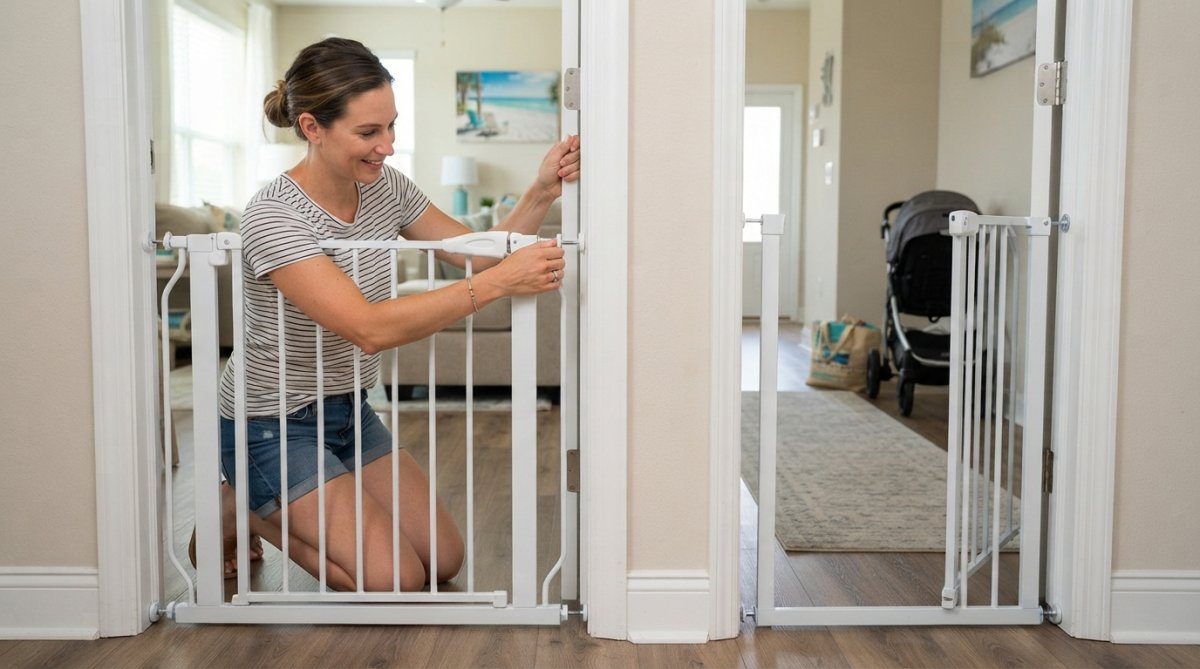
Pressure-mounted gates are the clear winner for temporary stays because they use tension bars instead of screws and brackets. You simply twist the frame to expand it between two walls or a doorway, and it stays put without leaving holes or damage. This matters enormously when you’re renting, most vacation rental agreements penalize you for wall damage.
Hardware-mounted gates require drilling into the wall frame and installing brackets with screws. They’re more secure, but they’re a non-starter for vacation rentals. You’d need landlord permission, patch the holes before you leave, and setup takes 20-30 minutes instead of 2-3.
Why Pressure-Mounted Gates Win for Temporary Stays
Pressure-mounted gates deliver zero-damage installation, which is non-negotiable when you’re staying somewhere you don’t own. Setup is genuinely simple: expand the frame until it’s snug, and it holds itself in place through tension. No tools. No drilling.
The trade-off is that pressure-mounted gates are slightly less rock-solid than hardware-mounted versions. A determined toddler might dislodge it, though most modern designs have safety stops that prevent collapse. For typical use, keeping your child out of the kitchen or off the stairs during a week-long beach trip, pressure-mounted gates are absolutely adequate.
Look for models with clear installation indicators that show when you’ve achieved proper tension.
Hardware-Mounted Gates: When They Make Sense
Hardware-mounted gates belong at home, where you own the walls and plan to keep the gate installed for months or years. They’re the only choice for stairways in permanent homes.
If you’re staying in a rental for an extended period and the landlord explicitly approves hardware installation, you could consider it. But you’d need to patch the holes before leaving. For vacation rentals on the First Coast, pressure-mounted is the way to go every time.
Lightweight Baby Gate for Travel: Portability That Actually Works
A portable baby gate under 5 pounds travels like a beach towel instead of a piece of furniture. Weight matters most if you’re flying with carry-ons only or renting a car without much trunk space. Jacksonville Airport and St Augustine Beach rentals often have limited storage, so a compact, light gate saves you from luggage stress.
The lightest models use aluminum frames instead of steel and skip extra features like walk-through gates. This isn’t a downgrade, it’s smart design for travel. You’re not creating a permanent nursery. You’re keeping your child safe for a week without adding packing stress.
Foldable gates collapse into a compact shape that fits in a standard suitcase. Retractable gates roll up like a window shade, saving even more space. Both let you pack the gate without dedicating an entire piece of luggage to it.
Retractable Baby Gate for Travel: The Expandable Solution
A retractable baby gate is essentially a mesh barrier on a spring-loaded roller system. You pull it across the opening, and it locks into place. To remove it, you lift the handle and it retracts back into compact housing.
Expandable retractable gates adjust to fit openings from about 24 inches to 40 inches wide, so they work in standard doorways throughout most vacation rentals. The mesh material is breathable, so your child can see through it and it won’t block light or views.
These gates are ideal if you’re traveling light and prioritize packability over maximum stability. They work beautifully for keeping a toddler contained in one room while you’re cooking. They’re less ideal if you need to block off a stairway, where you want maximum security.
Installation requires screwing the roller housing to one side of the doorway and the catch bracket to the other side. The holes are tiny, about the size of a drywall anchor, and you can patch them in 30 seconds with spackling compound before you leave.
Travel Baby Gate for Stairs vs. Doorways: Safety Standards That Matter
Stairway gates need to be rock-solid because a child falling down stairs is a serious injury risk. Doorway gates just need to keep a child out of a room, which is a lower safety threshold.
For stairways, you need a hardware-mounted gate with no gaps at the bottom or sides. The gate must be completely rigid. Pressure-mounted gates should never be used at the top of stairs because a child’s weight could dislodge them. At the bottom of stairs, pressure-mounted gates are acceptable, but hardware-mounted is safer.
For doorways, keeping a toddler out of the kitchen or away from the master bedroom, pressure-mounted and retractable gates are both fine.
JPMA & ASTM Certifications: Why They’re Non-Negotiable
JPMA (Juvenile Products Manufacturers Association) certification and ASTM (American Society for Testing and Materials) standards ensure that a baby gate has been tested for safety. These aren’t optional. They’re the difference between a gate that’s been rigorously tested and one that hasn’t.
JPMA-certified gates have passed tests for stability, durability, and gap width. ASTM standards (particularly ASTM F406) specify that gates must be at least 22 inches tall, have no openings larger than 6 inches that a child’s head could fit through, and meet specific load-bearing requirements.
When evaluating portable baby gate options, always check for these certifications. If a gate doesn’t mention JPMA or ASTM compliance, it’s a red flag.
Stairway Safety: What Makes a Gate Truly Secure
Stairway gates need to be hardware-mounted because they must be completely immovable. A child throwing their weight against a gate at the top of stairs could cause a fall, so the gate has to be anchored to the wall frame itself.
The gate should have no gaps at the bottom and a walk-through latch, which means you can open it one-handed while holding your child. Pressure-mounted gates don’t have this feature, which is another reason they’re not suitable for stairs.
Childproofing Your Vacation Rental: Real-World Setup Tips
Setting up a baby gate in a vacation rental is straightforward with a few practical steps.
First, walk through the rental when you arrive and identify where you need barriers. Most families gate off the kitchen (to keep toddlers away from hot stoves) or use a gate to confine the child to a safe room while unpacking.
Second, measure your doorways before you arrive. Most doorways are 28-32 inches wide, which fits standard travel gates. Knowing your rental’s dimensions lets you confirm your gate will fit before packing.
Third, check the doorway surface. Pressure-mounted gates work best on smooth, flat walls. If the trim is uneven or the walls are textured, the gate might not sit flush. You might need shims (thin wedges) to create an even surface.
Installation Indicators & User-Friendly Setup
The best travel gates have clear visual indicators that show when you’ve achieved proper tension. Some gates have a colored stripe that appears when fully extended. Others have a click mechanism that audibly locks into place. These features take the guesswork out of installation.
User-friendly setup means you can install the gate in under 3 minutes, even if you’re tired from travel.
Common Fail Scenarios & How to Avoid Them
The most common failure is installing a pressure-mounted gate too loosely. Check the tension throughout the day and re-tighten if needed.
The second common failure is installing a gate in a doorway that’s slightly too wide. Always measure before you buy, and if you’re between sizes, go with the larger gate model.
The third failure is underestimating how much your child has grown. A gate that was 28 inches tall when your child was 18 months might be too short now. Check the gate height and your child’s current reach before you travel.
TSA Travel & Airline Logistics: Getting Your Gate to Your Destination
If you’re flying to Jacksonville Airport or taking a road trip to St Augustine, you need to know how to pack and transport your baby gate.
Pressure-mounted and retractable gates are TSA-approved for carry-on luggage because they have no sharp edges and no components that could be used as weapons. You can pack them in your carry-on bag without any issues.
For checked baggage, there are no restrictions on baby gates. If you’re checking a larger gate, it counts as part of your luggage allowance, so make sure you have room.
The real logistics question is whether you want to travel with the gate at all. Many families rent gear instead of traveling with it. Rather than packing a gate, dealing with TSA questions, and managing it through your vacation, you can have a spotless, thoroughly sanitized gate delivered directly to your rental in St Augustine, Jacksonville Beach, Vilano, Ponte Vedra, Fernandina, Amelia Island, or surrounding areas on the First Coast. It’s set up and ready to use when you arrive, and it’s picked up when you leave. You travel light, and your child stays safe.
How First Coast Baby Rentals Makes Gate Setup Stress-Free
Traveling with babies is logistically complex. You’re managing car seats, strollers, high chairs, pack-and-plays, and now you’re thinking about whether to pack a baby gate. Each piece of gear adds weight, takes up luggage space, and requires setup when you arrive exhausted at your vacation rental.
First Coast Baby Rentals solves this by delivering spotless, thoroughly sanitized, and often brand-new baby gates directly to your rental. You don’t pack it. You don’t worry about whether it fits your doorways. You don’t spend 20 minutes reading instructions at 6 p.m. when you’re hungry and your toddler is cranky.
Our team handles the delivery and setup. We arrive at your rental, install the gate exactly where you need it, show you how it works, and make sure it’s secure. We’ve worked with hundreds of families vacationing on the First Coast, and we understand the unique challenges of childproofing temporary homes.
Every gate we rent is sanitized and inspected before every delivery. You’re getting equipment that meets safety standards and looks brand-new.
We also accommodate last-minute reservations. If you booked your vacation rental and suddenly realized you need a gate, we can often deliver within 24 hours. And if your vacation gets extended because of weather or a change in plans, you can extend your rental without hassle.
The comparison is straightforward: you can spend time packing, TSA screening, and setup, or you can book a gate from First Coast Baby Rentals and spend that time enjoying your family vacation. We deliver to St Augustine, Jacksonville Airport, Jacksonville, St Augustine Beach, Vilano, Ponte Vedra, Fernandina, Amelia Island, Jacksonville Beach, and surrounding areas throughout Northeast Florida.
Frequently Asked Questions
What's the safest portable baby gate for stairs during a vacation?
Look for gates with JPMA certification and ASTM standards compliance, these meet rigorous safety testing. For stairs, hardware-mounted gates are safest because they're permanently secured. Pressure-mounted gates work for doorways and temporary barriers, but avoid using them on stairs. Check the gate's barrier height and locking mechanism strength. If you're staying in Northeast Florida, First Coast Baby Rentals delivers sanitized, certified gates ready to install at your St. Augustine or Jacksonville Beach rental.
Are pressure-mounted gates actually safe for travel, or should I stick with hardware-mounted?
Pressure-mounted gates are absolutely safe, when used correctly. They're ideal for travel because they require no tools or drilling. Use them for doorways and room dividers, not stairs. Hardware-mounted gates offer more permanent security but require installation and leave holes. For vacation rentals where you can't damage walls, pressure-mounted is your best bet. Always check the installation indicator to confirm the gate is properly secured before letting your toddler near it.
How do I know if a lightweight baby gate for travel will actually fit my rental's doorways?
Measure your doorway width before booking. Most expandable travel gates adjust from 24 to 42 inches wide, but check the product specs. Bring a measuring tape or use a smartphone app. Some gates have adjustable width settings with clear markings. If you're renting in Jacksonville, Ponte Vedra, Fernandina, or Amelia Island and worried about fit, First Coast Baby Rentals can help you choose the right gate for your specific rental, no guessing required.
What makes a retractable baby gate better than a regular expandable one for travel?
Retractable gates roll up or collapse into a compact form, taking up almost no luggage space. Expandable gates are wider when extended but fold more simply. Retractable models are better if you're flying with carry-ons only. Both offer sturdy construction and adjustable width. The real advantage is portability, retractable gates weigh less and pack smaller. For traveling parents flying into Jacksonville Airport, a retractable option means one less bag to worry about.
How do I childproof a vacation rental if it has unusual doorway sizes or open layouts?
Start by measuring all potential hazard areas, stairways, kitchen entrances, deck access. For unusual sizes, look for gates with maximum expandability. Some rentals have wide openings that need two gates or a play yard alternative. Document the rental's layout with photos before arrival. For tricky setups in St. Augustine Beach, Vilano, or other First Coast locations, contact First Coast Baby Rentals, they know local rental properties and can recommend the right solution and deliver it set up and ready.
This article was written using GrandRanker