Table of Contents
- Why Traveling Light with Baby in Florida Changes Everything
- Your Complete Packing List for Florida with Baby
- Baby Gear Rental Florida: Skip the Checked Bags Entirely
- Gulf Coast vs. Atlantic Coast: Choosing the Right Florida Beach for Your Baby
- Best Baby Carrier for Disney World and Florida Theme Parks
- Real-Time Traffic and Crowd-Avoidance Hacks for Florida Family Travel
- How to Travel Light with Baby in Florida: Stress-Free Logistics from Airport to Beach
- Conclusion
Last Updated: May 28, 2026
Packing for a Florida vacation with a baby sounds simple until you’re standing at the airline counter, staring down three checked bags, a stroller travel bag, and a car seat box. The good news: you can absolutely travel light with baby Florida style, and it changes the entire trip. First Coast Baby Rentals has helped hundreds of families arriving in Northeast Florida ditch the gear mountain and show up with nothing but a carry-on, knowing everything they need is already waiting at their rental. Below, we’ll show you exactly how to pack smarter, pick the right beach, dodge the crowds, and keep your sanity from the airport to the shoreline.
Here’s what most guides get wrong: they tell you what to bring, not what to skip. The real strategy is knowing which items you can rent locally, which ones your baby actually needs, and which ones you’ve been guilted into packing by well-meaning parenting forums.
Why Traveling Light with Baby in Florida Changes Everything
Traveling light with baby in Florida is the single biggest quality-of-life upgrade a parent can make before a trip. Heavy gear means checked bag fees, carousel anxiety, car seat damage claims, and arriving at your vacation rental exhausted before the fun starts.
The Sunshine State’s heat adds another layer. Hauling a bulky stroller through a parking lot in 90-degree humidity while holding a sweaty, overtired baby is nobody’s idea of a stress-free getaway. The families who arrive with one carry-on each and a lightweight beach wagon waiting at the door? They’re already at the pool.
There’s also the logistics math. A typical family traveling with a baby often packs a crib, high chair, stroller, car seat, and beach gear. That’s potentially five pieces of additional luggage. Renting locally eliminates all of it. You check in faster, you’re not white-knuckling it through baggage claim, and you’re not paying to ship gear that might arrive damaged.
The resort-first strategy works here too. Book your vacation rental first, then build your gear list around what’s already available locally. This approach consistently reduces both packing stress and travel cost for families visiting spots like Saint Augustine, Ponte Vedra, and Amelia Island.
The shift from “bring everything” to “rent what you need” is the single most effective change families can make. Arrive lighter, start your vacation immediately, and skip the gear logistics entirely.
Your Complete Packing List for Florida with Baby
What to Pack vs. What to Skip (and Rent Instead)
A smart packing list for Florida with baby separates items into two columns: what you genuinely need on the plane, and what makes more sense to rent at your destination. Most parents dramatically overestimate the first column.
Pack these (carry-on or personal item):
- Diapers for travel day plus two buffer days
- Formula or nursing supplies
- Baby’s favorite comfort item (the one non-negotiable)
- Two changes of clothes per day, plus two extras
- Sunscreen, baby-safe insect repellent, and a sun hat
- Portable sound machine (fits in a diaper bag)
- Baby carrier for airport navigation
- Medications and first aid basics
Skip these (rent instead):
- Full-size stroller
- Pack n play or travel crib
- High chair
- Beach wagon
- Baby beach tent or sun shade
- Jumper or activity center for the rental house
The logic is simple. A full-size stroller weighs 20-30 pounds, takes up half a car trunk, and costs $50-100 to check each way. A stroller rental in Saint Augustine costs a fraction of that and arrives clean, inspected, and ready to go.
According to TSA’s official guidance on traveling with children, car seats and strollers can be checked for free on most airlines, but they’re also among the most frequently damaged items in baggage handling. Renting a car seat in Jacksonville or Saint Augustine eliminates that risk entirely.
Neurodivergent-Friendly Packing: Sensory and Comfort Essentials
Traveling with a baby or toddler who has sensory sensitivities requires a different packing calculus. The standard advice doesn’t account for the fact that a new environment, unfamiliar sounds, and disrupted routines can turn a beach vacation into a genuinely difficult experience.
The goal is sensory continuity: keeping as many familiar elements as possible while reducing environmental overwhelm.
Prioritize these items for neurodivergent travelers:
- Familiar sleep surface (request a specific crib model from your rental service so it matches home)
- Noise-canceling baby earmuffs for airports, theme parks, and crowded beaches
- Familiar-scented comfort items, like a pillowcase from home
- Chewy or tactile toys that are part of the daily routine
- A visual schedule in simple picture format for older toddlers
- Blackout travel curtain panels (lightweight, folds flat)
The mid-day reset window matters even more for sensory-sensitive children. Plan your itinerary around a guaranteed two-hour break at the rental, not a nap in a stroller at a theme park. Shallow, quieter beaches like the Vilano Beach area near Saint Augustine tend to work better than high-traffic resort beaches.
Request your rental crib in the same model your baby uses at home. First Coast Baby Rentals carries multiple crib models and can often match your home setup, which dramatically improves sleep quality in a new environment.
Baby Gear Rental Florida: Skip the Checked Bags Entirely
Baby gear rental in Florida is the most practical decision a traveling family can make, and it’s worth understanding what separates a good rental service from a mediocre one. The difference isn’t just convenience; it’s the condition of the gear your baby actually sleeps in and sits in.
First Coast Baby Rentals delivers sanitized, inspected equipment directly to your vacation rental in Saint Augustine, Jacksonville Beach, Ponte Vedra, Amelia Island, Fernandina Beach, Nocatee, and surrounding areas. Every item is cleaned before each delivery, and many pieces are brand new. The service accommodates last-minute reservations, which matters when your travel plans shift.
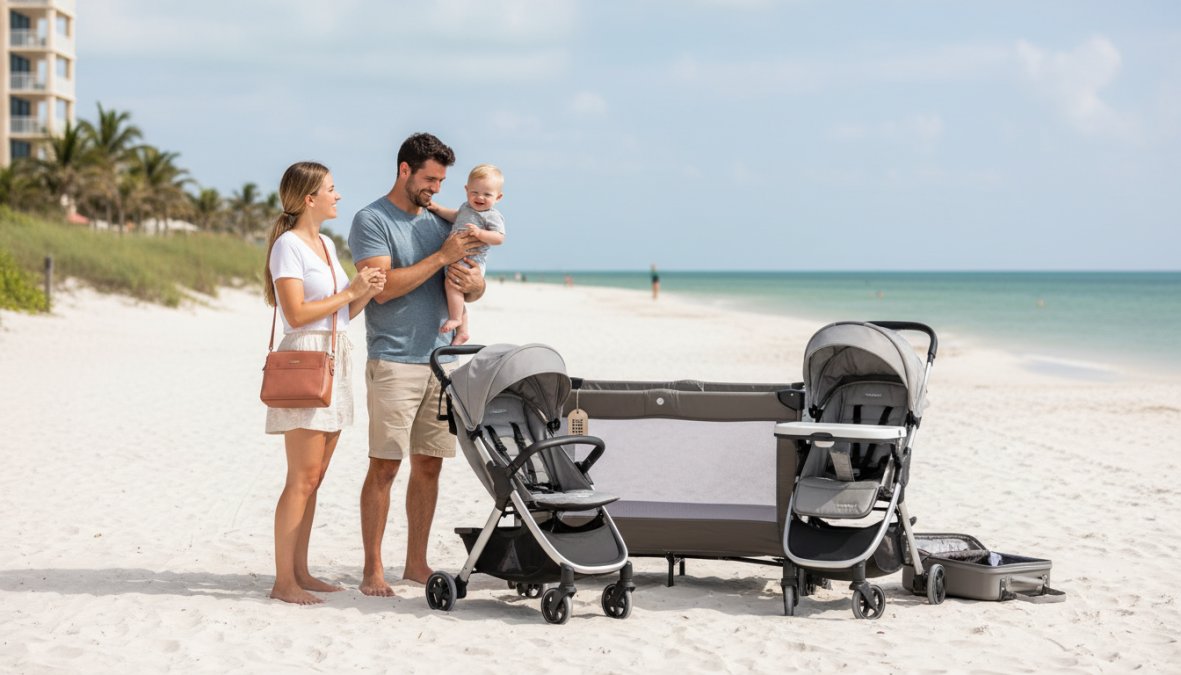
What makes this approach genuinely different from hauling your own gear: the equipment is set up before you arrive. You walk in, your baby’s sleep space is ready, the high chair is at the table, and the beach wagon is by the door. That’s the actual vacation starting the moment you check in.
According to AAP safe sleep guidelines for infants, babies should sleep on a firm, flat surface in a safe sleep environment. Renting from a service that inspects and sanitizes equipment before every delivery directly supports that standard, versus using a dusty pack n play from a vacation rental closet.
If weather turns, First Coast Baby Rentals also offers rental extensions, so you’re not rushing to return gear when a storm rolls through.
What to Expect from a Quality Baby Gear Rental Service in Northeast Florida
A quality baby gear rental service in Northeast Florida does four things consistently: delivers on time, provides clean equipment, sets everything up, and communicates clearly. Anything less is not worth the trade-off over bringing your own gear.
Here’s what to confirm before booking any rental service near you:
- Sanitation process: Ask specifically how items are cleaned between rentals. Look for services that inspect and sanitize every item before each delivery, not just between customers.
- Equipment age and condition: Brand-new or near-new gear is the standard to expect. Worn straps, faded fabrics, and outdated models are red flags.
- Delivery window: Confirm whether they deliver to your specific area. First Coast Baby Rentals covers Jacksonville Airport (car seat rental at JAX is available), Saint Augustine Beach, Vilano, Fernandina, and more.
- Last-minute availability: Travel plans change. A service that can accommodate same-day or next-day requests is worth prioritizing.
- Setup included: Equipment should be assembled and ready when you arrive, not left in boxes.
Gulf Coast vs. Atlantic Coast: Choosing the Right Florida Beach for Your Baby
Florida’s two coastlines feel completely different, and that difference matters enormously when you’re traveling with a baby. Choosing the wrong coast, or the wrong specific beach on the right coast, can turn a relaxing trip into a logistical headache before you’ve even unloaded the car.
The broad comparison is well-known: Gulf Coast water is calmer and warmer, Atlantic Coast beaches are wider and less crowded. But that framing is too coarse to be useful when you’re managing a baby in a sun hat who has a 90-minute window before a meltdown. What actually matters is water entry depth, shade availability, parking proximity, and crowd timing, and those vary dramatically even between beaches on the same coast.
Gulf Coast: What It Actually Looks Like with a Baby
The Gulf Coast’s signature is its shallow, warm, calm water. At beaches like Clearwater Beach and Fort Myers Beach, the water stays ankle-to-knee depth for 20 to 40 feet from the shoreline, which is genuinely ideal for babies who are just beginning to experience the ocean. The wave action is minimal enough that you can set a sitting baby at the waterline without worrying about a wave knocking them over.
The trade-offs are real and worth naming:
- Crowds: Clearwater Beach is one of the most visited beaches in the United States. In peak season (March through August), parking can fill by 9 AM. Arriving with a baby, a beach wagon, and a full setup after 9:30 AM on a weekend means a long walk from overflow parking in heat.
- Drive time from Northeast Florida: From Jacksonville or Saint Augustine, reaching Clearwater takes 3 to 3.5 hours on a good traffic day. That’s a significant commitment with a baby who has a finite tolerance for car travel.
- Jellyfish season: The Gulf Coast experiences periodic jellyfish blooms, particularly in summer. Check local beach condition reports before a Gulf-side trip with a baby who will be sitting at the waterline.
Better Gulf Coast options for families who want calm water without Clearwater’s crowd density:
- Caladesi Island State Park (Dunedin): Accessible only by ferry or kayak, which naturally limits crowds. The water is exceptionally calm and the beach is wide. The ferry ride itself is a low-friction activity babies tend to enjoy.
- Lovers Key State Park (Fort Myers Beach area): Less trafficked than the main Fort Myers Beach strip, with a tram from the parking area to the beach that eliminates the gear-hauling walk.
- Coquina Beach (Bradenton Beach): Wide, flat, and significantly less crowded than Siesta Key or Clearwater, with a large parking area and restroom facilities close to the waterline.
Atlantic Coast: What It Actually Looks Like with a Baby
The Atlantic Coast beaches of Northeast Florida, Saint Augustine Beach, Vilano Beach, Jacksonville Beach, Ponte Vedra, Amelia Island, offer a different operational profile. The waves are more active than the Gulf, but they are manageable for babies when you choose the right entry point and time of day.
The Atlantic side’s practical advantages for families with babies:
- Drive-on beach access: Saint Augustine Beach and several Jacksonville-area beaches allow vehicles on the sand. This is not a minor convenience, it means your gear goes from the car to the umbrella in one trip, with no wagon haul across soft sand in 90-degree heat.
- Width and space: Atlantic Coast beaches in Northeast Florida are wide, firm, and rarely feel crowded outside of holiday weekends. You can set up 50 feet from the nearest family without effort.
- Morning conditions: Atlantic-side beaches in Northeast Florida typically have their calmest wave conditions in the early morning, which aligns perfectly with the optimal baby beach window (8 to 10:30 AM before heat peaks).
- Proximity to vacation rentals and gear rental services: If you’re using a baby gear rental service based in Saint Augustine or Jacksonville, the Atlantic Coast is where your equipment is already positioned.
Beach-by-beach breakdown for Northeast Florida:
| Beach | Water Entry | Crowd Level | Drive-On Access | Best For |
|---|---|---|---|---|
| Saint Augustine Beach (main) | Moderate waves, gradual slope | Moderate | Yes | Families with toddlers, drive-on convenience |
| Vilano Beach | Calmer, more sheltered | Low | Yes | Infants, first beach trips, quiet setup |
| Ponte Vedra Beach | Moderate waves, firm sand | Low-moderate | No | Walking, shelling, older babies |
| Amelia Island (Main Beach) | Moderate, wide surf zone | Low | Limited | Space, privacy, nature-focused families |
| Jacksonville Beach (main) | Active waves, pier area busy | High on weekends | No | Families comfortable with more activity |
| Neptune Beach | Moderate, residential feel | Low-moderate | No | Quieter alternative to Jacksonville Beach |
Vilano Beach deserves specific attention. It sits just north of Saint Augustine across the Vilano Bridge and is consistently one of the lowest-crowd, most stroller-and-wagon-friendly beaches in Northeast Florida. The beach is wide, the wave action is gentler than the main Saint Augustine Beach strip, and drive-on access means zero gear-hauling distance. For families with infants on their first beach trip, Vilano is the practical first choice on the Atlantic side.
The Timing Variable That Changes Everything
Coast choice matters less than timing choice for families with babies. Both coasts become significantly more difficult to manage between 11 AM and 3 PM in summer, when heat index values peak and babies are most vulnerable to overheating.
The optimal Atlantic Coast baby beach day in Northeast Florida:
- 7:30 to 8 AM: Load the car. Drive-on beach access means you can park directly on the sand.
- 8 to 10:30 AM: Beach time. Morning light is softer, temperatures are manageable, and crowds are minimal. This is when the water is calmest on the Atlantic side.
- 10:30 to 11 AM: Pack up before the heat peaks. Baby is fed, sandy, and ready for a nap.
- 11 AM to 2 PM: Mid-day reset at the vacation rental. Nap, lunch, air conditioning.
- 4 to 6:30 PM: Return to the beach or explore Saint Augustine’s historic district. Evening temperatures are significantly lower, the light is beautiful, and the crowds have thinned.
This rhythm is not a compromise, it’s the structure that makes the whole day work. Families who try to push through the mid-day heat window with a baby consistently report it as the point where the trip went sideways.
Sensory Considerations by Beach Type
For babies and toddlers with sensory sensitivities, the beach environment itself is a significant variable. Loud surf, unfamiliar textures, and bright reflected light can overwhelm a child who handles everyday environments well.
- Firm, wet sand near the waterline is generally easier for sensory-sensitive babies than deep, soft dry sand, which can feel destabilizing underfoot.
- Vilano Beach and Ponte Vedra both have firmer sand than the powdery Gulf Coast beaches, which can actually be easier for babies who are bothered by the sensation of sinking.
- Noise-canceling baby earmuffs are worth packing for any beach trip with a sensory-sensitive child. The combination of wave noise, wind, and other beachgoers can be genuinely overwhelming at higher-traffic beaches.
- Arrive before 9 AM at any beach if sensory overload is a concern. The beach at 8 AM is a fundamentally different sensory environment than the beach at noon.
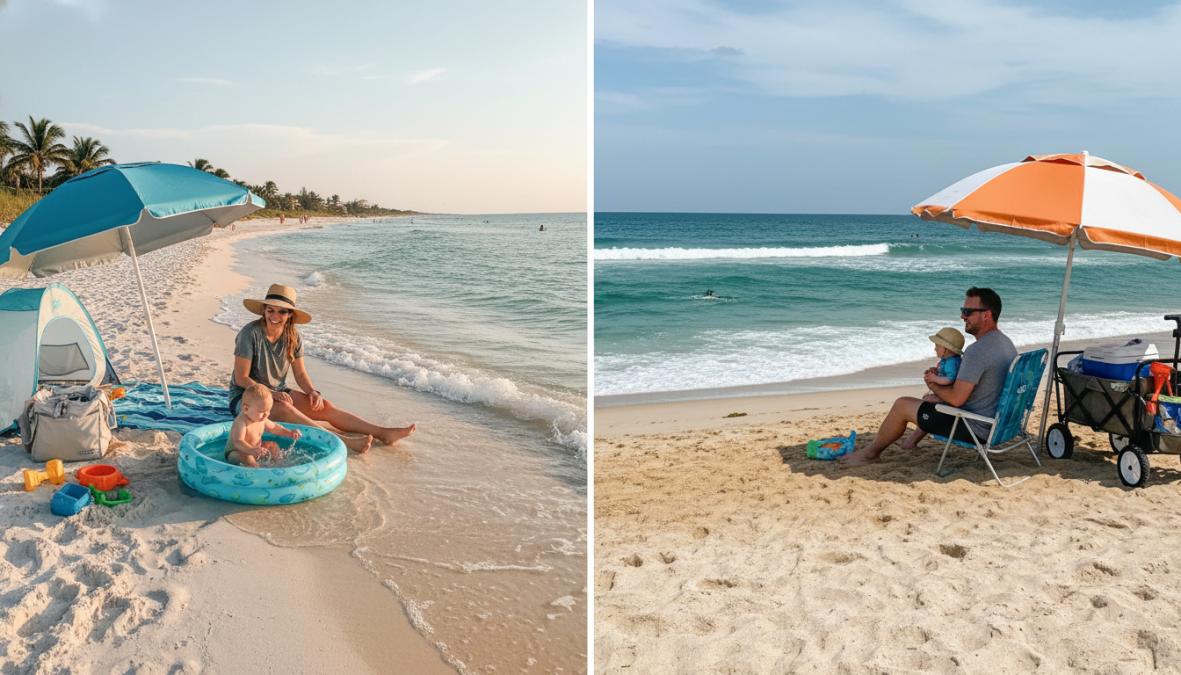
For families flying into Jacksonville International Airport, the Atlantic Coast is the operationally correct choice. You are 45 minutes from Saint Augustine Beach and 30 minutes from Jacksonville Beach. Adding a 3-hour drive to reach the Gulf Coast adds a full travel day to a trip that is already logistically complex with a baby.
The coast decision is really a logistics decision. Gulf Coast water is calmer, but the drive from Northeast Florida is long and the best beaches are crowded. Atlantic Coast beaches in Northeast Florida, especially Vilano Beach and Ponte Vedra, offer wide, low-crowd, drive-on access that is operationally superior for families using Jacksonville as their entry point. Time your beach sessions for 8 to 10:30 AM regardless of which coast you choose.
Best Baby Carrier for Disney World and Florida Theme Parks
The best baby carrier for Disney World and Florida theme parks is a structured soft carrier with lumbar support, padded hip belt, and full mesh ventilation, but choosing the right carrier is only half the decision. The other half is knowing exactly when to use it, when to switch to a stroller, and how to manage the heat before it becomes a safety issue.
Florida’s theme parks are not just hot. They are hot, humid, and physically enormous. Magic Kingdom alone covers 107 acres. A single day at EPCOT can mean 6 to 8 miles of walking. A carrier that works well for a 90-minute farmer’s market will feel like a punishment by hour four in August heat.
The Carrier-Stroller Split Strategy
The families who manage theme park days best don’t choose between a carrier and a stroller, they use both, strategically. The stroller handles transit between lands and serves as a mobile base for gear, snacks, and a sleeping baby. The carrier takes over the moment you enter a queue.
Disney World’s queue lines are explicitly not stroller-friendly. At most attractions, you’ll park the stroller in a designated area outside the queue entrance, carry your baby through the entire line, retrieve the stroller on exit, and repeat. On a busy day, that cycle happens 8 to 12 times. A carrier worn loosely around your waist, ready to clip on in 30 seconds, is the operational solution.
Universal Orlando’s queue design is similar, with the added complication that many of its most popular rides have strict height requirements that make them irrelevant for infants anyway. For families with babies under 12 months, Universal is better treated as a half-day walking experience than a full park day.
What to Look for in a Florida Theme Park Carrier
- Full mesh or perforated fabric panels: This is non-negotiable for Florida heat. Woven cotton carriers trap heat against both the wearer and the baby. Look for carriers marketed specifically for warm-weather use.
- Hip and lumbar support with a structured waistband: You are carrying 15 to 25 pounds for hours. A waistband that transfers weight to your hips rather than your shoulders is the difference between finishing the day and tapping out at 2 PM.
- Tool-free adjustment: You will be putting this carrier on and taking it off repeatedly. Buckle systems with single-handed adjustment beat wrap-style carriers for park use.
- Front and back carry options: Front carry for infants who cannot yet support their own head. Back carry for toddlers 6 months and older with good head control, which frees your sightlines and reduces heat buildup on your chest.
- Carrier weight rating that matches your child now and in six months: If you’re traveling with a 14-pound infant, buy for the 22-pound toddler they’ll be by your next trip.
Heat Management Is a Safety Issue, Not a Comfort Issue
Florida’s heat index regularly exceeds 100°F from June through September. A baby worn against an adult body in a non-ventilated carrier is exposed to both ambient heat and the adult’s body heat simultaneously. Overheating in infants can escalate quickly and is not always obvious until the baby is already symptomatic.
Practical heat management in a carrier at a Florida theme park:
- Check the heat index before you leave the hotel, not just the temperature. A 91°F day with 80% humidity has a heat index above 103°F. That changes your timeline.
- Use a clip-on stroller fan directed at the baby when in the carrier. Battery-powered fans are inexpensive, lightweight, and make a measurable difference.
- Apply a cool damp cloth to the back of the baby’s neck every 30 to 45 minutes during peak heat hours (11 AM to 3 PM).
- Schedule your carrier-heavy hours for morning. Use the carrier from park open until about 10:30 AM, transition to the stroller for midday, and return to the carrier for late afternoon when temperatures begin to drop.
- Know the cooling station locations before you go. Disney World’s First Aid stations are air-conditioned and stocked with basic supplies. They are located in every park and are not just for emergencies, they are legitimate mid-day reset points.
Avoid ring slings and stretchy wraps for full theme park days. They lack the structure for extended wear and concentrate heat at the front of the wearer’s torso. After two hours in Florida summer conditions, improper positioning becomes a real risk as the fabric stretches and the baby’s weight shifts downward. Reserve these carriers for shorter, lower-intensity outings.
Theme Park Alternatives That Eliminate the Carrier Problem Entirely
For families with babies under 9 months, the honest answer is that Disney World and Universal are not optimized for your age group. The rides your baby qualifies for are limited, the sensory environment is intense, and the logistics cost is high.
The alternatives that actually work better for this age group in Central Florida:
- Legoland Florida (Winter Haven): Specifically designed for ages 2 to 12, with gentler rides, lower crowds, and a layout that is significantly more stroller-friendly than Disney or Universal.
- Florida Aquarium (Tampa): Fully stroller-accessible, climate-controlled, and genuinely engaging for babies who are in the visual tracking and cause-and-effect developmental stage.
- Homosassa Springs Wildlife State Park: A real Florida wildlife experience, manatees, native birds, Florida panthers, at a fraction of the cost and with none of the queue complexity. Stroller-friendly paths throughout.
- Silver Springs State Park: Glass-bottom boat tours that require no carrier, no queue management, and no heat exposure beyond the boat ride itself.
For families flying into Jacksonville and staying in Northeast Florida, the theme park question is largely moot. Saint Augustine’s Castillo de San Marcos, the Fountain of Youth Archaeological Park, and the historic district’s pedestrian zones offer genuinely engaging half-day experiences that are stroller-friendly, low-cost, and don’t require a carrier strategy at all.
Babywearing International’s carrier safety guidelines
The carrier decision for Florida theme parks is really a heat management and logistics decision. Use a full-mesh structured carrier for queue navigation, pair it with a stroller for transit, and schedule your carrier-heavy hours before 11 AM. For babies under 9 months, consider whether a theme park day is the right choice at all, Florida’s state parks and aquariums offer comparable engagement with a fraction of the logistical complexity.
Real-Time Traffic and Crowd-Avoidance Hacks for Florida Family Travel
Florida traffic is genuinely unpredictable, and most travel guides ignore it entirely. I-95 between Jacksonville and Saint Augustine can run perfectly or become a parking lot with no warning. I-4 near Orlando is consistently among the most congested corridors in the country.
The families who navigate this best treat traffic avoidance as part of their itinerary, not an afterthought.
Practical crowd and traffic hacks:
- Use Waze, not Google Maps, for Florida highways. Waze updates incident reports faster and reroutes more aggressively on I-95 and I-4.
- Travel Tuesday through Thursday. Weekend arrivals and departures on Florida’s major corridors can add 45-90 minutes to any drive.
- Avoid the 3-5 PM window on I-95 southbound. This is peak congestion between Jacksonville and Saint Augustine, especially on Fridays.
- Book vacation rentals within 10 minutes of your primary beach. The fewer drives per day, the better your trip goes with a baby.
- Check Disney World crowd calendars before booking theme park days. The difference between a slow day and a peak day is measured in hours of queue time.
- Use Jacksonville International Airport (JAX) for Northeast Florida trips. It’s significantly less congested than Orlando International and puts you 45 minutes from Saint Augustine.
Planning Around Mid-Day Reset Windows
The mid-day reset is the most underused tool in family travel planning. Babies and toddlers who skip their midday rest become unmanageable by 3 PM, which is also when Florida beaches hit peak heat and crowds.
Structure your days around a guaranteed 11 AM to 2 PM window back at the rental. This isn’t a sacrifice; it’s the reason the rest of the day goes well. Morning beach time from 8-10:30 AM, back to the rental by 11, nap and lunch, then back out for late afternoon when temperatures drop and crowds thin.
This rhythm works especially well at Saint Augustine Beach, where morning tide conditions are often ideal for babies, and the historic district is pleasant for an evening stroll after the heat breaks.
How to Travel Light with Baby in Florida: Stress-Free Logistics from Airport to Beach
The full logistics chain of a Florida family trip has four pressure points: the airport, the car, the check-in, and the beach. Getting each one right is what separates a smooth trip from a chaotic one.
Travel light with baby Florida planning starts before you book anything. Map your logistics in this order: airport, rental car or transportation, vacation rental location, then gear rental delivery.
Airport Selection and Car Seat Strategy
Jacksonville International Airport (JAX) is the best entry point for Northeast Florida family travel. It’s smaller than Orlando International, the rental car center is close, and the drive to Saint Augustine Beach takes about 45 minutes with no traffic.
Car seat strategy is the most stressful part of flying with a baby for most parents. There are three options:
- Gate-check your own car seat. Free, but exposes the seat to baggage handling damage. Use a padded travel bag.
- Rent a car seat at your destination. Services like First Coast Baby Rentals offer car seat rental in Jacksonville and Saint Augustine, meaning you walk off the plane with nothing but your carry-on.
- Use a CODA or travel-specific car seat. Lightweight options like the Wayb Pico fold flat and fit in an overhead bin, but they’re expensive and not suitable for all ages.
For most families, option two is the cleanest solution. Car seat rental at JAX or Saint Augustine eliminates airport handling risk and means you’re not lugging a 15-pound seat through the terminal.
Budget-Friendly Ways to Reduce Travel Stress
Stress reduction doesn’t require a luxury resort budget. Many of the highest-impact changes cost nothing or very little.
- Book a vacation rental with a washer and dryer. This alone cuts your packing by 40%. You pack three days of clothes instead of seven.
- Order groceries delivered before you arrive. Services like Instacart deliver to most Saint Augustine and Jacksonville Beach vacation rentals. You arrive to a stocked fridge.
- Use splash pads instead of theme parks for toddlers. Saint Augustine and Jacksonville area splash pads are free or low-cost, require zero queue management, and toddlers genuinely prefer them to most theme park attractions.
- Choose vacation rentals near nature-based activities. Wildlife encounters at places like the Guana Tolomato Matanzas National Estuarine Research Reserve near Saint Augustine are free and genuinely memorable.
- Rent gear instead of buying travel-specific versions. A travel high chair costs $80-120 to buy. Renting one for a week costs a fraction of that.
The budget-friendly stress reduction framework is straightforward: every dollar you spend reducing friction (laundry access, grocery delivery, local gear rental) pays back in hours of actual vacation time. Every dollar spent on gear you’ll use once and store in a closet is a net loss.
According to U.S. Travel Association’s family travel research, family travel is one of the fastest-growing segments in domestic tourism. The families who report the highest satisfaction consistently cite reduced logistics complexity as a primary factor.
The most effective budget move for Florida family travel is renting gear locally instead of buying travel-specific versions. It reduces packing, eliminates airline fees, and costs less than purpose-built travel equipment.
Traveling with a baby doesn’t have to mean arriving exhausted before the vacation starts. The families who enjoy Florida most are the ones who show up light, with their gear already waiting and their first morning already planned. First Coast Baby Rentals delivers sanitized, inspected baby and beach equipment directly to vacation rentals across Saint Augustine, Jacksonville Beach, Ponte Vedra, Amelia Island, Fernandina Beach, and surrounding areas, with setup included and last-minute reservations welcome. Reserve your gear before your trip and walk into your rental ready to start the vacation immediately.
Frequently Asked Questions
What baby gear should I rent in Florida to save space?
The bulkiest items, full-size cribs, pack n plays, high chairs, strollers, and beach wagons, are the best candidates for baby gear rental in Florida. Renting locally means you fly with just a carry-on, skip baggage fees, and arrive without the physical strain of hauling gear through airports. Services like First Coast Baby Rentals in Northeast Florida deliver sanitized, often brand-new equipment directly to your vacation rental, already set up and ready to use.
Is it possible to travel to Florida with just a carry-on with a baby?
Yes, traveling light with baby in Florida is very achievable if you rent large gear locally. Pack only diapers for the flight, a few outfits, medications, and comfort items like a favorite toy or pacifier. Rent the crib, stroller, high chair, and beach equipment at your destination. This approach eliminates checked bags, reduces airport stress significantly, and makes the whole journey faster and easier for parents and babies alike.
Should I bring a stroller or a carrier for Florida theme parks?
For Disney World and other Florida theme parks, the best baby carrier is a structured ergonomic carrier, such as an Ergobaby or similar, for navigating crowds and standing in lines hands-free. However, a lightweight umbrella stroller is still useful for longer days when your baby needs to nap or you need a break. Many families rent a quality stroller locally for the Florida road trip portion and use a carrier specifically inside the parks where maneuverability matters most.
How do I pack for Florida's heat and humidity with a baby?
Focus on lightweight, breathable fabrics, cotton onesies, rash guards, and UV-protective swimwear. Pack fewer outfits than you think you need and plan to do a quick laundry mid-trip. Essentials include reef-safe sunscreen rated for infants, a wide-brim sun hat, a portable fan for the stroller, and a cooling towel. For your packing list for Florida with a baby, prioritize sun and heat protection over quantity of clothing, you can always rinse and reuse.
What are the best low-stress beaches in Northeast Florida for families with babies?
Northeast Florida's Atlantic Coast beaches, including St. Augustine Beach, Ponte Vedra, and Amelia Island, offer wide, uncrowded stretches of white sand that are ideal for toddler-friendly, low-friction beach days. These beaches tend to have calmer morning surf, ample parking, and easy access for beach wagons and gear. Staying close to your rental base in the St. Augustine area also reduces drive time, which is one of the most effective stress-free getaway strategies for families traveling with infants.
This article was written using GrandRanker