Table of Contents
- Why Traveling with an Infant to Florida Is Easier Than You Think
- Flying with an Infant Tips: What Every Parent Should Know Before Takeoff
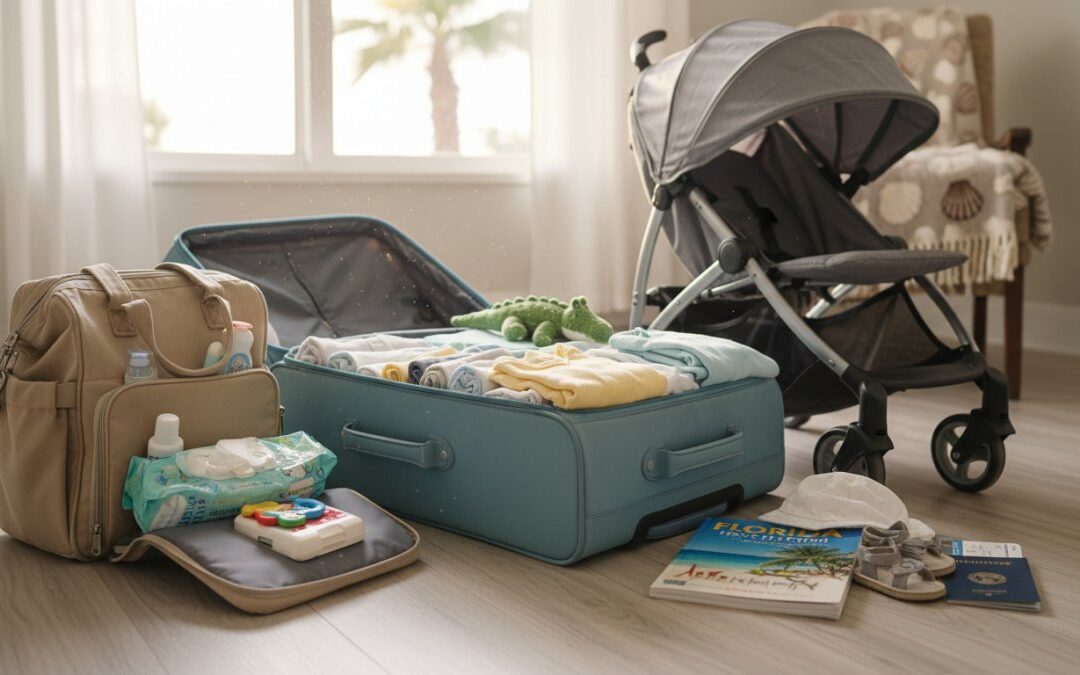
- Baby Travel Packing List for Florida: What to Bring and What to Skip
- Renting Baby Gear in Florida: How It Works and Why It Makes Sense
- Safety, Cleanliness, and Sanitization: What to Expect from a Reputable Rental
- Sun Protection for Babies in Florida: Keeping Your Little One Safe on the Beach
- Cost-Benefit Breakdown: Renting vs. Packing Baby Gear for Your Florida Trip
- Traveling with an Infant to Florida: Tips for a Smooth, Stress-Free Stay
- Conclusion
Last Updated: May 31, 2026
Traveling with infant to Florida is one of the most rewarding family trips you can plan, and it’s far less complicated than most first-time parents expect. At First Coast Baby Rentals, we’ve helped hundreds of families arrive at Northeast Florida’s beaches without a single checked bag full of baby gear, and the difference it makes to a family’s vacation is hard to overstate. Below, we’ll show you exactly how to plan your trip, what to pack, what to skip, and how renting baby equipment locally turns a stressful journey into a genuinely enjoyable one.
Here’s what most guides get wrong: they treat traveling with a baby as a logistics problem to solve. It isn’t. It’s a planning problem, and once you solve it once, you’ll wonder why you ever dreaded it.
Why Traveling with an Infant to Florida Is Easier Than You Think
Packing for a baby trip feels overwhelming until you realize most of what you think you need is already available at your destination. Florida is one of the most family-friendly states in the country, with vacation rentals, resorts, and beach towns built around families with young children. Saint Augustine, Jacksonville Beach, Ponte Vedra, Amelia Island, and Fernandina Beach all have the infrastructure to support families traveling with little ones.
The mental shift that changes everything: stop thinking about what your baby needs and start thinking about what your baby needs that you can’t get there. That list is much shorter than you think.
Infant travel is also more forgiving than parents expect on the flight side. Babies under two fly free as lap infants on most U.S. carriers, and most airlines offer early boarding for families. The real challenge isn’t the flight. It’s what happens after you land, when you’re tired, your baby is overstimulated, and you still have to set up a safe sleep environment before anyone can rest.
That’s the part worth planning carefully. Everything else is manageable.
Book your baby gear rental before you book your accommodations. Knowing what equipment will be delivered to your vacation rental lets you choose a property without worrying about whether it has a crib or high chair already.
Flying with an Infant Tips: What Every Parent Should Know Before Takeup
Flying with a baby for the first time feels like a high-stakes performance. The reality is that it’s mostly about timing and preparation, and both are within your control.
Feed your baby during takeoff and landing. Sucking and swallowing helps equalize ear pressure, which is the main source of infant discomfort during altitude changes. A bottle, breastfeeding, or even a pacifier works. This single tip prevents the majority of in-flight crying episodes that parents dread.
Book the earliest flight available. Early morning flights have fewer delays, less crowded airports, and tired babies tend to sleep through them. Afternoon flights, particularly on Fridays, are the worst option for traveling with little ones.
Bring more diapers than you think you need. A standard rule among experienced traveling parents is to pack twice as many as you’d normally use for the travel day, then add two more. Delays happen. Blowouts happen. Running out of diapers at 30,000 feet is a solvable problem only if you planned for it.
Pack a change of clothes for yourself in your carry-on. Not just for your baby. For yourself. You’ll thank yourself later.
Airline-Specific Gear Policies for Infant Travel You Need to Check
Airline policies on infant gear vary more than most parents realize, and the differences matter when you’re deciding what to bring versus what to rent locally.
According to FAA guidelines on child restraint systems in aircraft, the FAA recommends that children under 40 pounds use an approved child restraint system during flight rather than traveling as a lap infant. However, this requires purchasing a separate seat, which changes the economics of your trip significantly.
Key policies worth checking before you fly:
- Car seats on planes: Most FAA-approved car seats can be used on aircraft if you’ve purchased a seat for your child. Check the label for "FAA Approved for use in motor vehicles and aircraft." Not all car seats qualify.
- Gate-checking strollers: All major U.S. carriers allow stroller gate-checking at no charge. You leave it at the jetway and pick it up on arrival. This is standard, but each airline has size restrictions for gate check versus checked baggage.
- Bassinets on long flights: For international connections or longer domestic routes, many carriers offer bassinet seats in bulkhead rows. These must be reserved in advance and are first-come, first-served. If your Florida trip involves a connection, check this option.
- Checked bag fees for baby gear: Most airlines do not waive fees for checking a car seat or stroller separately from your regular baggage allowance. Confirm this before you pack.
The practical implication: if you’re flying into Jacksonville International Airport or flying out of Saint Augustine, renting a car seat locally eliminates the gate-check process entirely. Car seat rental near Jacksonville Airport is one of the most requested services for exactly this reason.
What to Do If Your Flight Is Delayed with a Baby
Flight delays with an infant require a different approach than delays without one. Your first move is to find a family restroom or nursing room in the terminal. Most major airports have them, and they’re significantly more comfortable for feeding and changing than standard restrooms.
Keep your baby’s schedule as intact as possible. If a delay pushes your flight past nap time, find a quiet corner away from gate announcements and treat it like a regular nap. Babies don’t know they’re in an airport. Darkness, white noise from a phone, and a familiar swaddle work just as well at gate B14 as they do at home.
Carry snacks for yourself. Delayed parents who haven’t eaten become stressed parents, and babies read parental stress quickly. A fed, calm parent handles a delay far better than a hungry, anxious one.
Baby Travel Packing List for Florida: What to Bring and What to Skip
A smart baby travel packing list for Florida is built around one principle: Florida’s heat changes everything. Items you’d pack for a mountain trip or a city visit become liabilities on a beach vacation.
Bring these without question:
- Lightweight muslin swaddles (double as beach blankets, nursing covers, and shade cloths)
- Portable sound machine
- Baby sunscreen rated SPF 50+ (more on this below)
- UV-protective swimwear and a wide-brim sun hat
- Enough formula or pumping supplies for the full trip plus one extra day
- Your baby’s regular sleep sack or preferred sleep environment items
- Waterproof changing pad
Skip these entirely:
- Full-size stroller (rent a BOB stroller or UPPAbaby locally, better suited for beach terrain)
- Travel crib (bulky, heavy, and unnecessary when a pack-n-play rental is available)
- High chair (available through rental services in Saint Augustine and surrounding areas)
- Baby bathtub (most vacation rentals have a sink or a regular tub that works fine)
The baby travel packing list for Florida gets shorter the more you lean on local rental services. Most families who’ve done this trip once arrive with a carry-on and a diaper bag. That’s the goal.
Do not pack your car seat in checked luggage without a hard-sided bag specifically designed for car seat travel. Baggage handling can damage harness systems and structural components in ways that aren’t visible but compromise safety. A damaged car seat should never be used.
Gear You Should Never Check at the Airport
Some baby gear is too important or too fragile to trust to baggage handlers. Car seats top this list. The plastic shell and harness system can sustain invisible structural damage that renders the seat unsafe, and airlines accept no liability for this.
Breast pumps, particularly electric ones, should travel in your carry-on. They’re considered medical devices by the TSA and do not count against your carry-on allowance on most carriers. Confirm this with your specific airline before travel day.
Medication, formula, and any specialized feeding equipment should always stay with you. A delayed or lost bag is an inconvenience for adults. For an infant on a specific formula, it’s an emergency.
Renting Baby Gear in Florida: How It Works and Why It Makes Sense
Renting baby gear in Florida is the single most effective travel hack available to parents traveling with infants. The concept is straightforward: instead of hauling a crib, stroller, high chair, and car seat through airports and into vacation rentals, you reserve the equipment before you arrive and find it set up and waiting when you walk through the door.
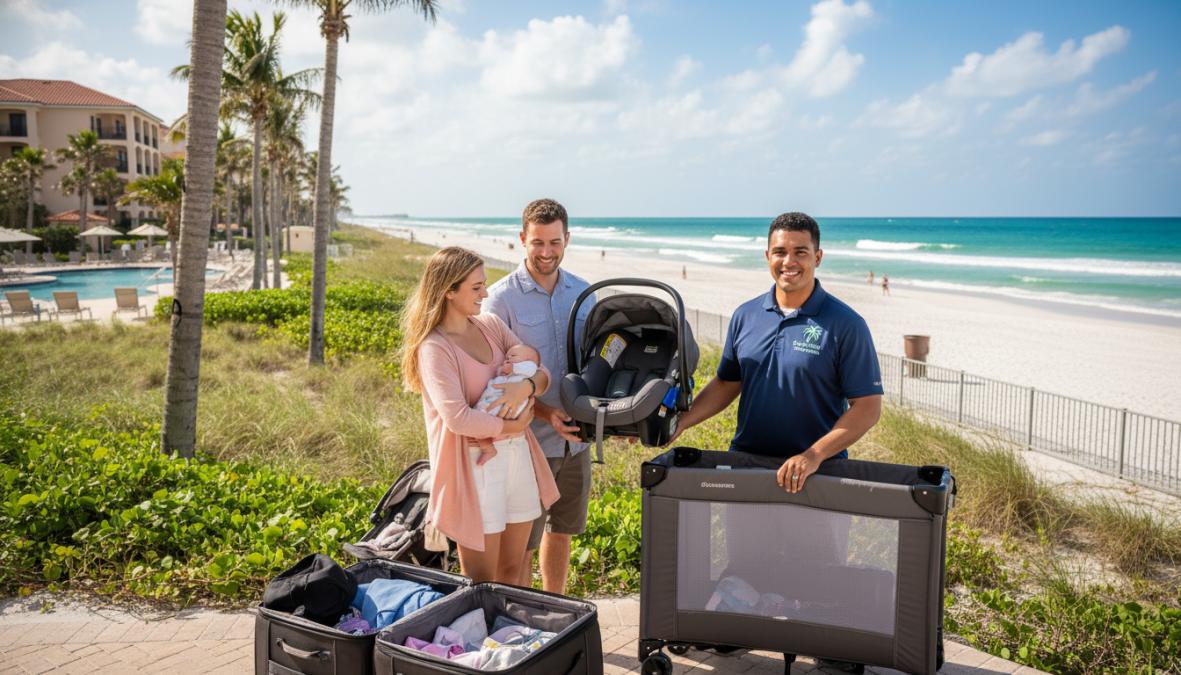
First Coast Baby Rentals delivers directly to vacation rentals across Northeast Florida, including Saint Augustine, Saint Augustine Beach, Vilano Beach, Ponte Vedra, Jacksonville Beach, Fernandina Beach, Amelia Island, Jacksonville, and areas like Nocatee. Equipment is sanitized, inspected, and often brand-new before every delivery. The gear is set up before you arrive, so your first task when you land isn’t assembly. It’s getting everyone settled.
The difference between arriving at a vacation rental with a crib already assembled versus arriving and building one yourself at 10pm after a travel day is not small. It’s the difference between a good first night and a terrible one.
According to AAP safe sleep guidelines for infants, infants should sleep in a firm, flat sleep surface with no soft bedding. A properly maintained rental crib meets these standards when sourced from a reputable provider that inspects and sanitizes equipment between uses.
What Gear Is Available to Rent in Northeast Florida
The rental inventory available through local baby gear services in Northeast Florida covers everything families typically need for a beach vacation:
| Gear Category | Examples Available |
|---|---|
| Sleep | Cribs, pack-n-plays, SNOO smart sleepers, Dock-a-Tots |
| Transportation | UPPAbaby strollers, BOB jogging strollers, Doona car seat/stroller combos, City Mini strollers, Nuna strollers |
| Car Safety | Infant car seats, convertible car seats (including for Jacksonville Airport pickup) |
| Beach | Beach wagons, beach tents, shade structures |
| Feeding | High chairs, booster seats |
| Bathing | Baby tubs, bathing seats |
Stroller rental in Saint Augustine is particularly popular for families visiting the historic district, where cobblestone streets make a quality jogging stroller worth the investment. For Amelia Island and Fernandina Beach, beach wagon rentals are among the most-requested items, since sand and stroller wheels are a poor combination.
Delivery, Setup, and Pickup: What the Process Looks Like
The process for renting baby equipment through a local Florida provider is designed to require as little effort from parents as possible.
- Reserve online before your trip, specifying your arrival date, rental duration, and delivery address.
- Coordinate delivery timing with your vacation rental check-in. Most providers, including First Coast Baby Rentals, accommodate last-minute reservations and can often arrange same-day delivery.
- Arrive to find gear assembled and ready to use. No unboxing, no instruction manuals, no missing parts.
- Extend if needed. Weather delays, extended stays, or simply not wanting to leave mean you can extend your rental period. This flexibility matters more than most families expect when a rainy week stretches a planned five-day trip into seven.
- Leave the gear in place. Pickup is handled after your checkout. You don’t carry anything out.
The entire process is designed around the idea that parents traveling with infants have enough to manage without adding equipment logistics to the list.
Safety, Cleanliness, and Sanitization: What to Expect from a Reputable Rental
Safety and hygiene are the first questions parents ask about renting baby gear, and they deserve a more specific answer than "we clean everything thoroughly." Most rental platforms stop at reassurance. This section goes further, explaining exactly what a rigorous sanitization protocol looks like, what questions to ask any provider, and what red flags to walk away from.
The Two-Stage Cleaning Standard: What Reputable Providers Actually Do
A meaningful sanitization protocol for infant gear has two distinct stages, and both matter:
Stage 1, Mechanical cleaning (removing biological material)
Sanitizing agents cannot work effectively on surfaces that still carry residue. Before any disinfection step, fabric components must be laundered and hard surfaces must be scrubbed to remove formula residue, skin oils, and organic matter. Skipping this step and going straight to a disinfectant spray is a common shortcut that leaves gear less clean than it appears.
Stage 2, Disinfection (killing pathogens on clean surfaces)
For hard surfaces, crib rails, high chair trays, stroller frames, the standard is a disinfectant rated effective against common infant-contact pathogens. For fabric components, mattress covers, harness straps, seat inserts, carrier padding, machine washing at appropriate temperatures followed by full drying is the baseline. Some providers use UV-C sanitization as an additional step for items that cannot be submerged or machine-washed.
The products used matter for a specific reason: many household disinfectants are not safe for infant contact surfaces. A responsible provider uses EPA-registered disinfectants that are cleared for use around children, or fragrance-free, dye-free formulations that do not leave chemical residue on surfaces a baby will mouth or press their face against.
When you book, ask your rental provider: “What specific products do you use to sanitize fabric components, and are they safe for infant skin contact?” A provider with a real protocol will answer this immediately. Vague answers like “we use safe cleaning products” are a yellow flag.
What a Crib Inspection Should Actually Cover
According to AAP safe sleep guidelines for infants, infants should sleep on a firm, flat surface with no soft bedding, inclines, or gaps where a baby could become entrapped. A rental crib that meets safe sleep standards requires more than a wipe-down between uses. A thorough inspection covers:
- Mattress firmness: A mattress that has softened or developed a depression from repeated use no longer meets safe sleep standards. Reputable providers replace mattresses on a defined schedule, not just when they visibly fail.
- Hardware integrity: All bolts, screws, and locking mechanisms should be checked and tightened. Crib hardware loosens with repeated assembly and disassembly.
- Slat spacing: Federal standards require crib slats to be no more than 2-3/8 inches apart. This should be verified after every reassembly, not assumed.
- Drop-side status: Drop-side cribs have been banned from manufacture and sale in the U.S. since 2011. No reputable rental service should have them in inventory. If a provider offers one, decline and report it to the CPSC.
- Mattress fit: There should be no gap larger than two fingers between the mattress edge and the crib frame on any side.
Recall Checks: The Step Most Providers Skip
The CPSC guidelines on baby product safety recalls maintains a searchable, actively updated database of recalled infant products. Recalls happen regularly, car seats, sleep positioners, strollers, and bouncers have all had significant recalls in recent years, and a piece of gear can look and function normally while still being subject to an active recall.
A responsible rental service cross-references its entire inventory against the CPSC recall database before every rental period, not just when they acquire new equipment. This is worth asking about directly:
- "Do you check your inventory against the CPSC recall database before each rental?"
- "How do you handle a recall that’s issued while a piece of gear is already on rental?"
The second question is the more revealing one. A provider with a real recall protocol will have a clear answer about how they notify customers and arrange immediate replacement.
Car Seat Safety: A Separate Standard
Car seats require a specific safety consideration that goes beyond cleanliness. A car seat that has been involved in a moderate or severe vehicle collision, even one with no visible damage, should be taken out of service. Reputable rental providers maintain documentation of their car seat inventory and retire seats that have any collision history, regardless of appearance.
For infant car seats specifically, the harness system and chest clip should be inspected for fraying, discoloration from chemical exposure, or any modification. Aftermarket harness covers, head inserts not included with the original seat, and non-manufacturer accessories are safety concerns, not comfort upgrades.
Never accept a rental car seat that has visible cracks in the shell, a harness that shows fraying or discoloration, or any component that appears to have been replaced with a non-original part. These are not cosmetic issues, they are structural ones.
Background Checks and Insurance: The Business-Level Safety Layer
Beyond the gear itself, the people delivering and setting up equipment in your vacation rental should meet a baseline standard. Professional baby gear rental services carry general liability insurance and conduct background checks on staff who perform deliveries and in-home setup. This is a reasonable baseline expectation, not an exceptional standard.
When you’re evaluating a provider, ask:
- "Do you carry liability insurance for delivery and setup?"
- "Are your delivery staff background-checked?"
A provider who hesitates on either question is worth reconsidering.
The four questions that separate a reputable rental provider from a casual one: (1) What is your specific sanitization protocol for fabric and hard surfaces? (2) Do you check inventory against the CPSC recall database before each rental? (3) What is your car seat retirement policy? (4) Do you carry liability insurance and conduct background checks on delivery staff? Specific, immediate answers to all four are the standard to hold any provider to.
Sun Protection for Babies in Florida: Keeping Your Little One Safe on the Beach
Florida sun is genuinely different from what most visiting families are used to. The UV index in Northeast Florida regularly reaches extreme levels between 10am and 4pm, and infant skin has significantly less melanin and protective capacity than adult skin.
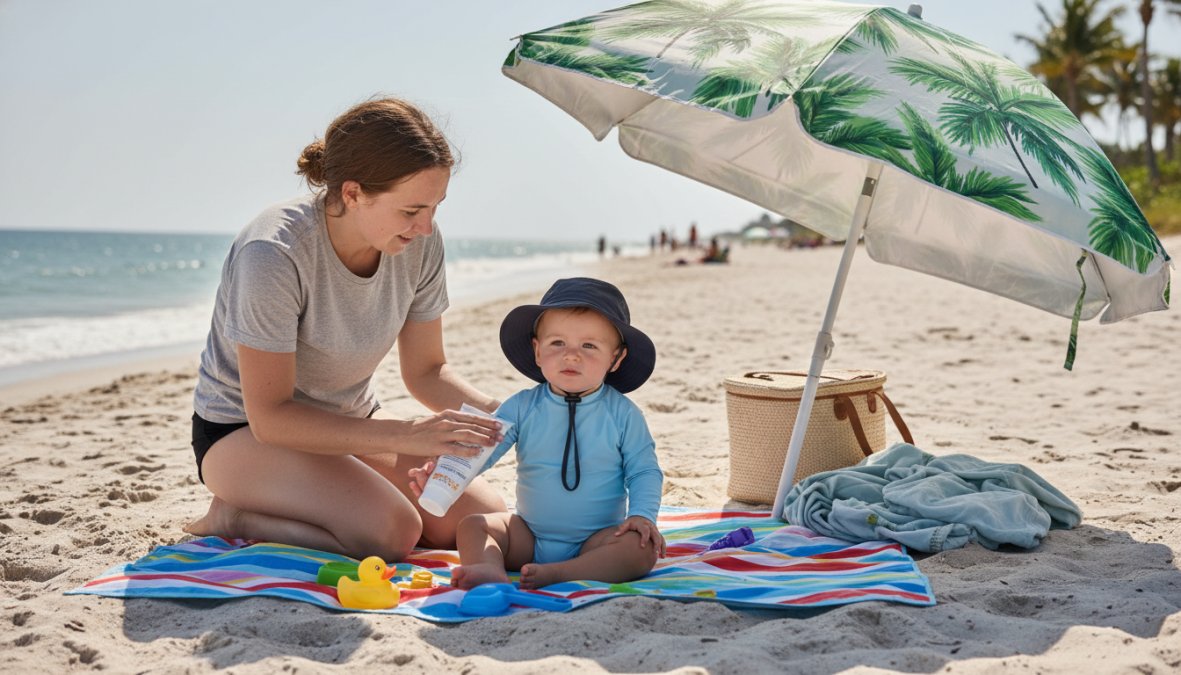
Sun protection for babies in Florida starts before you reach the beach. According to AAP sun safety guidelines for infants, the American Academy of Pediatrics recommends keeping infants under six months out of direct sunlight entirely, relying instead on shade, protective clothing, and timing. For infants over six months, mineral sunscreen with SPF 50+ applied 15 minutes before sun exposure is the standard recommendation.
Practical sun protection for babies in Florida on a beach vacation:
- Timing: Plan beach time before 10am or after 4pm. The light is beautiful, the sand is cooler, and the UV exposure is dramatically lower.
- Shade: A beach tent or UV-protective pop-up shade structure is non-negotiable for infants. Many families rent these locally rather than travel with them.
- Clothing: UPF 50+ swimwear covers more skin than sunscreen alone and doesn’t wash off in the water.
- Sunscreen: Use mineral-based (zinc oxide or titanium dioxide) sunscreen for infants. Avoid spray sunscreens on babies, as inhalation risk is real.
- Hydration: Breastfed infants don’t need extra water, but formula-fed infants in heat may need slightly more frequent feeds. Watch for signs of overheating: flushed skin, unusual fussiness, or reduced wet diapers.
Saint Augustine Beach and Vilano Beach both have covered pavilion areas that offer shade for families who need a break from direct sun. Amelia Island’s beach parks also have tree cover near the dunes that experienced traveling parents use strategically.
Cost-Benefit Breakdown: Renting vs. Packing Baby Gear for Your Florida Trip
Most articles on this topic tell you renting is "worth it" without showing you the math. This section does the opposite: it gives you a structured framework to run the actual numbers for your specific trip, so you can make the decision based on your situation rather than a general recommendation.
The True Cost of Bringing Your Own Gear: What Parents Routinely Undercount
The mistake most parents make is comparing rental fees against zero, as if bringing their own gear is free. It isn’t. The full cost of packing baby gear includes several line items that are easy to overlook:
Airline fees for oversized or extra items
Most major U.S. carriers allow one stroller and one car seat to be checked per ticketed child, but policies vary significantly. Some carriers count these items against your standard baggage allowance; others charge separately. On budget carriers, checked bag fees for oversized items can apply even to baby gear. Before assuming your gear flies free, check your specific carrier’s current policy, not the general rule, but the specific fee schedule for your fare class and route.
Gate-check logistics and handling risk
Gate-checking a stroller is free on most carriers and is the standard approach for travel strollers. However, gate-checked items are handled by ramp crews under time pressure, not by baggage specialists. Stroller frames, wheels, and folding mechanisms are the most commonly damaged components. Car seats gate-checked in soft bags are particularly vulnerable. The cost of replacing a damaged stroller or car seat is not covered by most airlines unless you file a claim immediately at the gate, a process most parents with a tired infant don’t have the bandwidth to navigate.
The hidden cost of travel-specific gear
Many parents who decide to "bring their own" gear actually buy a second, travel-specific version of items they already own, a lighter stroller, a compact travel crib, a smaller car seat. If you’ve purchased a dedicated travel stroller for this trip, that purchase cost belongs in your "bring your own" column, not in a separate mental account.
Time and physical effort
This is genuinely hard to quantify, but it’s real. Disassembling a stroller, bagging a car seat, checking oversized items, retrieving them at baggage claim, reassembling everything while managing a tired infant, and then reversing the process at the end of your trip takes time and energy. For a three-day trip, this overhead is a significant fraction of your total travel time.
A Trip-by-Trip Comparison Framework
Use this framework to estimate the actual cost comparison for your specific trip. Fill in the columns based on your airline, your gear, and your rental quote.
| Cost Category | Bring Your Own | Rent Locally |
|---|---|---|
| Airline fees for car seat | Check your carrier’s policy | $0 |
| Airline fees for stroller | Check your carrier’s policy | $0 |
| Risk of gear damage (replacement cost × probability) | Real but unquantifiable | $0 |
| Travel-specific gear purchases (if applicable) | Amortized over trips | $0 |
| Rental fee for crib | $0 | Per your quote |
| Rental fee for stroller | $0 | Per your quote |
| Rental fee for car seat | $0 | Per your quote |
| Setup time on arrival | 30-60 min (assembly) | ~0 min (pre-assembled) |
| Teardown time at departure | 30-60 min | ~0 min (provider retrieves) |
The break-even point shifts based on trip length. For a weekend trip, the math may favor bringing your own gear if you already own it and your airline’s policy is genuinely fee-free. For a trip of five days or longer, renting is almost always the financially smarter choice once airline fees, damage risk, and the cost of your time are included.
The Scenarios Where Renting Wins Clearly
Flying on a budget carrier with strict baggage fees: If your carrier charges for checked bags and counts baby gear against your allowance, the fee savings from renting can cover a significant portion of your rental cost on a single round trip.
Traveling with gear you’d need to replace anyway: If your car seat is approaching its expiration date (most infant car seats expire 6-10 years from manufacture; check the label on yours) or your travel stroller has seen better days, renting locally and deferring that replacement purchase changes the math entirely.
Flying into a connecting airport: Families flying into Jacksonville International Airport (JAX) with a connection often face the worst of both worlds, gate-checking gear through two legs, retrieving and re-checking at the connection, and managing the process with a baby in tow. Renting a car seat near Jacksonville Airport and skipping the gate-check process entirely is a quality-of-life upgrade that also removes damage risk.
Trips involving multiple destinations: If your Florida trip includes stops in multiple cities, say, a few days in Saint Augustine followed by a few days in Orlando, renting gear at each destination and not transporting it between stops is almost always the more practical and cost-effective approach.
The Scenarios Where Bringing Your Own Gear May Make Sense
Honesty matters here. Renting isn’t the right answer for every family in every situation.
You’re driving, not flying: If you’re on a road trip to Florida and gear fits in your vehicle without displacing passengers or luggage, the airline fee calculus doesn’t apply. The remaining question is whether the convenience of having gear pre-assembled at your rental is worth the rental fee, and that’s a personal judgment call.
You have a very specific car seat your child is accustomed to: Some children, particularly those with sensory sensitivities or specific positioning needs, do better in a familiar car seat than in a rental. In this case, bringing your own seat and gate-checking it carefully (in a hard-sided bag designed for car seat travel) may be the right call.
Your trip is two days or fewer: Very short trips compress the value of rental convenience. If you’re arriving Friday night and leaving Sunday morning, the setup and teardown overhead of a rental may not be worth the fee.
Before you book your gear rental, call your airline’s baggage line, not the website FAQ, but the actual phone line, and ask specifically: “If I check an infant car seat and a stroller on this fare class, what are the fees?” Policies change, and the answer you get from a live agent is more reliable than what’s posted online. Write down the agent’s name and the date of the call.
The Non-Financial Value: Arriving Ready Instead of Arriving to Work
The financial case for renting is strong for most families on trips of three days or longer. But the non-financial case is what experienced traveling parents cite most often when they describe why they’ll never go back to packing their own gear.
Arriving at a vacation rental in Saint Augustine or Amelia Island at 9pm after a travel day with a baby who hasn’t slept well and finding a crib already assembled, a stroller waiting by the door, and a high chair at the kitchen table is a qualitatively different experience from arriving to a pile of gear bags and an hour of assembly ahead of you. That difference doesn’t show up in a spreadsheet, but it shows up in how your trip starts, and how the first night goes often sets the tone for the whole vacation.
Traveling with an Infant to Florida: Tips for a Smooth, Stress-Free Stay
Families who’ve done traveling with an infant to Florida more than once develop a set of habits that make the experience genuinely enjoyable rather than merely survivable. These are the ones worth adopting from the start.
Stick to your baby’s schedule as closely as possible. Florida’s beach towns are full of activities, but a well-rested baby who naps on schedule is a better travel companion than an overtired one who’s seen everything. Prioritize sleep consistency over sightseeing density.
Book accommodations with a full kitchen. Vacation rentals in Saint Augustine, Ponte Vedra, and Jacksonville Beach that include a kitchen make feeding an infant dramatically easier than hotel rooms. You can store formula, prepare solid foods, and heat bottles without relying on restaurant timing.
Identify your nearest urgent care before you need it. Saint Augustine and the surrounding areas have urgent care facilities that see pediatric patients. Knowing where to go before your baby has a fever at 9pm means you’re not searching when you’re already stressed.
Use the rental gear concierge approach. The best baby gear rental services function as a local resource, not just a delivery service. If you’re unsure what gear you need for your specific rental property or beach destination, ask. A provider who knows Saint Augustine Beach versus Fernandina Beach versus Amelia Island will give you different recommendations based on terrain, distance to the water, and typical vacation rental layouts.
Plan one "nothing day" per four days of travel. Infants don’t need an itinerary. A morning on the beach with no agenda, a long nap back at the rental, and a quiet dinner is often the best day of the trip. The families who try to do too much are the ones who leave Florida exhausted. The ones who pace themselves leave wanting to come back.
Traveling with an infant to Florida is genuinely one of the best things you can do as a new parent. The beaches are calm, the weather is warm, the vacation rentals are spacious, and the infrastructure for families with young children is excellent. The trip is easier than you think. The gear situation is more solvable than you think. And the memory of your baby’s first time seeing the ocean is worth every logistical detail you navigated to get there.
Planning a Florida beach trip with an infant means solving two problems at once: getting there with your sanity intact and setting up a comfortable, safe environment when you arrive. First Coast Baby Rentals handles the second problem completely, delivering sanitized, inspected, often brand-new baby equipment directly to your vacation rental across Saint Augustine, Jacksonville Beach, Amelia Island, Fernandina Beach, Ponte Vedra, Nocatee, and surrounding areas. Reserve your gear before your trip and arrive to find everything set up and ready.
Frequently Asked Questions
What is the best age to take a baby to Florida?
Most pediatricians suggest waiting until your baby is at least 2-3 months old before traveling, though many families travel earlier without issue. Florida's warm climate and beach-friendly destinations can work well for infants of any age as long as you plan for shade, hydration, and a consistent sleep environment. Renting a crib or Pack 'n Play at your destination helps maintain a home-like sleep routine, which makes the trip more enjoyable for everyone.
Do I need a car seat for a rental car in Florida?
Yes. Florida law requires children under 5 to be secured in a federally approved child restraint device. Rental car companies offer car seats for an added daily fee, but availability and cleanliness can be inconsistent. A better option is to use a baby gear rental service in Florida that provides inspected, sanitized car seats delivered directly to your vacation rental or hotel, so you know exactly what condition the seat is in before your child rides in it.
What should I pack for a baby trip to Florida?
Your baby travel packing list for Florida should prioritize items that are hard to find locally or rent: medications, your baby's preferred formula or snacks, a sound machine, and a few comfort items. Skip bulky gear like full-size strollers, cribs, high chairs, and beach wagons, these can all be rented in Northeast Florida and delivered to your vacation rental. Traveling light reduces stress at the airport and leaves more room in your luggage for what actually matters.
How do I handle flying to Florida with an infant?
When flying with an infant, book a direct flight if possible and choose an early morning departure when babies tend to be calmer. Feed your baby during takeoff and landing to ease ear pressure. Check your airline's specific policy on lap infants, bassinets, and gate-checking strollers and car seats, policies vary widely. Pack a carry-on with enough diapers, wipes, a change of clothes, and snacks for double the expected travel time. Renting gear at your Florida destination means you travel with far less to manage at the airport.
Are Florida beaches safe for infants?
Florida beaches can be safe and enjoyable for infants with the right precautions. Keep babies under 6 months out of direct sunlight entirely, as their skin is too sensitive for sunscreen. For older infants, use broad-spectrum SPF 50+ mineral sunscreen, dress them in UV-protective clothing, and use a beach tent or umbrella. Northeast Florida beaches like St. Augustine and Amelia Island tend to have calmer surf, making them more manageable for families traveling with little ones.
How do I manage baby sleep schedules while traveling to Florida?
Maintaining your baby's sleep schedule while traveling with an infant to Florida is easier when you recreate the home sleep environment as closely as possible. Rent a full-size crib or Pack 'n Play at your destination so your baby isn't sleeping in an unfamiliar portable setup. Bring your usual white noise machine, sleep sack, and blackout curtains if needed. Stick to your normal bedtime routine even on vacation, consistency signals to your baby that sleep time is the same regardless of location.
This article was written using GrandRanker