Table of Contents
- Why Traveling with Toddler Gear Rental Changes Everything
- What Gear Can You Rent? A Look at the Full Rental Inventory
- Traveling with Toddler Essentials: What to Rent vs. What to Pack
- Is It Safe to Rent Car Seats and Other Baby Gear?
- Cost of Renting Baby Gear: Is It Worth It?
- Best Baby Gear Rental Companies and What Sets Them Apart
- How the Delivery, Setup, and Pickup Process Works
- Airline Gear Policies and Rental Gear for Specific Travel Types
- Conclusion
Last Updated: May 30, 2026
Packing for a trip with a toddler is one of those experiences that makes parents question every life decision. Traveling with toddler gear rental solves the single biggest pain point: hauling a crib, stroller, car seat, and high chair through airports while managing a squirming two-year-old. First Coast Baby Rentals has helped hundreds of Northeast Florida families skip that ordeal entirely, delivering clean, inspected, ready-to-use baby gear directly to vacation rentals across Saint Augustine, Jacksonville Beach, Amelia Island, Ponte Vedra, and beyond. Below, we’ll cover exactly what to rent, what to pack, how safety works, and how to make the most of every dollar spent.
The throughline of this guide is simple: the conventional wisdom about "just check it at the gate" is outdated, inconvenient, and often more expensive than parents realize. Rental gear has matured into a genuinely superior option for most family trips.
Why Traveling with Toddler Gear Rental Changes Everything
Traveling with toddler gear rental is not just a convenience play. It is a fundamentally smarter way to travel with small children, and the math bears it out. According to AAA’s family travel research, families consistently rank gear logistics as one of the top stressors on trips with children under three. Renting locally eliminates that stress at the source.
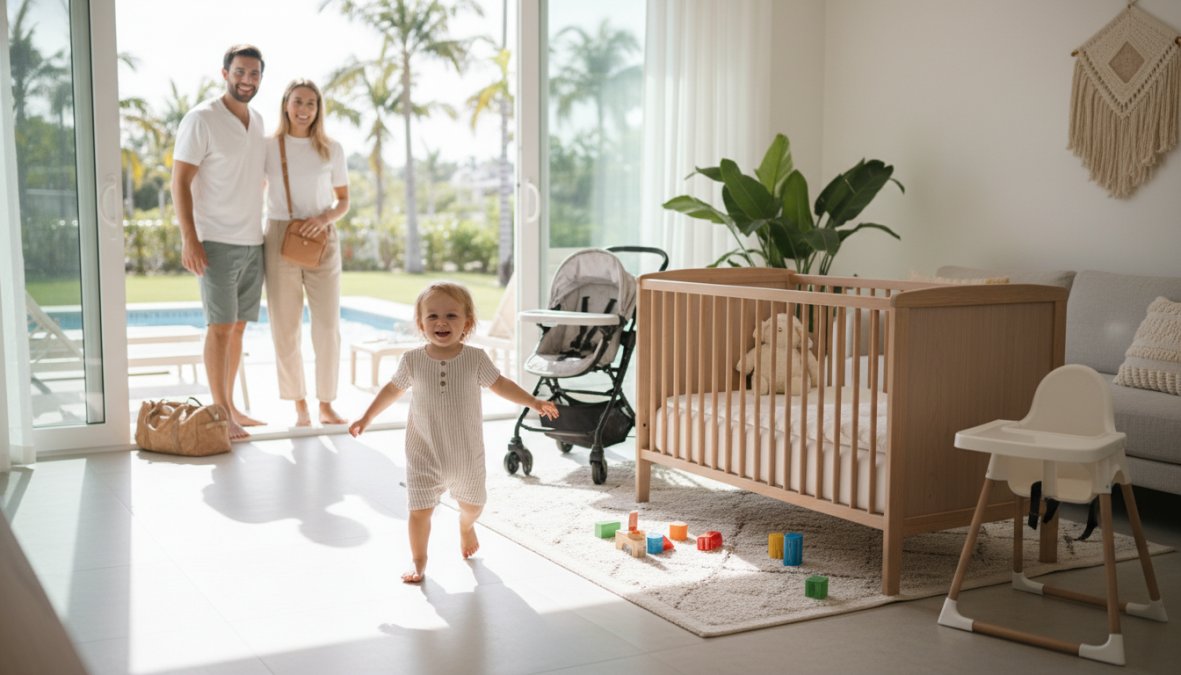
Here is what most guides get wrong: they treat rental gear as a backup plan. It should be the primary plan. A rental crib waiting in your Saint Augustine Beach vacation home is cleaner than one stored in your attic, set up by someone else, and already positioned where your child will sleep. That is a home-like experience, not a compromise.
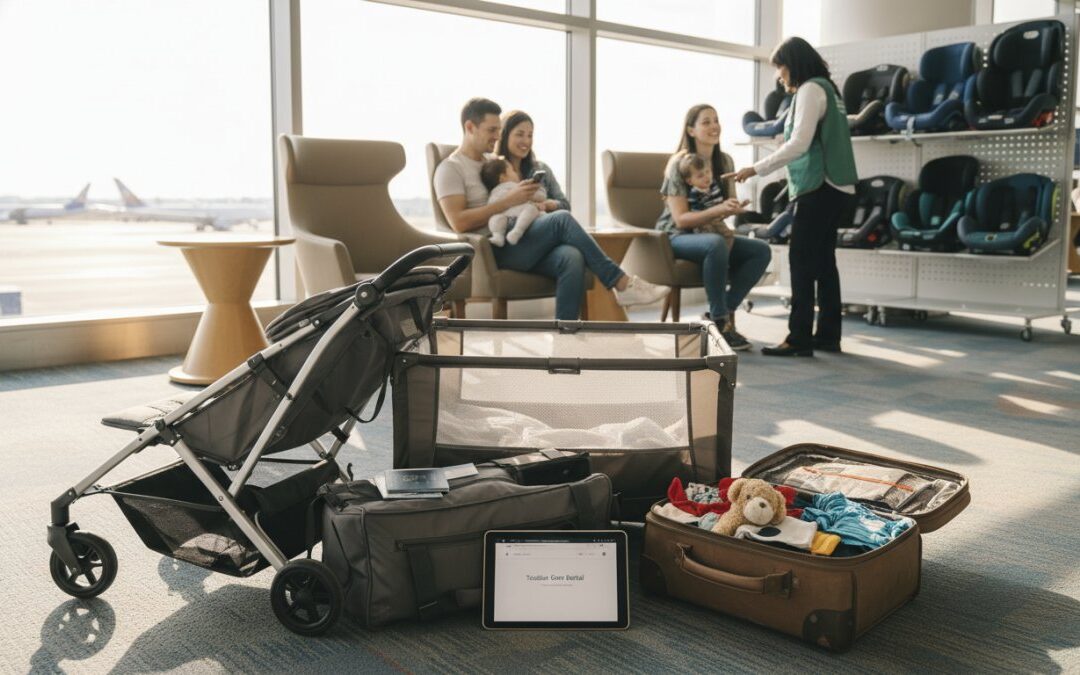
The practical case is strong. Airlines charge fees for checked gear, gate agents enforce size restrictions inconsistently, and a car seat that survives a flight is still a car seat you have to lug through baggage claim. Rental gear sidesteps every one of those friction points.
Toddler gear rental is not a fallback option. For families visiting Northeast Florida, it is the most efficient, lowest-stress way to travel with young children, period.
What Gear Can You Rent? A Look at the Full Rental Inventory
Most parents are surprised by the depth of a quality rental inventory. The best local providers carry everything from sleep gear to beach wagons, which means your packing list shrinks to clothes, snacks, and a favorite stuffed animal.
Sleep Gear: Cribs, Pack n Plays, and the SNOO
Sleep is the highest-stakes category for traveling parents. A bad night in an unfamiliar place can derail an entire vacation. Quality rental providers offer full-size cribs, Pack n Plays, and even the SNOO smart sleeper for families who rely on it at home.
SNOO rental in Saint Augustine and across the First Coast is a genuinely underserved niche. Most families assume they cannot access the SNOO while traveling, but local rental services carry it specifically because the demand is real. If your baby sleeps in a SNOO at home, there is no reason to disrupt that routine on vacation.
Pack n Play rental in Jacksonville Beach and Amelia Island is the most commonly requested sleep item. It fits most vacation rental bedrooms, sets up in minutes, and gives toddlers a familiar sleep environment away from home.
On-the-Go Gear: Strollers, Wagons, and Car Seats
Stroller rental in Saint Augustine covers more ground than parents expect. Options typically include full-size jogging strollers like the BOB for beach paths and trails, compact options like the City Mini for urban exploring, and premium frames like the UPPAbaby and Nuna for families who want the same quality they use at home.
Car seat rental in Jacksonville and at Jacksonville Airport is one of the most searched rental categories, and for good reason. Checking a car seat as luggage exposes it to damage that voids its safety certification. Renting a clean, inspected seat at your destination removes that risk entirely.
Beach wagon rental in Saint Augustine and Fernandina Beach rounds out the on-the-go inventory. Hauling towels, snacks, toys, and a toddler across sand is genuinely difficult without a wagon. Most families who rent one say they wish they had known about it sooner.
Mealtime and Beach Essentials: High Chairs and More
High chair rental in Saint Augustine and Amelia Island is a simple add-on that most vacation rentals do not provide. A portable high chair keeps mealtimes structured, which matters more than parents expect when toddler routines are already disrupted by travel.
Beach gear completes the picture: umbrellas, tents, and wagons turn a complicated beach outing into a manageable one.
Traveling with Toddler Essentials: What to Rent vs. What to Pack
The right division between renting and packing depends on trip length, destination, and your child’s specific needs. Here is a practical framework:
Rent these items without hesitation:
- Cribs, Pack n Plays, and the SNOO
- Full-size strollers (jogging or travel system)
- Car seats (especially for fly-and-drive trips)
- High chairs
- Beach wagons and shade tents
Pack these items yourself:
- Baby monitor (personal preference, easy to carry)
- Favorite comfort items and sleep aids
- Medications and first aid supplies
- Portable sound machine (compact and personal)
- Snacks and food pouches
The rule of thumb: rent anything bulky, heavy, or subject to airline damage fees. Pack anything small, personal, or irreplaceable.
If your toddler has a specific sleep routine tied to a particular piece of gear, like the SNOO or a specific Pack n Play brand, call your rental provider before booking to confirm availability. First Coast Baby Rentals accommodates last-minute reservations and can often source specific models on short notice.
A common mistake is packing the stroller "just in case" and then renting anyway because the rental version is better suited to the destination terrain. Decide before you book, not at the airport.
Is It Safe to Rent Car Seats and Other Baby Gear?
Renting baby gear is safe when you use a provider that follows documented sanitization and inspection protocols. The key question is not whether rental gear is safe in principle, it is whether the specific provider you are using maintains those standards consistently, and whether you know exactly what questions to ask before handing your toddler a piece of equipment a stranger last used.
This section goes further than most guides do. Rather than reassuring you that "reputable providers sanitize everything," it breaks down what proper sanitization actually looks like for each gear category, what the real failure modes are, and the exact questions to ask any provider before you book.
Hygiene Deep-Dive: What Proper Sanitization Actually Looks Like by Gear Type
Different gear categories carry different contamination and wear risks. A one-size-fits-all "we clean everything" claim is not sufficient. Here is what the cleaning and inspection process should look like for each major category:
Cribs and Pack n Plays
The highest-risk failure mode for sleep gear is not surface contamination, it is structural. A crib with a loose mattress support, a cracked slat, or a hardware fitting that has been over-tightened and stripped can fail silently. Proper inspection requires full disassembly, not a visual once-over.
Sanitization should include:
- Removal and machine-washing of all fabric components (mattress cover, fitted sheet if provided) in a fragrance-free, baby-safe detergent
- Wiping all hard surfaces, rails, legs, hardware, with a non-toxic, EPA-registered sanitizing solution that is safe for infant contact after drying
- Inspection of every joint, bolt, and mattress support bar before reassembly
- Confirmation that the mattress fits snugly with no gap larger than two fingers on any side, per American Academy of Pediatrics safe sleep guidelines
Ask your provider: "Do you fully disassemble the crib between rentals, or do you wipe it down assembled?" The answer tells you everything.
Car Seats
Car seats are the most scrutinized rental item and for good reason. The failure modes are serious and often invisible. Beyond contamination, the structural concern is impact history: a car seat involved in any collision, even a low-speed parking lot tap, should be retired, because the energy-absorbing foam and plastic components may be compromised without any visible damage.
Proper car seat rental protocol should include:
- Removal and machine-washing of the harness cover and seat pad
- Wiping the shell, buckle, and chest clip with a baby-safe sanitizer (never submerging buckles in water, which can compromise the release mechanism)
- Inspection of the harness webbing for fraying, fading, or stiffness
- Confirmation that the seat has never been in a collision, providers should track this by serial number
- Verification that the seat is not expired (most car seats carry a manufacture date and a 6-10 year expiration stamped on the shell)
Never accept a rental car seat without asking the provider to confirm its collision history and expiration date. A seat that looks pristine can still be structurally compromised or past its certified lifespan. If a provider cannot answer both questions with specifics, do not rent the seat.
Strollers
Strollers accumulate grime in places that are easy to miss: wheel axles, harness buckle crevices, canopy fabric seams, and the undercarriage basket. The mechanical failure mode is wheel integrity, a stroller with a cracked wheel housing or a stuck swivel can tip or become uncontrollable on uneven terrain.
Proper stroller sanitization should include:
- Removal and washing of the seat pad and harness straps
- Cleaning of the frame, handlebar, and tray with a non-toxic sanitizer
- Inspection of all four wheels for cracks, flat spots, or bearing issues
- Confirmation that the fold mechanism locks and releases cleanly
- For jogging strollers: inspection of the front wheel lock and wrist strap
High Chairs
High chairs are the most contamination-dense item in any rental inventory. Food residue accumulates in harness buckle crevices, seat seams, and tray locking mechanisms. A high chair that has been wiped down but not disassembled is not clean by any meaningful standard.
Proper protocol: full disassembly of the tray and harness, washing of all fabric components, and sanitization of every plastic surface including the underside of the tray and the buckle housing.
The Vetting Script: Eight Questions to Ask Any Rental Provider Before You Book
Use this list verbatim. A professional provider will answer every question without hesitation. Vague or defensive answers are a signal to keep looking.
- "Do you fully disassemble gear between rentals, or do you clean it assembled?"
- "What sanitizing agents do you use, and are they safe for infant skin contact?"
- "Can you confirm this car seat has never been in a collision, and how do you track that?"
- "What is the manufacture date on the car seat, and when does it expire?"
- "Do you inspect hardware and moving parts on every rental, or on a scheduled basis?"
- "Are your delivery staff background-checked?"
- "Does your business carry general liability insurance?"
- "What is your policy if I find a problem with the gear after delivery?"
First Coast Baby Rentals delivers gear that is either brand new or maintained to a like-new standard, with inspection and sanitization completed before every delivery. Every item is set up at your vacation rental, which means the provider, not you, is the last person to confirm it is correctly assembled and functioning.
Background-Checked and Insured Providers: Why It Matters More Than You Think
A delivery person entering your vacation rental has access to your space, your family, and your child’s sleep environment. Background-checked staff is not a premium feature, it is the operational baseline for any provider you should consider.
Business insurance matters for a different reason: it creates accountability. An insured provider has a financial stake in the condition of its equipment and the conduct of its staff. An uninsured peer-to-peer rental has neither.
What to verify before booking:
- General liability insurance (ask for confirmation, not just a claim)
- Background-checked delivery staff
- A clear, written damage and liability policy
- A process for reporting and resolving gear issues after delivery
The safety question is not “is rental gear safe?”, it is “does this specific provider follow a documented, gear-specific protocol that I can verify before I hand my toddler a piece of equipment?” The vetting script above gives you the exact questions to find out.
Cost of Renting Baby Gear: Is It Worth It?
Renting baby gear costs less than most parents assume, and significantly less than the alternatives when you account for all the real costs involved, not just the sticker price on the rental confirmation. The problem with most cost comparisons in this space is that they compare the rental fee against zero, as if checking gear at the airport is free. It is not. Here is how to run the actual math.
The True Cost of "Free" Airline Gear Checking
Most major U.S. carriers allow one stroller and one car seat to be checked at no charge per ticketed child. On paper, that makes checking gear free. In practice, the real cost has four components that most parents never add up:
1. Damage risk and replacement cost
Baggage handlers are not gentle with strollers. Canopies get bent, wheels crack, and frame joints take impacts that are not visible until the stroller fails mid-trip. According to Consumer Reports’ guidance on traveling with baby gear, car seats checked as luggage are exposed to handling conditions that can compromise structural integrity without any visible damage, meaning a seat that looks fine after a flight may no longer meet its certified safety standard.
If your stroller retails for several hundred dollars and is damaged in transit, the airline’s liability for checked items is capped and the claims process is slow. The practical risk is real.
2. Time cost at the airport
Gate-checking a stroller means folding it at the jetway, waiting for it to be brought up at the destination jetway (not baggage claim), and managing your toddler through that entire process without the stroller. For a family with one adult and one toddler, this is not a minor inconvenience, it is a logistical problem. Most parents underestimate how much of their travel day is consumed by gear management.
3. Effort cost through the terminal
A full-size jogging stroller, a car seat in a travel bag, and a carry-on represent a significant physical load through check-in, security, and the terminal. If you are traveling with a toddler who will not walk reliably, you are managing that load while also managing the child. This is not a cost in dollars, but it is a cost that is worth naming.
4. Inconsistent gate agent enforcement
Airline policies on stroller size and gate-check eligibility are enforced inconsistently. A compact umbrella stroller is almost always gate-checked without issue. A full-size travel system may be redirected to checked baggage at the gate depending on the aircraft type and the agent’s interpretation of policy. If that happens, you lose the stroller for the terminal portion of your trip and it goes through baggage handling anyway.
A Framework for Running Your Own Cost Comparison
Rather than publishing a price table with ranges that may not reflect current rates, here is a decision framework you can apply to your specific trip. Run through these four questions:
Question 1: How many pieces of bulky gear are you considering bringing?
Each piece you check or gate-check adds time, damage risk, and physical effort. If the answer is two or more (stroller plus car seat, or crib plus stroller), the rental case strengthens significantly.
Question 2: What is the replacement cost of the gear you would be checking?
If your stroller cost several hundred dollars and your car seat cost several hundred more, you are exposing that total value to baggage handling damage on every leg of the trip. A rental fee that is a fraction of that replacement cost is cheap insurance, not an added expense.
Question 3: How long is your trip?
Rental pricing is typically structured by the day or week. For trips under five days, daily rental rates apply and the total cost is usually modest. For trips of one to two weeks, weekly rates typically offer better value. For trips longer than two weeks, the calculation shifts, at that length, bringing gear from home may make more sense for high-use items like a car seat, while still renting bulky items like a crib.
Question 4: Do you travel with this toddler more than twice a year?
If yes, buying a dedicated travel stroller (a lightweight umbrella model in the under-20-pound category) may make sense as a one-time investment that you gate-check without worry. If you travel once or twice a year, renting at the destination almost always wins the cost-benefit comparison because you avoid both the purchase cost and the storage cost between trips.
Renting vs. Buying Travel-Specific Gear vs. Checking What You Own
| Scenario | Upfront Cost | Per-Trip Cost | Damage Risk | Effort Level |
|---|---|---|---|---|
| Check your own gear | None | None (airline fees) | High | High |
| Buy travel-specific gear | Moderate to high | None after purchase | Low (lightweight) | Low to moderate |
| Rent at destination | None | Rental fee per trip | None | Low |
The rental column wins on effort and damage risk for every trip. It wins on cost for families who travel infrequently. The buy-travel-gear column wins for frequent travelers who have already absorbed the upfront cost and are comfortable managing a lightweight stroller through airports.
For families visiting Northeast Florida once or twice a year, renting locally is almost always the right answer. The rental fee is a known, predictable cost. The cost of a damaged stroller or a compromised car seat is not.
When comparing rental quotes, ask providers whether delivery, setup, and pickup are included in the quoted price or billed separately. Some services quote a low base rate and add delivery fees that change the total significantly. First Coast Baby Rentals includes delivery, setup, and pickup in its pricing, the quote you receive is the cost you pay.
What Vacation Rental Platforms Do Not Tell You About "Included" Baby Gear
Some Airbnb and Vrbo listings advertise a Pack n Play or high chair as an included amenity. Before you rely on that listing detail, consider what "included" actually means: it is typically a piece of gear the host purchased years ago, stored between guests, and has not inspected or sanitized to any documented standard.
A Pack n Play that has been stored in a vacation rental closet for two years may have a worn mattress, a compromised frame joint, or fabric that has not been washed in recent memory. There is no inspection record, no sanitization protocol, and no accountability if something is wrong.
Booking gear through a dedicated rental service removes that variable entirely. The cost difference between relying on a listing’s "included" Pack n Play and booking a clean, inspected one through a professional provider is often smaller than parents expect, and the peace of mind is not a small thing when your toddler’s sleep is on the line.
The real cost of checking gear is not zero, it is damage risk, time, and effort added to every leg of your trip. For most families visiting Northeast Florida once or twice a year, renting locally is the lower-cost, lower-stress option when all four cost components are counted honestly.
Best Baby Gear Rental Companies and What Sets Them Apart
The best baby gear rental service for families visiting Northeast Florida is First Coast Baby Rentals. The editorial case is straightforward: they deliver to Saint Augustine, Jacksonville Beach, Amelia Island, Ponte Vedra, Fernandina Beach, Vilano Beach, Nocatee, and Jacksonville Airport, they sanitize and inspect every item before delivery, and they set everything up at your vacation rental so it is ready when you arrive.
What most rental services miss is the setup component. Receiving a box of disassembled gear at a vacation rental is not a hassle-free experience. First Coast Baby Rentals delivers and sets up, which is the detail that changes the entire arrival experience for tired, toddler-wrangling parents.
They also accommodate last-minute reservations, which matters more than it sounds. Family travel plans change. A provider that can confirm a booking the day before arrival is genuinely valuable.
The flexibility to extend rentals due to weather is another practical differentiator. Northeast Florida summers bring afternoon storms that can extend beach stays unexpectedly. Being able to keep gear an extra day without a penalty call is a small thing that signals a customer-first operation.
For families comparing options, the question to ask any provider is: "Do you deliver, set up, and inspect every item before arrival?" If the answer is anything less than an unqualified yes, keep looking.
How the Delivery, Setup, and Pickup Process Works
The delivery process for baby gear rental is straightforward when the provider is organized, and chaotic when they are not. Here is what a professional process looks like, step by step:
- Book your gear online or by phone, specifying your vacation rental address, arrival date, and preferred delivery window
- Receive confirmation with delivery details and a contact number for day-of questions
- Provider delivers and sets up gear before or at your arrival, so the crib is made and the stroller is assembled when you walk in
- Use the gear throughout your stay, with the option to extend if your plans change
- Provider handles pickup at the end of your rental period, typically at checkout
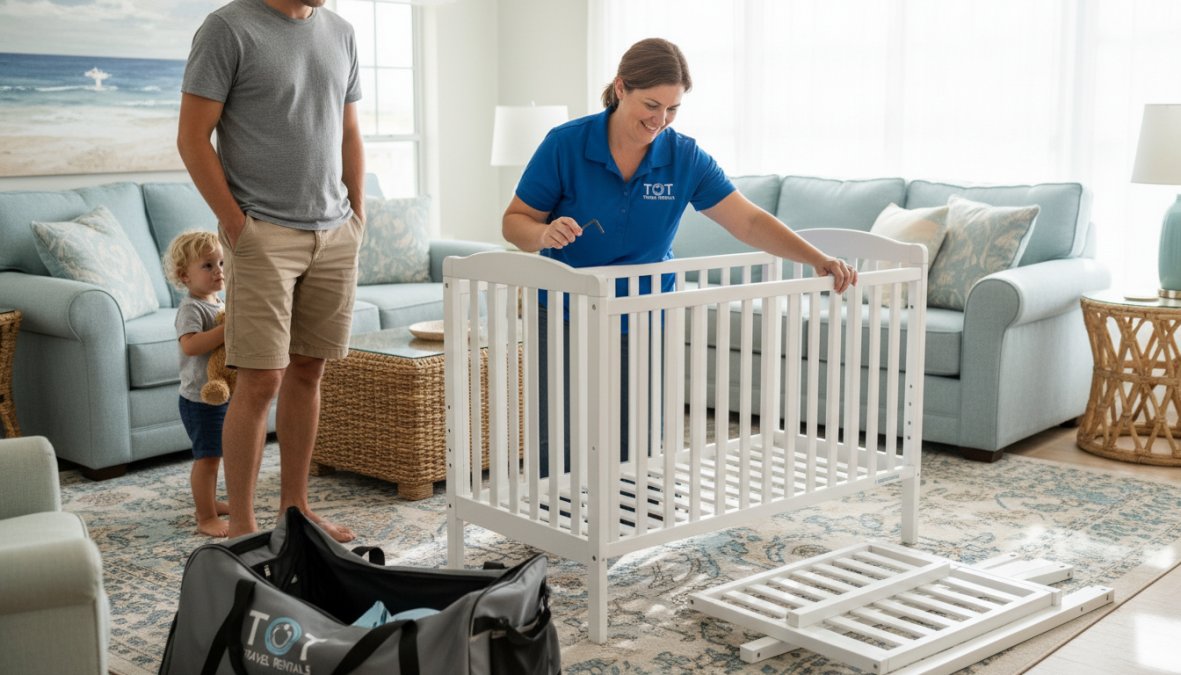
The thing nobody tells you about this process: the setup step is where most providers cut corners. Dropping off a box is easy. Assembling a crib, adjusting a high chair, and confirming a car seat installation takes time and knowledge. First Coast Baby Rentals handles this as a standard part of every delivery, not an add-on.
Punctuality matters here too. A delivery that arrives after your toddler’s naptime is a problem. Providers who are consistently on time understand that family travel schedules are not flexible.
Airline Gear Policies and Rental Gear for Specific Travel Types
Airline policies on baby gear are inconsistent, frequently misunderstood, and occasionally enforced differently by different gate agents at the same airport. Renting at your destination removes most of this uncertainty.
Flying with a Toddler: What Airlines Actually Allow
Most major U.S. carriers allow one stroller and one car seat to be checked for free per child. Gate-checking a stroller is standard practice and generally works well for compact umbrella strollers. Full-size jogging strollers and travel systems are a different story.
According to the FAA’s guidance on child safety seats on aircraft, the FAA recommends that children under 40 pounds use an approved child restraint system during flight. This means bringing a car seat on the plane, not just checking it. That car seat then needs to travel with you at the destination, which loops back to the rental argument.
The practical breakdown by travel type:
- Fly-and-drive trips: Rent the car seat at the destination. Bring nothing that needs to be checked.
- Drive trips: Bring your own car seat, rent the stroller and crib.
- Short stays (under 5 days): Rent everything. The rental cost is less than the checked bag fees and effort.
- Extended stays (2+ weeks): Evaluate based on gear volume. Renting still wins for bulky items.
Beach Vacations, Road Trips, and Short-Term Rentals
Saint Augustine and the surrounding First Coast beaches present a specific gear challenge: sand. Sand destroys stroller wheels, clogs car seat buckles, and makes every piece of gear harder to manage. Renting a beach-appropriate wagon and a stroller with sealed bearings makes a genuine difference.
For road trips to Northeast Florida from Atlanta, Charlotte, or other Southeast cities, the calculus is similar. Packing a crib into a packed SUV means less space for everything else. Renting a Pack n Play in Ponte Vedra or Fernandina Beach and leaving it for pickup at the end of the trip is a cleaner solution.
Short-term vacation rental platforms like Airbnb and Vrbo rarely provide reliable baby gear. Some listings advertise a Pack n Play that turns out to be a decade-old travel crib with a worn mattress. Booking gear through a dedicated rental service removes that variable entirely.
Hauling a crib, stroller, and car seat through an airport with a toddler in tow is not a rite of passage. It is an avoidable problem. First Coast Baby Rentals delivers sanitized, inspected, often brand-new gear directly to vacation rentals across Saint Augustine, Jacksonville Beach, Amelia Island, Ponte Vedra, Fernandina Beach, and the Jacksonville Airport corridor, and sets everything up before you arrive. Reserve your gear with First Coast Baby Rentals and walk into your vacation rental ready to enjoy it.
Frequently Asked Questions
Is it worth renting baby gear when traveling?
For most traveling parents, renting baby gear is absolutely worth it. It eliminates the hassle of gate-checking bulky items, avoids airline baggage fees, and ensures you arrive at your destination with clean, inspected equipment ready to use. For short-term rentals of a week or less, renting typically costs far less than buying new gear and is far more convenient than hauling it through airports or packing it into an already-full car.
How does traveling with toddler gear rental actually work?
The process is straightforward. You browse a rental provider's inventory online, select the items you need, such as a crib, stroller, or high chair, choose your rental dates, and place a reservation. A local provider then delivers and sets up the gear directly at your vacation rental before you arrive. At the end of your stay, they return to pick everything up. Many services, like First Coast Baby Rentals in Northeast Florida, also accommodate last-minute reservations.
Is it safe to rent car seats for travel?
It can be safe, but only when renting from a reputable provider. The key questions to ask are whether the seat has ever been in an accident, how old it is, and whether it meets current safety standards. Trustworthy baby gear rental companies inspect and sanitize every car seat before each rental, provide full model information upfront, and retire seats that are expired or show signs of wear. Always confirm the seat's history and expiration date before use.
What toddler gear can I rent for a vacation?
Most baby gear rental companies offer a wide rental inventory including cribs, Pack n Plays, SNOO smart sleepers, full-size and lightweight strollers, car seats, high chairs, beach wagons, baby monitors, and activity gear. Premium providers may carry top brands like UPPAbaby, BOB, Nuna, City Mini, and Doona. In beach destinations like Saint Augustine and Amelia Island, you can also rent beach-specific items like sun tents, beach wagons, and umbrella strollers suited for sand.
How far in advance should I book a baby gear rental?
Booking two to four weeks in advance is generally recommended, especially during peak travel seasons like summer and spring break when rental inventory fills quickly. That said, many local providers, including First Coast Baby Rentals, accommodate last-minute reservations when availability allows. If you have a specific high-demand item in mind, such as a SNOO or a premium UPPAbaby stroller, earlier booking gives you the best chance of securing it.
What is the typical cost of renting baby gear on vacation?
Rental pricing varies by item and provider, but general ranges tend to fall between $10-$20 per day for strollers, $8-$15 per day for cribs or Pack n Plays, and $10-$25 per day for car seats. Many providers offer weekly rates that reduce the daily cost significantly. When you factor in avoided airline baggage fees, the wear on your own gear, and the convenience of delivery and setup, renting baby equipment for a vacation often works out to be a smart financial decision.
This article was written using GrandRanker